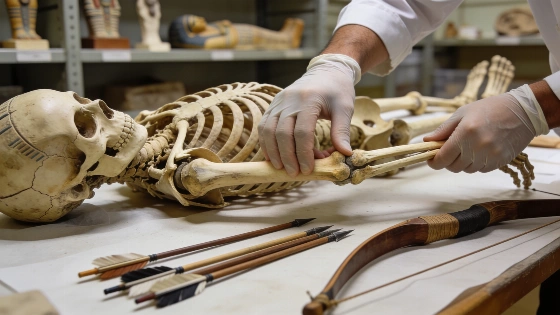
Analysis of nearly 4,000-year-old skeletal remains from Egypt's Middle Kingdom reveals pronounced upper-body muscle attachments in several royal women. Researchers propose these changes may reflect archery or weapon training, but experts urge caution
Recent research on a group of Middle Kingdom Egyptian royal burials has reignited debate over the physical activities of elite women nearly 4,000 years ago. A team of archaeologists and bioarchaeologists examined partial skeletal remains from six individuals, including four women believed to be daughters of Amenemhat II, recovered from tombs near the pyramids at Dahshur. The study, published in Frontiers in Environmental Archaeology, focused on the size and development of muscle attachment sites-known as entheses-on the bones of these individuals, aiming to reconstruct aspects of their daily activities.
Burials and Skeletal Evidence
The remains analyzed were originally excavated in the 1890s by Jacques de Morgan and stored at the Egyptian Museum in Cairo, where they were largely forgotten until their rediscovery in 2020. The collection included partial skeletons of King Hor, Princess Ita, Khenmet, Itaweret, Noub-Hotep, and an unidentified woman possibly Sathathormeryt. Preservation was variable, with only 22% to 58% of each skeleton surviving and most skulls missing. Age at death was estimated from surviving bones, with the women ranging from their late 20s to mid-40s.
Several of the women were interred with bows, arrows, and daggers, raising questions about the function of these objects. Using X-ray imaging and infrared spectroscopy, the researchers identified pronounced muscle attachments on the right shoulders, arms, and hands of Princess Ita and Noub-Hotep, as well as robust features in the upper limbs of Khenmet and Itaweret. The team interpreted these patterns as consistent with repeated upper-body activity, possibly related to archery, hunting, or weapon handling.
Interpreting Activity from Bone
Muscle attachment sites can enlarge in response to repeated use, but their interpretation is complex. The study's authors argued that the observed asymmetry and robusticity in the upper limbs of these royal women fit the biomechanical demands of drawing a bow or wielding weapons. However, independent bioarchaeologists have cautioned that such skeletal changes are not specific to any one activity. Factors such as age, body size, genetics, and other repetitive movements can produce similar bone responses, and the absence of a comparative group from the same period limits the strength of the conclusions.
For example, some individuals showed robust muscle attachments on both sides of the body, whereas archery typically produces marked asymmetry. The ages at death-ranging from late 20s to mid-40s-also mean that age-related bone changes could play a role. Without a control group of non-elite or non-weapon-associated individuals from the same context, it is difficult to determine whether these skeletal features are unusual or simply reflect normal variation.
Weapons in the Tombs
The presence of bows, arrows, and daggers in the tombs of these women has often been interpreted as symbolic or ceremonial. The new study suggests that at least some royal women may have actively trained with these weapons, challenging assumptions about gendered activity in ancient Egypt. However, outside experts note that funerary artifacts do not always reflect the lived experiences of the deceased. Objects could have been included for ritual reasons or intended for use by others in the afterlife.
Comparative research from other periods and regions has shown that weapons in burials do not always indicate direct use. For instance, a recent analysis of an Iron Age child burial with a sword in Gaul, discussed in this related report, highlights the need for caution when linking grave goods to individual activity or status. In the Egyptian case, the lack of a broader comparative dataset makes it difficult to determine whether the muscle changes observed are truly exceptional or part of a wider pattern among elites.
Limits of the Evidence
The study's findings are intriguing but remain provisional. The incomplete preservation of the skeletons, reliance on 19th-century labels for identification, and absence of soft tissue or DNA evidence all constrain interpretation. The researchers' use of imaging and spectroscopy provides valuable data on bone morphology, but the link between muscle attachment size and specific activities such as archery cannot be established with certainty. Further research comparing these individuals to contemporaneous populations, both elite and non-elite, would be necessary to clarify whether the observed skeletal features reflect specialized training or broader patterns of activity.
Despite these limitations, the study contributes to ongoing discussions about the roles and experiences of royal women in ancient Egypt. It also underscores the importance of critical evaluation when interpreting activity from skeletal remains, especially in the absence of robust comparative data.
Understanding how archaeologists infer activity from bone requires familiarity with the concept of entheses-sites where muscles, tendons, or ligaments attach to the skeleton. These areas can become more pronounced with repeated or strenuous use, but are also influenced by age, genetics, and overall health. While pronounced entheses may suggest habitual activity, they rarely point to a single behavior without supporting evidence. Comparative analysis with well-documented reference populations is essential for distinguishing activity-related changes from normal variation or age-related remodeling.