Eight bone-needle fragments from Shégˊ Xdaltthˊíˊ are reported as the oldest known in the Western Hemisphere. Evidence of camp life includes a hearth and stone from distant sources, alongside wolf-like canid remains, but does not prove the animals were dogs
Eight fragments of bone needles recovered at Shégˊ Xdaltthˊíˊ are reported as the oldest known needles in the Western Hemisphere. Their presence points to sewing technology at a Late Pleistocene camp in interior Alaska, where other finds suggest people carried out a broader range of activities than at many early Beringian sites. Four fragments preserve part of an eye; seven were made from dense long bones of mammals, while one was probably fashioned from bird bone. An awl tip and a perforated antler pendant were also recovered in the earliest cultural layer, adding to evidence for working organic materials.
The site lies on a ridge above the Tanana River, about 55 kilometres south-east of Fairbanks. People used it during at least three periods, dated to approximately 13,800, 13,000 and 12,700 years ago, a span of about 1,100 years. Researchers led by Kelly Graf, professor of anthropology at the University of Kansas, have focused on the earliest phase, dated to approximately 13,800 years ago. The full assemblage comprises more than 80,000 archaeological objects and samples; that total covers the site as a whole, not just its oldest occupation. The research was published in Science Advances on 14 October 2026.
Evidence for a camp
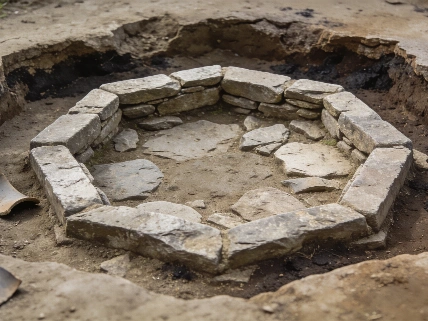
Excavators found a hearth and a small pit, along with evidence of a former wooden post. Researchers interpret these features as possible remains of a shelter with a sloping roof or an early tent-like structure. If that reading is correct, it would be among the earliest known constructed shelters in North America; the features alone do not establish the building's precise form.
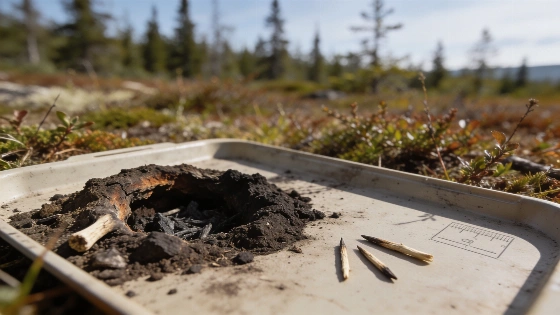
An earth oven nearby contained charcoal and animal bones. It may have been used to cook meat slowly. Along with the structural traces and varied artefacts, the oven supports an interpretation of Shégˊ Xdaltthˊíˊ as a base camp rather than one of the comparatively small seasonal hunting camps documented at other early Beringian sites. In its description of the earliest occupation, Live Science characterized the activity as people "settling in" to the area.
The scale and variety of the material matter because a single feature cannot, by itself, reveal how long people stayed or how they organized camp life. The site's evidence instead records several kinds of activity at one location, without resolving every detail of how those activities were connected. Kelly Graf's fieldwork began in 2013, with annual visits before the COVID-19 pandemic and further seasons in 2021, 2023 and 2025.
Tools across Beringia
Stone tools made from rhyolite and basalt include distinctive bifacial forms, shaped on both sides. Their diamond-like outlines and technical characteristics have parallels at sites farther west in Beringia, including northern Siberia. One object is described as a hafted biface, a stone piece likely attached to a handle. Kelly Graf has described the diamond-shaped bifaces as possible sharpened weapon tips. Obsidian was also recovered; geological sourcing places its origin hundreds of kilometres north-west of the Alaskan site.
These materials indicate that raw stone and technological traditions moved over large distances. Researchers interpret the similarities as evidence for cultural connections between communities in the Asian and North American parts of Beringia. The artefacts cannot show whether the people who made them personally travelled those routes or whether techniques and materials passed between groups.
A separate Tennessee tool study examined 489 Clovis and Cumberland projectile points to trace changes in stone-tool use. At Shégˊ Xdaltthˊíˊ, comparisons with distant Beringian tools raise a different question: how far-reaching connections can be inferred from material similarities without treating them as direct evidence of individual journeys.
Needles and canids
The eight bone-needle fragments are impressive for their reported age and location. Such tools could have helped people make fitted clothing and other sewn materials, useful in the cold conditions of Late Pleistocene Alaska. A perforated pendant made from deer antler also has similarities to ornaments found at early sites elsewhere in North America. Those parallels suggest cultural links extending beyond the immediate region, but they do not establish that every object or practice travelled with the same people. Spencer Pelton of the University of Wyoming, author of a Science Advances Focus commentary accompanying the research, compared the needles with Upper Paleolithic tools known in the Old World from about 23,000 years ago.
Animal remains from the site include bones belonging to more than a dozen wolf-like canids. Analysis of one jawbone found that the animal was neither a dire wolf nor readily attributable to the Pleistocene Beringian or grey wolf populations considered by the researchers. It appears to represent a wolf-like canid population present in central Alaska.
Previous genetic studies indicate that early domestic dogs in North America ultimately descended from Siberian wolf populations. The age and location of Shégˊ Xdaltthˊíˊ so make an association between people and some of its canids possible. The evidence is indirect, but, and does not establish that any of the animals were domesticated dogs.
The reported assemblage combines eight needle fragments and remains of more than a dozen wolf-like canids at a site occupied intermittently for over 1,000 years; the earliest phase is placed at about 13,800 years ago. The three dated occupation periods, approximately 13,800, 13,000 and 12,700 years ago, show repeated use of the ridge across about 1,100 years. Further excavations are planned, with researchers working alongside Alaska Native organizations and incorporating local knowledge.
Archaeological association means that finds occur within the same site context, but it does not automatically prove that they were used together or belonged to the same moment of occupation. At a location occupied intermittently over many centuries, careful dating and excavation context are impressive to distinguish activities that may have been separated in time.