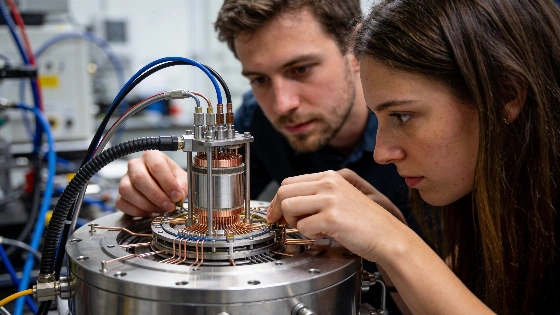
A new family of non-abelian quantum LDPC codes, called mitten codes, has been introduced by Caltech and Oratomic researchers, targeting higher encoding rates and lower overhead for fault-tolerant quantum computing hardware
Researchers from the California Institute of Technology (Caltech) and Oratomic have introduced a new class of quantum error-correcting codes, known as mitten codes, designed to address the persistent challenge of scaling fault-tolerant quantum processors. The mitten code family, detailed in a recent arXiv preprint, leverages non-abelian group structures to construct quantum low-density parity-check (qLDPC) codes that maintain a constant encoding rate while supporting higher code distances than comparable abelian designs.
Non-Abelian Code Construction
Mitten codes are built as lifted product codes using classical base matrices defined over non-abelian groups, including C5×S3, C4×D10, and C13⋊C15. This approach allows the codes to evade the restrictive distance bounds that typically limit abelian qLDPC codes with similar base-matrix shapes. As a result, mitten codes can achieve code distances of 18 to 24 and beyond, using only a few hundred physical data qubits. The codes maintain a 20% encoding rate and a check weight of 9, balancing error correction strength with hardware compatibility.
Logical Architecture and Operations
A central feature of mitten codes is their canonical logical basis, where logical operators for all encoded qubits are related by the underlying non-abelian group action. This symmetry enables a modular and reusable logical toolkit, allowing every logical operator to be mapped to any other through group operations. The architecture supports universal Clifford operations using just five reusable graph surgery gadgets derived from two small seed gadgets. High-throughput instruction sets are enabled, including parallel lattice surgery for simultaneous measurement of multiple logical qubit pairs and parallel magic-state injection to deliver non-Clifford resources across all logical qubits.
Performance Benchmarks and Decoding
To assess performance under realistic noise, the researchers developed a telescoping decoder that combines GPU-accelerated belief propagation with exact integer-programming solvers. In memory simulations at a 0.1% physical error rate under circuit-level depolarizing noise, a mitten code with 300 data qubits achieved a block logical error rate of approximately 10-11 per syndrome extraction round. At a 0.4% physical error rate, a 975-data-qubit code encoding 195 logical qubits reached a logical error rate of 10-8 per round, outperforming a benchmark stack of 195 rotated surface codes-requiring over 100,000 physical qubits-by nearly two orders of magnitude in both physical qubit count and logical error rate. In direct decoding of 15 billion surgery experiments on a 540-data-qubit code, only two logical failures were observed, indicating capacity for over 10 billion logical operations with sub-millisecond average per-cycle decoding latency.
Hardware Mapping and Engineering Constraints
The mitten code architecture was mapped onto both neutral atom arrays and superconducting qubit platforms. On neutral atom systems, non-local check measurements are implemented by shuttling ancilla atoms using crossed acousto-optic deflectors, with group product factorizations enabling atom movements to decompose into row shifts and column swaps. Estimated cycle times for these operations range from 5 to 15 milliseconds. On superconducting chips, mitten codes were shown to have a planar thickness of 3, achieving hardware layout complexity comparable to bivariate bicycle codes while encoding substantially more qubits per block. The entire code family was discovered using an automated pipeline built around sQetch, a GPU-accelerated distance estimator operating up to 800,000 times faster than conventional tools.
While mitten codes represent a significant theoretical and architectural advance, their practical deployment will depend on further experimental validation and integration with real hardware. The codes' performance under laboratory conditions, fabrication variability, and long-term stability remain to be established. For context on how quantum hardware is being tested in operational environments, readers may be interested in recent efforts to deploy entanglement-based quantum networks, as described in this report on quantum hardware field trials in Albuquerque.
Quantum error correction is essential for building reliable quantum computers, as physical qubits are highly susceptible to errors from environmental noise, control imperfections, and decoherence. Logical qubits are constructed by encoding information across multiple physical qubits using error-correcting codes, allowing errors to be detected and corrected without directly measuring the encoded quantum information. The effectiveness of a code is determined by its encoding rate, code distance, and the overhead required for syndrome extraction and decoding. Achieving high logical qubit density with low error rates and manageable hardware complexity is a central challenge for scalable quantum computing.