A survey in Sudan's Miseida region recorded nearly 300 sites, spanning Mesolithic activity to a Christian-era church. A monumental carving may represent a ruler, but its date and identity remain uncertain.
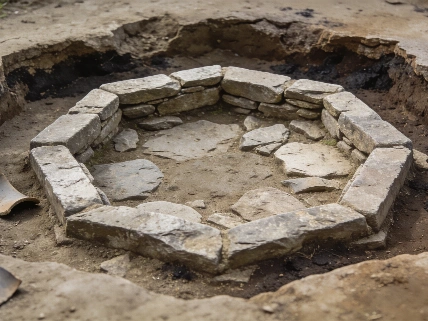
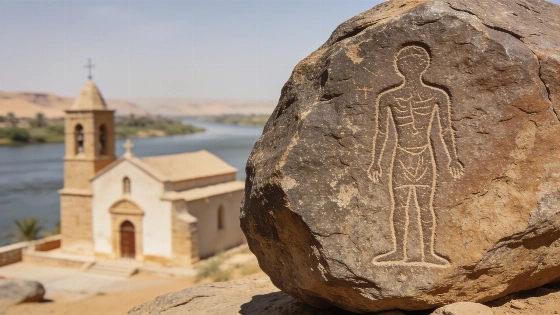
A survey of Sudan's Miseida region documented nearly 300 archaeological sites, including a life-sized human figure carved into granite that may depict a Nubian ruler. A Christian church built beside it dates to around the 7th century CE, probably centuries after the rock art was made. The church's proximity places later religious activity beside older rock art, but does not show that its builders chose the site because of the carving.
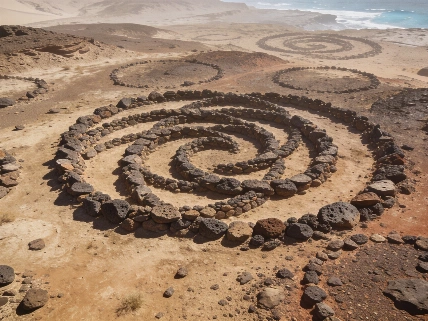
The boulder is one discovery in the Miseida region of Mahas, near the Third Cataract of the Nile in northern Sudan. Researchers documented settlements and evidence of stone-tool making and use, alongside pottery and rock art. The team combined field surveys and spatial mapping with analysis of ceramics and rock images, drawing on local oral traditions and settlement patterns as well. Together, the evidence records activity across thousands of years, though not continuous occupation throughout that span.
The carved figure
The human image has previously been interpreted as a Nubian ruler. Carved on a granite outcrop, the life-sized figure has no established precise date or identified subject. Researchers consider possible dates in either the Kerma period, roughly 2500-1500 BCE, or the broader Kushite period, about 780 BCE-350 CE. A comparison with an image of the Meroitic king Sherkarer at Gebel Qeili offers one point of reference, not proof of the figure's identity.
The interpretation matters because Miseida lies in a borderland of ancient Nubia. A monumental image of a ruler in such a setting could have communicated political authority or territorial presence, but that remains a hypothesis. No accompanying inscription names the figure or links it to a particular dynasty.
Other carvings on the surrounding rock depict wildlife, including a lion and rhinoceros, as well as an elephant and cattle. These motifs reflect rock-art activity at the site, but they need not all belong to the same period. A report on the Polish survey also describes the later reuse of this field.
Layers of activity
The archaeological sequence reaches back to the Mesolithic, dated in the study's chronology to approximately 12,000-8,200 years before present. Material from the Late Neolithic and Pre-Kerma period, approximately 3000-2500 BCE, forms a later concentration associated with more intensive settlement and economic activity.
By comparison, evidence from roughly 1700 BCE to the 4th century CE is less abundant at Miseida. This interval encompasses Kerma and later Kushite history, as well as the Meroitic period. The uneven archaeological record does not, by itself, establish that people left the region.
Teams from the University of Warsaw and Jagiellonian University conducted the research, with participation from the Institute of Archaeology and Ethnology of the Polish Academy of Sciences. A separate medieval excavation near Puck documents a different archaeological setting and period.
Church and ceramics
Carvings around the church include crosses and ships, associated with the Christian phase of activity at the site. The church's construction around the 7th century CE marks a later use of the same field, long after the possible Kerma- or Kushite-era carving.
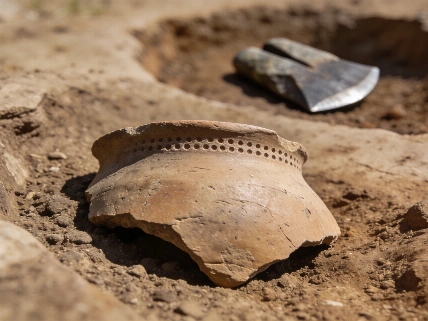
Ceramics found near the church indicate connections with other centers in medieval Nubia. The assemblage includes material associated with the emergence of the Nobadian kingdom, as well as pottery from early traditions of the Makurian Kingdom, centered on Dongola and dating between the late 5th and 7th centuries CE.
Published in the journal Antiquity, the study documents a field with archaeological evidence from multiple periods. The chronology and identity of the human figure remain open questions, with Kerma- and Kushite-period dates among the proposed possibilities. A summary of the study's chronology describes the figure's date as imprecise.
A petroglyph is an image carved into a rock surface. At Miseida, the human figure is best described as a large rock carving interpreted as a possible Nubian ruler. The proposed Kerma or Kushite date rests on archaeological and comparative interpretation, rather than a direct date for the carving.