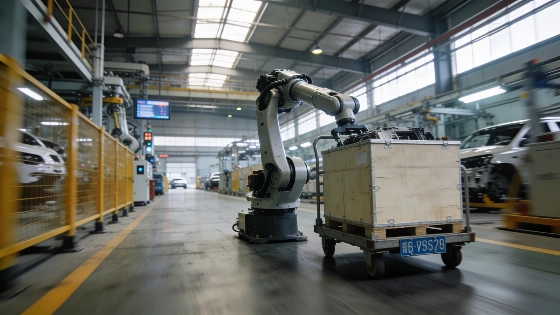
UBTECH and FAW-Volkswagen will jointly develop and test embodied-AI humanoid robots for factory logistics and smart-manufacturing demonstrations. The agreement expands earlier production-line trials but does not establish autonomous routine deployment or identify a timetable, site, robot fleet or logistics task list.
UBTECH and FAW-Volkswagen are taking their humanoid-robot partnership from vehicle inspection into factory logistics. Announced on October 8, the agreement covers joint development, testing and demonstration scenarios for embodied-AI applications in real production environments. It is a strategic research-and-development program, not confirmation that humanoid robots are already operating autonomously in regular factory logistics.
That distinction is important in robotics research. An embodied-AI system must connect perception, planning and physical action under changing conditions, rather than simply produce a digital response. The companies have not identified the humanoid model for the new logistics work, the exact jobs it will perform, the production site or sites involved, the number of robots, or a timetable for routine use. Existing Walker S Lite tests in Qingdao therefore cannot be treated as proof that the new logistics program has started at that plant.
From a scientific standpoint, the proposed work resembles a field-validation problem: performance must be measured in the target environment, with real people, equipment, routes and production constraints. Researchers at MIT and other robotics laboratories commonly separate perception accuracy, task completion, motion safety and recovery from failure when evaluating physical systems. Those dimensions are more informative than a general claim that a robot has an embodied brain or a foundation model.
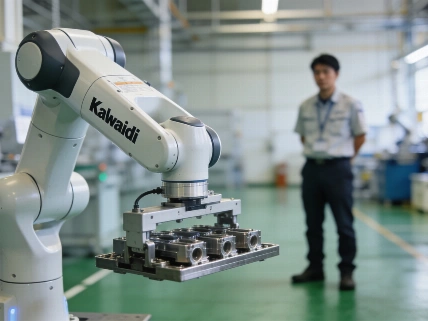
Factory logistics is a demanding test for flexible automation because it can involve changing routes, varied objects, temporary obstructions and production layouts that are less predictable than a fixed machine operation. A serious evaluation would normally specify a task definition, number of trials, completion and failure rates, intervention frequency, cycle time, energy use and safety events. None of those results has been published for the new UBTECH-FAW-Volkswagen program.
FAW-Volkswagen previously used UBTECH's Walker S Lite humanoid robot at its Qingdao factory for vehicle quality-inspection training. The robot was connected to the plant's automation control system. That connection illustrates how a humanoid machine may be integrated into existing industrial infrastructure, but it does not by itself establish independent decision-making, reliable operation without supervision or safe recovery from unexpected events.
The partnership began in July 2024 when FAW-Volkswagen opened production-line scenarios at Qingdao for UBTECH's industrial Walker S humanoid. Tests included bolt tightening, component installation and parts handling. Industrial logistics and supply-chain work were identified at that stage as possible areas for later cooperation. The new agreement turns that possibility into a formal area for joint development while leaving performance evidence for logistics tasks still to be produced.
In an embodied system, the control loop runs from sensing to interpretation, action selection and movement, followed by new sensor feedback. This creates a continuous interaction with the environment: a misplaced component, blocked path or changed instruction can alter the next action. The architecture is therefore only one part of the scientific question. The relevant issue is whether the complete system maintains predictable behavior across repeated trials and under disturbances.
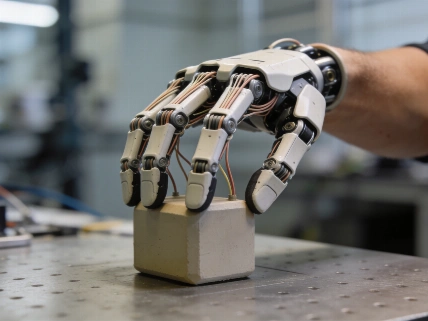
UBTECH describes its industrial humanoid platform through four parts: an embodied brain, a humanoid cerebellum for motion control, robotic hardware and swarm intelligence for coordinating multiple robots. The company says its embodied-intelligence stack combines a foundation model, a world model and an action model so a robot can interpret surroundings, anticipate environmental changes and select actions. Those descriptions explain the intended architecture but are not a published logistics benchmark or independent validation of factory performance.
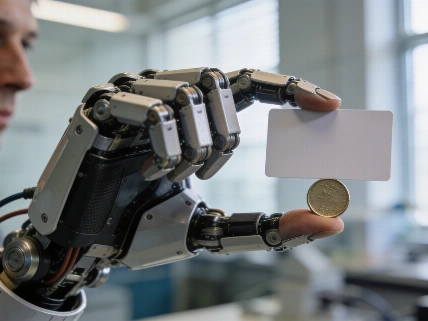
The distinction matters. A robot that can execute several physical actions on one platform may be more adaptable than dedicated equipment designed for a single motion, yet adaptability also creates more situations that must be tested. A credible industrial study would need to distinguish successful autonomous actions from tasks completed after human prompting or intervention. It would also need to report the operating envelope: lighting, floor conditions, payloads, speed limits, proximity to workers and the consequences of a perception or manipulation error.
Peer-reviewed robotics research in journals such as Nature emphasizes the value of reproducible experimental descriptions, controlled comparisons and clearly defined evaluation metrics. For this partnership, those details would help determine whether a humanoid offers an advantage over established conveyors, automated guided vehicles or robotic arms, rather than merely demonstrating that it can perform a task once. No comparative logistics benchmark, confidence interval, failure analysis or independent replication has been reported for the new program.
UBTECH's industrial humanoid super smart factory in Liuzhou, Guangxi began operating on September 12. The 14,000-square-meter facility produces the Walker S and Cruzr series and is designed to manufacture robots using robotic systems. According to the Guangxi regional government, its stated production capacity is one robot every 10 minutes. That is a manufacturing figure rather than evidence that the machines can perform logistics work safely or efficiently in a customer's plant.
UBTECH has also stated that its humanoid factory is designed for production of up to 10,000 robots per year and that deliveries from several product lines were expected in the second half of 2026. These are company production plans, not a commitment to supply that number of robots to FAW-Volkswagen. Manufacturing capacity should therefore not be confused with the size of the test fleet or with evidence of large-scale deployment.
For context on the wider industrial robotics race, Samsung's robot project shows how major manufacturers are also exploring humanoid platforms through existing hardware capabilities. The comparison should not be stretched further: the available material does not provide equivalent performance tests for the two efforts. NASA's work with autonomous systems also illustrates a broader engineering principle relevant here: operating in a complex environment requires explicit treatment of sensing, uncertainty, fault recovery and human oversight, not only a capable actuator or model.
FAW-Volkswagen operates five production bases in Changchun, Chengdu, Foshan, Qingdao and Tianjin, producing Volkswagen, Audi and Jetta vehicles. The company therefore offers UBTECH a multi-site automotive manufacturing context in which future demonstrations could be evaluated. The current agreement does not say which of those plants will host the new logistics trials, and it does not connect the new program to the earlier Qingdao Walker S Lite testing.
At the systems level, a useful trial would also examine coordination between the robot and the factory's warehouse, manufacturing-execution and safety systems. A logistics robot may need to identify a destination, request access to a route, confirm a load and stop when a human enters a restricted area. These are engineering requirements, not evidence that the current agreement has already solved them. The public materials provide no results on emergency procedures, human approval, intervention requirements or multi-robot coordination.
The reported evidence supports a partnership and a defined testing direction. It supports neither a claim that humanoid robots are ready to replace established factory logistics systems nor a claim that the new applications are autonomous. Inspection training and earlier physical tasks demonstrate areas of experimentation, not repeatable performance across an operational logistics network.
In robotics, embodied AI refers to software that links perception and decision-making with physical action. A foundation model or world model may help a machine interpret objects and surroundings, but the phrase does not specify how reliably the robot detects hazards, plans motion or recovers from errors. Physical deployment requires evidence from repeated trials in the intended environment, transparent metrics and clear human-control arrangements rather than architecture descriptions alone.
CERN's large-scale engineering programs provide another useful reminder that complex technical systems are assessed through layered validation, operational controls and documented failure modes. The analogy does not imply that factory humanoids have reached that level of maturity; it highlights why a demonstration, a controlled pilot and a validated production system should be reported as separate stages.
UBTECH and FAW-Volkswagen have made the next logical move by placing humanoid systems in a concrete industrial workflow instead of relying only on staged demonstrations. But the significance of this agreement lies in the test it creates, not in a capability already proven. Until the companies report repeatable logistics results, task-level metrics and the human-control arrangements behind them, this remains an ambitious factory experiment rather than a validated route to large-scale humanoid deployment.