In a lung-cancer planning study, a printed pin array shaped a single-energy carbon-ion beam; phantom measurements showed more than 99% target coverage, while delivery took about 30 seconds
In phantom tests based on a lung-cancer treatment plan, a single-energy carbon-ion beam covered more than 99% of the target volume with at least 95% of the prescribed dose. Irradiation took about 30 seconds. The result came from a patient-specific 3D-printed modulator, not treatment delivered to the patient, according to coverage of the study by Physics World.
One Energy Layer
Synchrotron-based carbon-ion therapy commonly uses pencil-beam scanning to build a three-dimensional dose across successive energy layers. Changing beam energy takes about 4 seconds per step, extending delivery to several minutes. During treatment of a moving lung or liver tumour, breathing can shift the target relative to the scanning beam and introduce dose uncertainties.
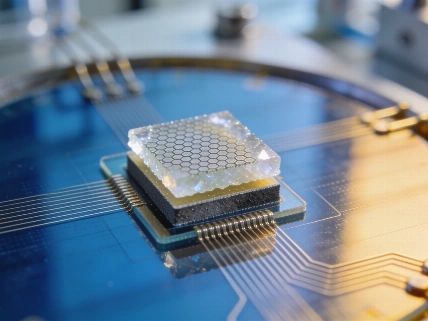
The team, from GSI Helmholtz Centre for Heavy Ion Research and Technische Hochschule Mittelhessen (THM), used a passive 3D range modulator (3DRM) to shape a scanned beam at one fixed energy. Its individually profiled pins degrade the beam by different amounts, creating the spread-out Bragg peak needed to cover the target. This physical beam shaping replaces repeated synchrotron energy changes with delivery in a single energy layer.
TRiP, GSI's treatment-planning system, converted a conventional multi-energy plan into a single-energy plan. It accounts for Coulomb scattering in the modulator material in its beam modelling and dose calculations. The software also translates the plan into pin dimensions and weights for a patient-specific design, which the team manufactures by high-precision 3D printing. In a separate hardware field, an earlier silicon photonics report covered optical switching for AI clusters; the present study instead shapes a carbon-ion beam with a printed physical structure.
Testing the Plans
Researchers built three modulators for a lung-cancer case study involving a patient who had previously received photon radiotherapy. The designs placed the modulator 50, 70 or 100 cm from the target. Each plan used two coplanar beams at a fixed energy of 259.89 MeV/u, with 3 mm spot spacing and a prescribed single-fraction dose of 3 Gy(RBE).
For testing, the team placed the modulators in the beamline and measured dose in a WERNER water phantom containing a moving ionization-chamber array. All three plans delivered a single energy layer, with more than 99% of the target volume receiving at least 95% of the prescribed dose. The organ-at-risk doses also remained within the specified clinical criteria.
Delivery took around 30 seconds, or four synchrotron filling cycles. Completing irradiation within one or a few breath-holds could reduce the effect of breathing on dose placement. The test established performance in a moving phantom; it did not demonstrate treatment of a patient with the modulator.
Limits and Next Steps
Modulator placement involved a trade-off. Greater distance from the target produced larger beam sizes at the target, increasing exposure to surrounding healthy lung tissue, although all three plans met the stated organ-at-risk limits. TRiP calculations agreed well with FLUKA Monte Carlo simulations, and both were also consistent with the phantom measurements.
The roughly 30-second delivery reflects how many ions the synchrotron can supply per cycle. Senior author Uli Weber said a higher beam intensity could allow a field to be delivered in one extraction lasting a few seconds. He also reported that GSI had used a modulator for conformal FLASH irradiation of a lung-tumour target in 150 ms. That separate result does not establish FLASH carbon-ion treatment with the workflow tested here.
Moving the method into clinical use would require adapted quality assurance, according to Weber. He identified fabrication precision as a central challenge: the pin structures are as small as 100 to 200 µm, and the team spent 10 years reaching its reported level of manufacturing quality. The study evaluated planning and phantom dosimetry for a single lung-cancer case; it did not report patient treatment or clinical outcomes.