A team at Cleveland Clinic and IBM Research has implemented a quantum convolutional neural network on real quantum hardware to classify immunogenic cancer peptides, comparing its performance to classical machine learning models
Researchers from Cleveland Clinic and IBM Research have experimentally tested a quantum machine learning framework designed to predict which tumor gene mutations produce immunogenic neoantigens-abnormal peptides that can trigger a T-cell immune response. The study, published in Science Advances as "Quantum convolutional HLA immunogenic peptide prediction (Q-CHIPP): Next-generation neoantigen prediction with quantum neural network," evaluates whether quantum convolutional neural networks (QCNNs) can extract biologically relevant features from limited and noisy immuno-oncology datasets, a persistent challenge for classical machine learning approaches.
Quantum Model Architecture
The Q-CHIPP framework integrates two QCNN models, each targeting a specific aspect of the neoantigen prediction pipeline for HLA-A*02:01-restricted 9-mer peptides. The first model predicts peptide binding to the major histocompatibility complex (MHC) using anchor-site residues, while the second model predicts T-cell receptor (TCR) recognition based on contact-site residues. To avoid confounding effects, the TCR model is trained only on peptides already confirmed to bind MHC. A peptide is classified as immunogenic only if both models independently return a positive result, reflecting the biological requirement for both MHC binding and TCR recognition.
Experimental Implementation and Error Mitigation
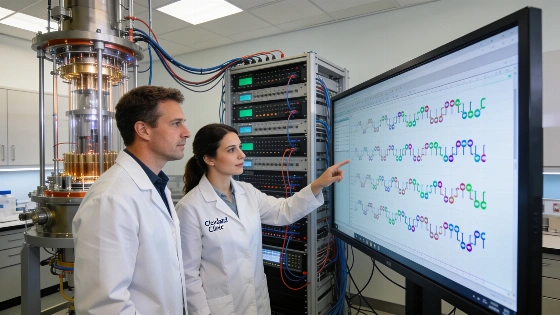
To run these models on pre-fault-tolerant quantum hardware, the team implemented several empirical noise mitigation strategies. These included Pauli twirling, dynamical decoupling, and controlled shot-based sampling, with up to 20,000 circuit executions per sample. A warm-start transfer protocol was used, where weights optimized in simulation were further fine-tuned on physical quantum processing units (QPUs). The researchers scaled their approach to full-length 9-mer peptide modeling using up to 46 qubits on the IBM Quantum System One installed at Cleveland Clinic. Under identical parameter constraints and with training sets as small as 150 samples, the error-mitigated QCNN achieved a 6% higher classification accuracy than a parameter-matched classical convolutional neural network baseline.
Clinical Dataset and Benchmarking
The Q-CHIPP framework was validated on a cohort of 111 HLA-A*02:01-positive lung cancer patients treated with immune checkpoint inhibitors. The researchers processed 209,889 candidate peptides, generated by sliding a window around somatic mutations, to estimate each patient's predicted immunogenic neoantigen burden. Stratifying patients by Q-CHIPP's predictions revealed a statistically significant difference in overall survival (P = 0.0085), outperforming the widely used NetMHCpan binding rank threshold (P = 0.0275). Notably, Q-CHIPP identified 25,542 unique candidate immunogenic peptides that were missed by classical benchmark models, with a strong selection for TCR-interaction residues at position 7.
Comparison with Classical and Quantum Benchmarks
While the Q-CHIPP study demonstrates that quantum neural networks can be trained and executed on current hardware for a biomedical classification task, the practical advantage over classical models remains modest and context-dependent. The 6% accuracy improvement was observed under strict parameter-matching and low-data conditions, but the absolute performance and generalizability will require further validation as quantum hardware matures. The study's approach to error mitigation and transfer learning highlights the engineering challenges of running quantum machine learning algorithms on noisy intermediate-scale quantum (NISQ) devices. For context, recent work has also explored quantum processors performing tasks beyond classical supercomputers, as discussed in this analysis of quantum verification methods.
Quantum machine learning for biomedical applications is still in its early stages, with most demonstrations limited by hardware noise, circuit depth, and data encoding constraints. The Q-CHIPP experiment provides a concrete example of how quantum neural networks can be benchmarked against classical models on a real-world dataset, but it does not establish a general quantum advantage for medical prediction tasks. Ongoing improvements in qubit fidelity, error mitigation, and hybrid quantum-classical workflows will be necessary before such approaches can be considered for clinical deployment.
Quantum convolutional neural networks (QCNNs) are a class of quantum circuits inspired by classical convolutional neural networks, designed to process structured data such as sequences or images. In the Q-CHIPP study, QCNNs were used to analyze short peptide sequences by encoding amino acid information into quantum states and applying parameterized quantum gates to extract features relevant for immunogenicity prediction. Unlike classical neural networks, QCNNs can in principle exploit quantum superposition and entanglement to represent complex correlations, but their practical performance is currently limited by hardware noise and the overhead of repeated measurements. Error mitigation techniques, such as Pauli twirling and dynamical decoupling, are essential for reducing the impact of decoherence and control errors in NISQ devices. As quantum hardware improves, QCNNs may offer new ways to model biological data, but their utility must be evaluated through careful benchmarking against the best available classical methods.