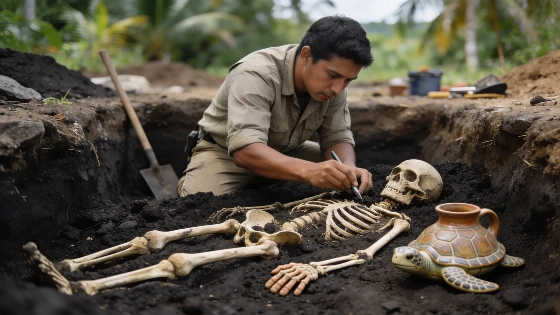
Archaeologists excavating in Antiguo Cuscatlán, El Salvador, have uncovered a 2,800-year-old burial featuring a face-down skeleton and a ceramic vessel shaped like a sea turtle, offering new evidence for mortuary practices in pre-Maya Mesoamerica
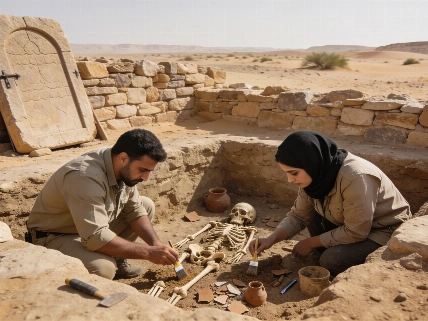
An archaeological team working in Antiguo Cuscatlán, a suburb of San Salvador, has uncovered a burial dating to the Middle Preclassic period (c. 1000-400 BCE) that includes a prone human skeleton and a ceramic vessel modeled as a sea turtle. The burial was discovered beneath a layer of volcanic ash attributed to the Plan de la Laguna eruption, which is estimated to have occurred between 850 and 830 BCE. Although the skeleton has not yet been directly radiocarbon dated, its stratigraphic position below the ash provides a secure terminus ante quem for the interment.
Excavation Context and Preservation
The burial was located during controlled excavations directed by Carlos Flores Manzano, an archaeologist and doctoral student at Yale University, under the auspices of El Salvador's Ministry of Culture. The skeleton was found lying face-down, with one hand in close proximity to the sea turtle-shaped ceramic vessel. To ensure preservation during recovery, the burial was encased in plaster before removal from the site for laboratory analysis. The vessel itself is a rare example of animal-shaped ceramics from this period and region, and its association with the burial is considered archaeologically secure.
During the Middle Preclassic, communities in southeastern Mesoamerica were transitioning toward more sedentary lifeways and developing increasingly complex social structures. Previous excavations in the region, including at the nearby site of Chalchuapa, have revealed mortuary patterns that some researchers have interpreted as evidence for human sacrifice, particularly in the context of bound-limb burials. However, interpretations of these practices remain debated, and alternative explanations have been proposed for unusual burial positions and associated artifacts.
Interpretation and Alternative Explanations
The prone position of the skeleton and the presence of the sea turtle vessel have prompted discussion among archaeologists regarding the possible symbolic or ritual significance of the burial. While some earlier studies, such as those at Chalchuapa, have linked similar mortuary treatments to the sacrifice of war captives, more recent scholarship-including work by Flores Manzano-has questioned whether all such burials should be interpreted as evidence of ritual killing. Instead, the arrangement may reflect cosmological beliefs or concepts of the underworld, with the sea turtle motif potentially referencing celestial or mythological themes later documented in Maya astronomy.
The burial is one of the earliest securely dated examples of its kind in the region, and its discovery raises the possibility that additional burials with similar characteristics may be present at the site. The number of individuals interred in this context remains unknown, but comparisons with Chalchuapa, where 33 skeletons were recovered from a single structure, suggest that larger mortuary features could exist. For context, research on other ancient burial sites, such as the analysis of organic artifacts and grave goods in southern Italy, has provided comparative data on elite mortuary practices and regional variation in funerary customs (see this analysis of Mediterranean burial traditions).
Ongoing Analysis and Research Limitations
Following recovery, the skeleton and associated vessel have been transferred to laboratory facilities for further study. Planned analyses include chemical and isotopic testing to investigate the individual's diet, health, and possible cause of death. The results of these studies are expected to clarify aspects of the individual's life history and the broader mortuary practices of the community. However, until direct radiocarbon dating and comprehensive osteological assessment are completed, key questions regarding the individual's age, sex, and the precise circumstances of burial remain unresolved.
Interpretations of mortuary evidence from this period are complicated by the limited number of well-preserved burials and the challenges of distinguishing between ritual, symbolic, and practical motivations for burial treatment. The presence of animal-shaped ceramics, prone body positions, and stratigraphic association with volcanic events all contribute to a complex archaeological record that resists simple explanation. Ongoing research will be necessary to determine whether this burial represents an isolated case or part of a broader pattern in pre-Maya Mesoamerica.
Understanding the significance of burial position and associated artifacts in ancient mortuary contexts requires careful consideration of both archaeological evidence and the limitations of interpretation. Prone burials-where the body is placed face-down-have been documented in various regions and periods, but their meaning can vary widely. In some cases, prone position has been linked to social exclusion, punishment, or ritual, while in others it may reflect cosmological beliefs or practical concerns. Without direct evidence of cause of death or explicit cultural explanation, archaeologists must rely on contextual clues, comparative data, and cautious inference to reconstruct the intentions behind ancient funerary practices.