
Fast Radio Burst
1 reportFast Radio Burst is an astronomical phenomenon recognized by characteristic signals, timescales, energy scales, and source environments. Researchers test interpretations with observational signature, frequency distribution, and theoretical interpretation, while incomplete records, model assumptions, and measurement limits constrain certainty.
The page treats competing physical models, together with signal detection and event timescales as distinct parts of Fast Radio Burst. For questions involving signal detection, the account uses population statistics as the measured record and independent detections to expose uncertainty; the comparison must account for the fact that selection effects and uncertain source distances can alter inferred rates or energies.
The page treats competing physical models, together with signal detection and event timescales as distinct parts of Fast Radio Burst. For questions involving signal detection, the account uses population statistics as the measured record and independent detections to expose uncertainty; the comparison must account for the fact that selection effects and uncertain source distances can alter inferred rates or energies.
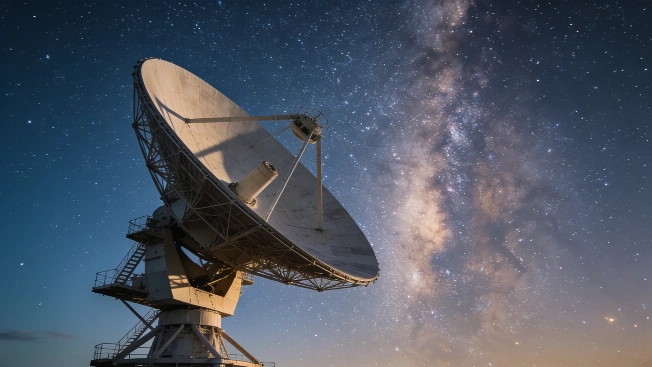
Webb Finds Tiny Host Galaxy for Farthest Fast Radio Burst
James Webb Space Telescope observations place the farthest localized fast radio burst in a remarkably small, metal-poor dwarf galaxy with intense star formation, strengthening the case for a young magnetar origin while leaving room for multiple FRB mechanisms.