Swiss startup ZuriQ has built a nine-ion 2D array using micro-Penning traps on a chip fabricated by Infineon, aiming to address scaling limits in trapped-ion quantum computing with $25.5 million in new seed funding
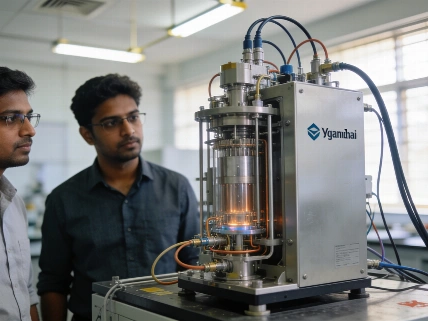
ZuriQ, a quantum hardware startup based in Switzerland, has announced the successful demonstration of a two-dimensional trapped-ion array fabricated on an industrial semiconductor line. The company, spun out of ETH Zürich in 2024, secured $25.5 million in seed funding to advance its micro-Penning trap architecture, which aims to overcome the scaling bottlenecks of conventional trapped-ion quantum processors.
Micro-Penning Traps and 2D Arrays
Traditional trapped-ion quantum computers typically use radio-frequency (RF) Paul traps, which confine ions in one-dimensional chains. These chains are limited by the complexity of junctions required to connect multiple segments, restricting the practical scaling of qubit numbers. ZuriQ's approach replaces oscillating RF fields with static magnetic and electric fields in micro-Penning traps, enabling ions to move freely in two or three dimensions. This architecture allows the number of qubits to scale with the surface area of the chip, rather than just its length, potentially supporting much larger quantum processors.
Industrial Fabrication with Infineon
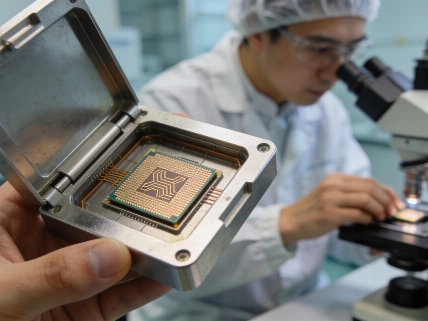
A central element of ZuriQ's roadmap is its partnership with Infineon Technologies AG, which brings established semiconductor manufacturing processes to the fabrication of ion-trap chips. Unlike RF-based designs, the static-field Penning architecture eliminates the need for high-voltage, high-frequency signals that can introduce heat and integration challenges. This compatibility with standard silicon CMOS processes is intended to bridge the gap between laboratory prototypes and scalable, manufacturable quantum hardware.
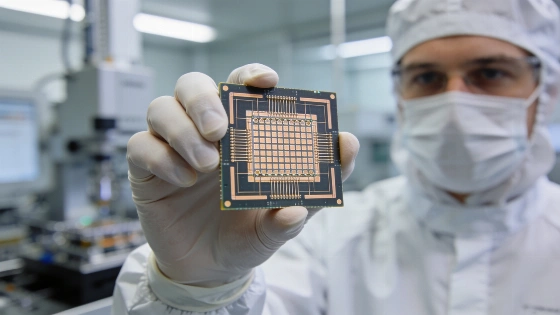
The company reports that its nine-ion 3×3 array, developed in collaboration with ETH Zürich and fabricated on Infineon's production lines, is the largest two-dimensional trapped-ion array demonstrated to date. The device was built and validated within 18 months, and follows earlier experimental work published in peer-reviewed journals, including demonstrations of arbitrary 2D and 3D ion shuttling and two-qubit gate operations in micro-Penning traps.
Scaling and Technical Milestones
ZuriQ is now developing a 40-ion processor using the same industrial process, with the goal of demonstrating further scaling toward chip-scale quantum computing. The company's technical team, which includes researchers with experience from IonQ, Xanadu, and Hamamatsu, is set to expand as part of the new funding round. The seed capital will be used to accelerate research and development, increase chip fabrication throughput with Infineon, and advance the platform toward practical utility.
In the context of quantum hardware startups, ZuriQ's focus on industrial fabrication and two-dimensional ion-trap arrays distinguishes its approach from other architectures. For comparison, recent industry activity has included initiatives such as the expansion of quantum dot laser production for optical interconnects, as reported in coverage of Innolume's new MBE system.
Evidence, Limitations, and Next Steps
While the nine-ion array represents a technical milestone, the demonstration remains at the prototype stage. Key performance metrics such as gate fidelity, coherence time, and error rates for the current device have not been independently reported. The transition from a nine-ion demonstrator to a multi-thousand-qubit system will require advances in control electronics, calibration, error correction, and system integration. The company's roadmap depends on the reproducibility of fabrication, stability of ion control, and the ability to maintain high-fidelity operations as system size increases. Independent replication and peer-reviewed benchmarking will be essential to validate the platform's scalability and practical utility.
By combining a native two-dimensional qubit geometry with industrial chip manufacturing, ZuriQ aims to address the engineering barriers that have limited the expansion of trapped-ion quantum processors. However, the gap between laboratory demonstration and a fault-tolerant, commercially useful quantum computer remains substantial, and will require sustained progress in both device physics and large-scale system engineering.
In trapped-ion quantum computing, a physical qubit is typically realized by the internal states of a single ion confined in an electromagnetic trap. The distinction between physical and logical qubits is critical: while physical qubits are directly manipulated and measured, logical qubits encode information redundantly across many physical qubits to detect and correct errors. Achieving fault tolerance-where logical error rates can be reduced by increasing code size-requires not only high-fidelity gates and long coherence times, but also robust error correction protocols and stable device operation. The challenge for any hardware platform is to demonstrate that these requirements can be met as the number of qubits increases, and that fabrication and control can be scaled without introducing prohibitive noise or variability.