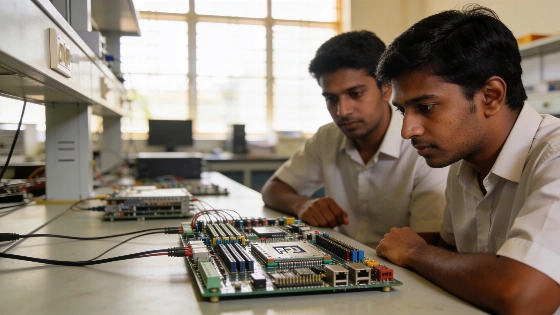
Yenepoya University and REYRA AI plan a Mangaluru laboratory for quantum-inspired hardware and software while preparing students and faculty through certification courses in quantum computing and Quantum Machine Learning.
Yenepoya University is preparing to turn quantum computing education into a hardware research program. Its memorandum of understanding with Edutecnicia Pvt. Ltd. through the AI research unit REYRA AI calls for a Quantum AI Catalyst Lab at the Yenepoya School of Engineering & Technology in Mangaluru. Indian and specialist reports dated 23 September 2026 confirm the agreement, but do not report that the laboratory is already operating, that equipment has been purchased, or that experiments have begun.
Quantum-inspired computing uses mathematical strategies motivated by quantum algorithms without requiring a processor to manipulate fragile quantum states. An FPGA is a reconfigurable electronic device that can be adapted for specialized computational tasks. The announcement does not provide a qubit count, quantum-processor specification, operating temperature, gate fidelity, coherence time, error rate, benchmark result, or measured speed advantage.
That distinction is important because quantum advantage is a comparative claim, not a label applied to any system using quantum terminology. A credible result would require a clearly defined task, a strong classical baseline, specified hardware and software conditions, statistically appropriate measurements, and reproducible data. A widely discussed Nature benchmark study illustrates the level of experimental detail normally expected when researchers compare a quantum processor with classical computation; it does not establish such a result for the proposed Mangaluru lab.
The partnership therefore concerns infrastructure and development capacity rather than a verified quantum-computing performance result. Its proposed FPGA direction is closer in the near term to specialized classical acceleration than to the operation of a fault-tolerant quantum computer.
The stated educational scope includes quantum algorithms, embedded hardware, quantum-inspired optimization, Edge AI, quantum machine learning, quantum circuit synthesis, undergraduate and faculty training, and researcher development. These are planned activities: the available reports do not provide enrollment figures, course duration, assessment results, laboratory schedules, or evidence that participants have already completed the program.
For universities entering this field, separating instruction from experimental validation is essential. A course can teach circuit design or quantum-machine-learning concepts without showing that an algorithm outperforms a classical method. A meaningful evaluation would normally specify the dataset, train-test protocol, model architecture, hardware, computational budget, baseline implementation, uncertainty estimates, and independently repeatable performance metrics. Concepts developed at institutions such as MIT and CERN also demonstrate why interdisciplinary work must distinguish theoretical models, engineering prototypes, and experimentally validated systems.
The proposed hardware direction is concrete in one respect: the partners identify FPGA-based accelerators as a target. Such devices can implement specialized mathematical operations with greater configurability and potentially lower latency or energy use than general-purpose processors for selected workloads. That possibility is application-dependent and does not establish that the hardware will contain qubits, exploit entanglement, or deliver a quantum speedup.
In a mature accelerator study, researchers would report the FPGA family, clock frequency, precision, memory architecture, data-transfer overhead, power draw, latency, throughput, and comparisons with CPU and GPU baselines. None of those measurements is supplied for this proposed project. The relevant engineering questions remain open until prototype designs and test conditions are published.
The intended application areas give the lab a broad remit. Medical imaging can involve high-dimensional reconstruction, segmentation, and classification, while logistics can involve combinatorial routing and scheduling. However, the available announcement does not identify a medical dataset, model architecture, clinical validation study, routing benchmark, sample size, confidence interval, or comparison with an existing CPU, GPU, or FPGA implementation. The proposed projects therefore remain proof-of-concept work until those details are reported.
Independent Indian coverage confirms the existence of the partnership news but adds no published technical metrics, financial terms, or regulatory details. The material describes an MoU and a planned collaboration rather than a completed product, validated medical system, or deployed quantum service. No independent replication, peer-reviewed result, or technical dataset is supplied.
This makes the partnership significant as an organizational commitment, not as evidence that quantum AI has solved a practical computing problem. Its value will depend on whether the proposed lab produces reproducible hardware measurements, publishes transparent comparisons with classical systems, and trains people who can work across electronics, algorithms, and quantum information without confusing quantum-inspired methods with quantum hardware.
A physical qubit is a controllable quantum system, while a logical qubit encodes information across multiple physical components to detect or correct errors. Neither is identified in this announcement. NASA and other major research organizations routinely distinguish mission-ready systems from laboratory demonstrations; the same discipline is appropriate here. The most defensible reading is that Yenepoya and REYRA AI are building a pathway toward experimentation and skills development, with FPGA prototypes and proof-of-concept models as the near-term focus. That is a credible starting point, but it is not yet a demonstrated quantum advantage or a scalable quantum processor.