IonQ and South Korea's SDT announced a multi-year partnership on September 21, 2026, covering deployment of a Superion 256 quantum system, silicon-vacancy memory modules, local hardware integration and a planned hybrid quantum-classical facility for medical and biomedical research.
IonQ is moving its South Korean relationship beyond cloud software and into physical quantum infrastructure. On September 21, 2026, the US company and South Korea's SDT announced a multi-year strategic partnership covering delivery of IonQ's Superion 256 quantum computer and a silicon-vacancy, or SiV, quantum-memory module. The companies describe the arrangement as the first public deployment of these systems in South Korea.
The public announcement says the Superion 256 will be deployed at an SDT customer site in South Korea. It also describes joint work toward a hybrid quantum-classical data center, linking the hardware program to future medical and biomedical research rather than to an already demonstrated clinical application. The commercial announcement is summarized in IonQ's partnership release.
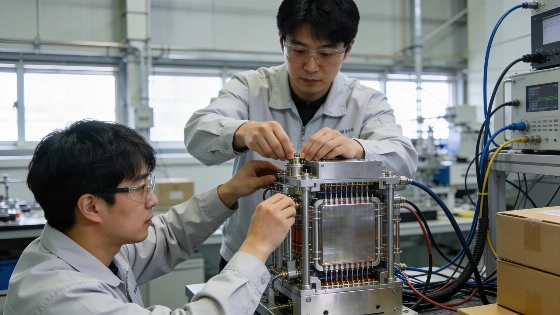
The deal gives SDT a role in assembling systems and building part of IonQ's regional supply chain. It extends earlier cloud-based and software-integration work into hardware production, system assembly, manufacturing operations, regional resale and commissioning. Those activities matter because a quantum computer is not delivered by a processor alone: it also requires specialized packaging, control electronics, calibration, cryogenic or optical infrastructure where applicable, classical computing resources and service engineering.
The agreement does not establish that the planned systems are already operating in South Korea. It sets out a commercial and manufacturing relationship covering future deployment and facility development. The number 256 identifies the announced qubit configuration of Superion 256; it is not, by itself, a benchmark of useful computational performance, error correction or reliability.
SDT plans to open a dedicated quantum manufacturing and system-integration facility in Gumi. According to the announcement, the site is intended to package and produce IonQ's SiV quantum-memory modules while also handling quantum-system assembly, integration and commissioning. Industry coverage has characterized the proposed facility as a potential Asia-Pacific hub for assembly, packaging and technical support, although its final capacity, schedule and operating performance have not been disclosed.
Silicon-vacancy centers are atomic-scale defects in diamond in which the electronic structure can support optically addressable spin states. In quantum-networking research, such defects are studied as interfaces between stationary quantum information and photons that can carry information through optical links. That makes SiV devices scientifically relevant to quantum memories and network nodes, but the partnership announcement provides no storage-time measurements, photon-collection efficiency, fidelity data or independent test results for the planned modules.
A quantum memory also serves a different function from a processor. A processor manipulates quantum states to execute an algorithm, while a memory is intended to preserve and retrieve quantum information for a defined interval. In a future network, memories could help coordinate links whose photons do not arrive simultaneously. The practical value of that architecture depends on measured coherence, interface fidelity, synchronization and loss rates, none of which are reported for this project.
SDT will participate in assembling and operating IonQ systems and will seek opportunities to manufacture additional quantum components. The Gumi facility could therefore become part of IonQ's global supply chain and its strategy for commercial expansion in the Asia-Pacific region. That possibility is organizationally significant, but it should not be confused with proof that local manufacturing has already achieved a particular yield, throughput or cost target.
A separate project will focus on a cancer center in South Korea. IonQ and SDT intend to develop hybrid quantum-classical infrastructure for medical and biomedical research. In such systems, quantum processors and conventional computers handle different portions of a workload: classical machines typically manage data preparation, control, optimization and readout, while a quantum processor is assigned a narrower computational subroutine when a suitable algorithm exists.
The proposed research setting is relevant to areas such as molecular modeling and drug discovery because these fields can involve computationally intensive problems. However, the announcement does not report a completed cancer study, a clinical result, a validated drug-discovery workflow or a measured advantage over conventional computing. At this stage, the medical component is a planned infrastructure project, not evidence of a quantum treatment, diagnostic capability or improved patient outcome.
Scientific evaluation will ultimately require the same distinctions emphasized across institutions such as MIT and CERN and in journals including Nature: a hardware specification is not equivalent to an independently reproduced result. Useful assessments would need clearly defined workloads, comparison baselines, error metrics, confidence intervals where appropriate, and enough repeated trials to separate device behavior from statistical noise. No such experimental dataset is included in the partnership announcement.
IonQ already works with the Korea Institute of Science and Technology Information, SK Telecom, Hyundai Motor Company, Seoul National University and Sungkyunkwan University. The SDT relationship adds hardware deployment and manufacturing operations to that existing network of research and industry links. It also illustrates how quantum companies are attempting to build regional ecosystems rather than rely only on remote access to machines hosted elsewhere.
The concrete development is commercial and organizational: IonQ has secured a multi-year South Korean partner for hardware supply, system integration and planned manufacturing support. The agreement also identifies Superion 256 as the first publicly announced model of its kind to be deployed in South Korea. The announcement provides no benchmark results, trial counts, processing measurements, error rates or independent evaluation of the computer or the SiV memory modules.
The measurable commercial scope reported here is a multi-year agreement involving one named quantum computer, one quantum-memory approach and a planned facility in Gumi. The announcement identifies no contract value, delivery date, system count or operating performance. Those omissions prevent a reliable assessment of the deal's scale beyond the functions and projects explicitly described.
Hybrid computing does not mean that a quantum processor replaces conventional computing. It means workloads are divided between quantum and classical resources, with the classical system still responsible for substantial control and computation. For this partnership, that architecture is a proposed foundation for medical and biomedical research rather than a demonstrated clinical platform. NASA's quantum-computing experiments and other large-scale scientific programs similarly illustrate why integration, calibration and verification are as important as processor size, although they do not provide evidence about the performance of this specific IonQ-SDT deployment.
IonQ's South Korean expansion is significant because it places manufacturing, integration and research infrastructure in the same commercial plan. Yet the evidence currently reaches only as far as the signed agreement and the stated development intentions. Until the Gumi facility and hybrid projects produce independently assessed operating results, the strongest defensible reading is that IonQ is building a regional hardware presence-not that quantum computing has already delivered a medical breakthrough.