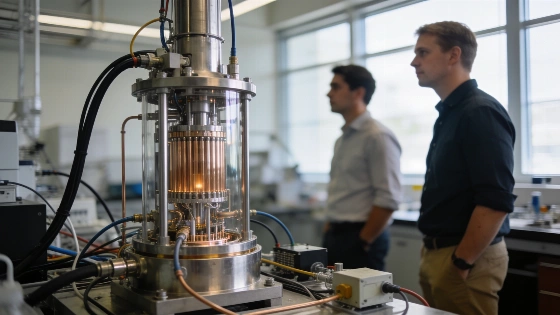
Maryland's quantum strategy now links federal benchmarking with university research funding, hands-on training and company laboratories across five hardware approaches, creating an ecosystem whose value depends on reproducible testing and commercial results
Maryland is no longer simply trying to attract quantum companies. It is assembling the infrastructure they would need to test competing hardware approaches, recruit specialized talent and move from laboratory systems toward commercial use.
The strategy is visible in the connections between institutions rather than in any single company announcement. IonQ is expanding its Maryland headquarters in College Park; Microsoft has established a Quantum Research Center in the University of Maryland's Discovery District; IQM is integrating superconducting processors with high-performance computing providers; Quantum Motion is building a silicon-CMOS hardware base; and Riverlane is placing error-correction work near the hardware it serves. QuEra has added neutral-atom systems to the same regional network.
On September 23, 2026, Maryland officials, the University of Maryland and Microsoft presented the new center as part of the state's Capital of Quantum initiative. The facility is intended to support development, training and collaboration with government partners. At approximately 15,000 square feet, or about 1,394 square meters, it represents a physical research and testing site rather than merely an expanded office.
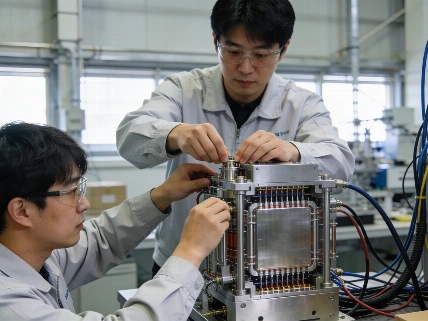
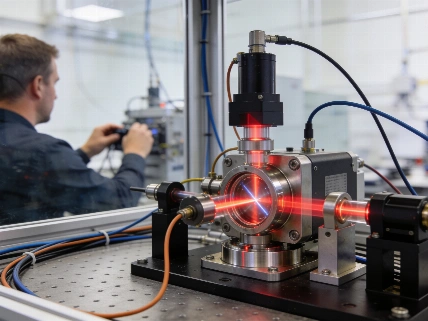
That gives the corridor five distinct hardware approaches: trapped-ion systems from IonQ, topological hardware from Microsoft, superconducting processors from IQM, silicon-spin CMOS devices from Quantum Motion and neutral-atom systems from QuEra. Riverlane's error-correction work cuts across those architectures rather than belonging to just one of them.
The arrangement matters because quantum hardware is not judged by qubit count alone. Companies also need control systems, calibration, error correction, independent validation, fabrication and testing capacity, federal access, skilled researchers and eventual customers. Maryland is placing those functions within one institutional network instead of waiting for a conventional business cluster to form on its own.
The University of Maryland says the Discovery District facilities also include space for partner companies and laboratories intended for hands-on training. Their connection to Mid-Atlantic Crossroads, the university's high-speed research network, gives the cluster an infrastructure layer that can support data-intensive collaboration between laboratories, universities and public-sector evaluators.
The most consequential piece is the Capital of Quantum Benchmarking Hub at the University of Maryland's Applied Research Laboratory for Intelligence and Security. Maryland and DARPA signed the agreement in April 2025, with each committing up to $100 million over four years, subject to project progress. The hub is designed to provide independent evaluation of whether commercial quantum approaches can reach utility-scale performance.
That purpose gives the cluster a sharper edge than a state program carrying a quantum label. A common evaluation framework can compare modalities that otherwise make incompatible claims about performance. In a field where one architecture may offer a strength that another lacks, comparable evidence is more useful than a larger headline qubit number.
The testing function also creates exposure. Nearly twenty companies have entered the DARPA benchmarking pipeline, according to the source material, so participation can provide credibility if a system performs well and reveal weaknesses if it does not. The role of independent evaluation is also central to an earlier Maryland analysis of Microsoft's research center and its connection to hardware verification.
Maryland's financial commitment is substantial but remains an investment in capacity rather than proof of technical success. Governor Wes Moore proposed $27.5 million in the FY26 budget in January 2025 for the Capital of Quantum initiative, with a goal of attracting $1 billion in combined state, federal and private investment over five years. The FY27 budget later allocated $20 million toward IonQ's global headquarters, $22 million for the University of Maryland's Quantum Startup Foundry and national testbeds, $20 million for a Deep Tech Facility and $12 million for ARLIS and quantum faculty recruitment.
The wider cluster also includes a planned 110,000-square-foot ARLIS headquarters, expansion of IonQ's global headquarters and state-private quantum investments identified by the governor's office. Taken together, these commitments indicate an attempt to connect research, workforce development, security-oriented evaluation and company growth rather than fund a single laboratory in isolation.
The timeline shows how the infrastructure accumulated. Microsoft announced its 15,000-square-foot Quantum Research Center in September 2025 with classified research zones, a hardware makerspace and direct DARPA access for its Majorana topological chip. IQM opened its first U.S. Quantum Technology Center in April 2026. Quantum Motion joined the benchmarking pipeline in June 2026, while Riverlane announced its U.S. headquarters in College Park in September and QuEra added neutral-atom systems days later.
In September 2026, Microsoft said the Maryland center would give DARPA direct physical access to a system based on Majorana 2 for independent testing and evaluation. The stated arrangement places the system within DARPA's Underexplored Systems for Utility-Scale Quantum Computing program, part of the agency's broader Quantum Benchmarking Initiative. That access is important methodologically because evaluation performed at or near the hardware can examine operational conditions rather than relying only on vendor-supplied summaries.
These facilities do not establish that any company has built a useful fault-tolerant quantum computer. The source material provides no processor-level measurements for gate fidelity, readout fidelity, coherence, logical error rate, operating temperature, circuit depth or runtime. It also does not report a completed commercial deployment, an independently reproduced benchmark result or a quantum system that has delivered revenue-generating performance because of its Maryland location.
That absence is not a minor technical footnote. Benchmarking must distinguish a promising architecture from a system that can sustain reliable computation, and it must account for calibration drift, control errors, connectivity, fabrication variability and the classical processing surrounding a quantum device. A testing center can make those distinctions possible; it cannot make them favorable in advance.
For comparison, the discipline expected in major experimental programs at MIT, CERN and NASA depends on defined protocols, instrument traceability and results that can be independently checked. Quantum benchmarking needs the same habits. A result that cannot specify the workload, calibration conditions, error model and statistical uncertainty is difficult to compare, regardless of how impressive its qubit count may appear.
Maryland's model therefore faces three concrete tests. The DARPA hub must produce data that separates viable approaches from weaker ones. Companies must convert research presence into deployments and contracts rather than stopping at co-location. The state must also show that its institutional density and federal proximity create an advantage that another region cannot reproduce simply by offering incentives.
Illinois has the Quantum Proving Ground, while Colorado has built a cluster around federal laboratories and academic research. Maryland's distinguishing feature is the concentration of multiple hardware modalities, federal benchmarking, university research, talent development and state capital in one corridor. That combination may compound: each new company can enlarge the technical labor pool, provide another reason for researchers to come to the region and broaden the data available to evaluators.
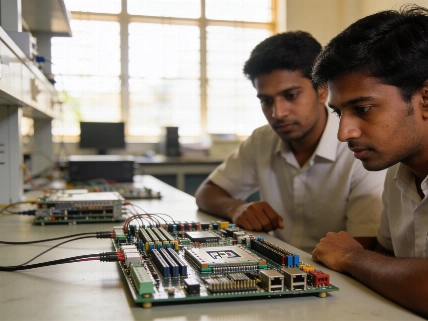
The new center's training function matters as much as its floor area. Quantum systems require expertise spanning cryogenic or vacuum equipment, microwave or optical control, semiconductor processing, software, classical electronics and error correction. A shared laboratory can expose students and engineers to those interfaces directly, although the available evidence does not yet quantify enrollment, graduation rates, hiring outcomes or the number of trained users.
But compounding is a result to be demonstrated rather than a property to be assumed. A larger network can also spread attention across incompatible platforms, increase the cost of impartial comparison and produce a dense collection of research centers without a corresponding increase in useful systems. The decisive evidence will come from benchmark outcomes, technical reproducibility and customer adoption, not from the number of buildings or announcements.
A benchmarking hub compares architectures under shared criteria rather than treating every qubit as equivalent. A physical qubit is one controllable quantum system, while a logical qubit encodes information across multiple physical components to detect or correct errors. Maryland's reported infrastructure addresses the conditions needed to evaluate that distinction, but the available evidence does not yet show a logical-qubit system or a complete fault-tolerant machine. As discussions in Nature's quantum-information research illustrate, the scientific question is not simply how many physical elements exist, but whether encoded information can be controlled reliably enough for useful computation.
Maryland is building the machinery for judgment first, and its strategy deserves to be judged by what that machinery reveals. The state's most consequential asset may therefore be neither a particular processor nor a single funding announcement, but a shared environment in which competing claims can be tested under comparable conditions.