QuEra has established a Discovery District office and expanded its University of Maryland partnership, giving researchers, educators, and students cloud access to a 256-qubit neutral-atom processor.
QuEra Computing has established a physical base inside Maryland's quantum cluster while making its 256-qubit Aquila processor available through the University of Maryland's National Quantum Laboratory. The move adds neutral-atom hardware to a regional ecosystem that already includes several competing quantum architectures. The company's announcement concerns infrastructure and research access rather than a newly reported processor benchmark, algorithmic result, or independent performance assessment.
The Boston-based company is opening an office in Discovery District Maryland and joining Maryland's Capital of Quantum initiative. QuEra says the office will be located in the Discovery Center alongside other quantum companies, including Microsoft, Quantum Motion, IQM, and Riverlane. The location is intended to connect the company with University of Maryland talent, federal research partners, and the wider commercial ecosystem.
The announcement coincided with the ribbon-cutting of the Microsoft Discovery Center at the University of Maryland. Maryland's governor's office described that event as a critical milestone in the state's effort to become a global leader in quantum information science and technology. The regional strategy is anchored by the University of Maryland and was launched in January 2025.
Maryland officials describe the Capital of Quantum as a coordinated effort involving more than $500 million in public, federal, and private quantum investments. A state and industry account published around the same time likewise reported that Maryland had secured more than $500 million in quantum investment since the initiative began. Those figures describe the broader cluster, not a specific QuEra investment or a measured increase in computing performance.
The location places QuEra near federal research organizations including NIST, NASA Goddard, and the U.S. Army Research Laboratory. That proximity creates access to a concentrated research environment, but the announcement does not report a new benchmark, gate-fidelity measurement, error-correction demonstration, or independent comparison with other quantum processors. The Maryland expansion is therefore best understood as an ecosystem and access development.
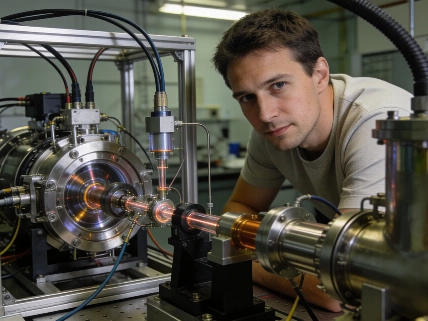
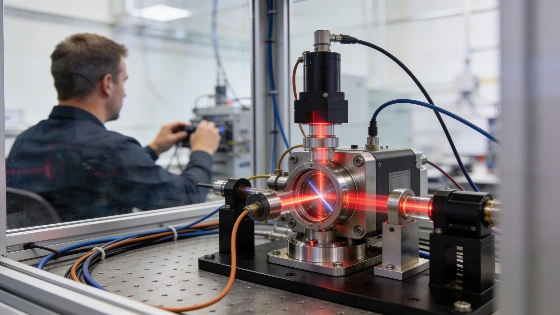
QuEra's platform uses neutral atoms as qubits. The atoms are held in a room-temperature vacuum system with optical tweezers, while laser control allows the positions of the qubits to be rearranged dynamically. In these systems, atomic internal states encode quantum information and optical operations manipulate, entangle, and measure the atoms.
This architecture differs from fixed-layout systems based on trapped ions, silicon CMOS, or superconducting circuits. Its central engineering proposition is reconfigurable connectivity: the arrangement of atoms can be adapted to an algorithm instead of relying entirely on permanent physical wiring. The system also avoids the dilution refrigeration used by many superconducting quantum processors, although vacuum equipment, laser stability, optical alignment, calibration, and measurement control remain substantial engineering requirements.
Neutral-atom processors are part of a broader experimental field that combines atomic physics, laser science, control engineering, and quantum information theory. Research groups associated with institutions such as MIT and Harvard have helped establish the scientific foundations of programmable atomic arrays, while journals including Nature have published peer-reviewed work on neutral-atom manipulation and quantum simulation. Those broad research achievements should not be confused with a performance claim about the Maryland deployment.
The architecture describes a hardware modality rather than a demonstrated advantage. The supplied announcement gives no gate fidelities, readout fidelities, coherence times, operating circuit depths, error rates, confidence intervals, or classical comparison. It therefore supports a conclusion about infrastructure and access, not about whether Aquila solves a useful problem faster or more accurately than a classical computer.
The expanded partnership with the University of Maryland's National Quantum Laboratory will make QuEra's neutral-atom systems available to the laboratory's user community. QLab director Norbert Linke said the access will support researchers, educators, and students. The stated uses include algorithm development, hardware benchmarking, and quantum workforce training, with cloud access allowing users to run experiments without operating the vacuum chamber, laser systems, and control electronics themselves.
Cloud access can lower the practical barrier to experimentation, but it does not remove the need to account for calibration, measurement noise, connectivity, sampling overhead, and the distinction between physical and logical qubits. Researchers using the platform must still characterize device-specific errors and report experimental conditions clearly, much as laboratories at CERN and NASA distinguish instrument capability from the uncertainty of a particular measurement.
The platform contains 256 physical qubits as described in the announcement. No logical-qubit count or error-correction result is reported, so the figure should not be read as a measure of fault-tolerant capacity. The announcement also does not identify a completed algorithmic demonstration, runtime comparison, p-value, confidence interval, or independent verification of quantum advantage.
Maryland's cluster is being assembled around hardware approaches that make different trade-offs. QuEra contributes neutral atoms; the wider Discovery District ecosystem includes trapped-ion, silicon CMOS, and superconducting technologies. Comparing those systems by qubit count alone would obscure differences in control, connectivity, measurement, error mechanisms, cooling requirements, and the amount of classical infrastructure needed to operate each processor.
The regional arrangement also links commercial developers with university researchers and federal laboratories. Riverlane's Maryland base has focused on quantum error-correction work, as an earlier report described. QuEra's immediate contribution is different: its Maryland presence combines local engineering and partnership capacity with access to neutral-atom hardware.
That distinction matters because a quantum cluster is not itself a quantum computer. Offices, partnerships, and cloud services can support software development, education, and workforce training, but they do not establish fault tolerance, practical quantum advantage, or scalable manufacturing. Those claims require measured hardware evidence under stated conditions and comparisons against serious classical baselines.
QuEra's official Maryland announcement frames the office and QLab access as ecosystem-building measures. The 256-qubit Aquila system remains publicly accessible through cloud services, making it relevant to researchers who need hands-on exposure to neutral-atom programming. However, cloud availability does not by itself establish that the processor has 256 protected logical qubits or can execute fault-tolerant algorithms.
Neutral-atom qubits are individual controllable atoms whose internal states encode quantum information. Optical tweezers position them and lasers manipulate them, while measurement converts the final quantum state into classical data with some probability of error. A 256-qubit processor can therefore provide a valuable experimental platform without containing 256 protected logical qubits; the hardware count describes physical systems, not the amount of error-corrected computation available. QuEra's Maryland expansion is best understood as a concrete investment in access and regional capability, while the evidence supplied here does not justify stronger claims about performance. That restraint is not a weakness of the announcement; it is the correct boundary between building quantum infrastructure and demonstrating useful quantum technology.