The companies report a 7 mdB switch benchmark across production wafers using HyperLight's TFLN Chiplet platform, a reduction from their 20 mdB milestone in 2025
Quantum signals cannot be amplified without disturbing their underlying quantum state, so losses in switches and other components can accumulate across a photonic network. On November 10, 2026, Xanadu Quantum Technologies Limited and HyperLight Corporation announced an optical-switch insertion-loss result of 7 millidecibels (mdB) using thin-film lithium niobate (TFLN). The Business Insider Markets announcement describes the result as a manufacturing-line milestone.
Loss in the network
Photonic quantum systems route single photons through optical components to generate entangled cluster states used in measurement-based gates. Every switch adds a chance that a photon will be lost before reaching its destination, reducing the usable quantum signal.
The reported 7 mdB equals 0.007 dB and corresponds to approximately 99.84% transmission, or about 0.16% optical loss in a single pass. Xanadu and HyperLight compare it with their 20 mdB (0.020 dB) result in 2025. The stated insertion-loss value is 0.013 dB lower, a 65% reduction and nearly a threefold decrease in the loss figure. The transmission change is not the same as a threefold improvement in an entire processor.
Wafer line results
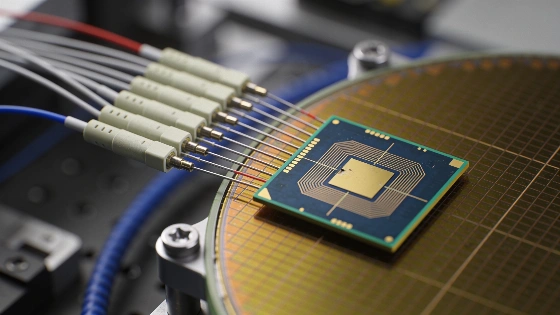
The switch was fabricated using HyperLight's TFLN Chiplet platform on a wafer manufacturing line the companies describe as compatible with high-volume production. Xanadu and HyperLight said the achievement showed "excellent yield and repeatability." The companies present the result as a production-wafer measurement, extending the benchmark beyond a single isolated device.
Thin-film lithium niobate is used in commercial high-bandwidth optical interconnects for AI and telecommunications, according to the article's technical background. That manufacturing experience is relevant to producing photonic components, though a switch-level result does not itself demonstrate a scalable quantum processor.
Comparing materials
The companies set their result against a published benchmark of roughly 100 mdB (0.10 dB) for barium-titanate phase shifters on silicon nitride, associated with PsiQuantum research reported in Nature. The devices use different material platforms and serve different quantum functions: the barium-titanate system was described for active feed-forward switching and spatial multiplexing. The figures provide context, not a controlled head-to-head comparison.
A separate TFLN photonics report covered an EPFL device for converting millimeter waves to light, a different task from switching photons in a quantum processor.
What the metric shows
Lower switch loss matters because photonic quantum signals cannot be restored with ordinary amplification. Xanadu's stated strategy uses room-temperature photonic computing networks, avoiding massive cryo-refrigeration overhead. The companies also point to possible power-efficiency benefits for optical routing inside enterprise AI data centers.
The 7 mdB figure is a component-level measurement; it does not establish a corresponding improvement in a complete quantum processor. Overall system performance also depends on other losses and efficiencies, including photon sources, detectors, optical propagation and coupling. The companies describe the wafer-line result as a step toward commercial photonic quantum systems.