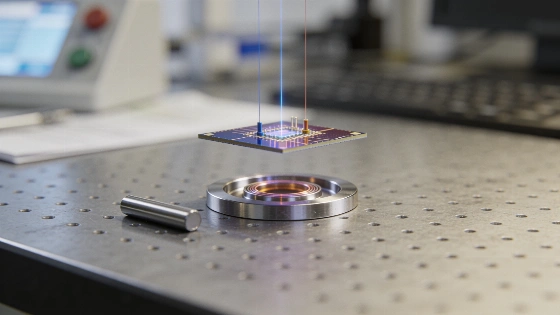
A thin-film lithium niobate photonic molecule paired with a sub-millimeter resonator reached 67% internal conversion efficiency, while free-space antenna coupling keeps total wireless efficiency far lower
Room-temperature thermal millimeter-wave photons occupy a broad spectrum, but an optical cavity can filter out a narrow slice for measurement. EPFL researchers used that effect in an integrated device that converts between millimeter waves and telecom light. Operating near 263 GHz and 1,561 nm (about 192 THz), the transducer reached a reported 67% internal photon-conversion efficiency.
A compact optical cavity
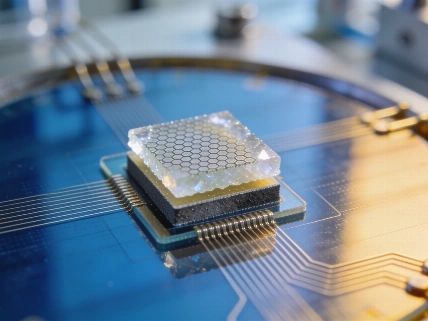
The team from the École Polytechnique Fédérale de Lausanne (EPFL) Hybrid Photonics Laboratory and Center for Quantum Science and Engineering built the optical component from a suspended 400 nm thin-film lithium niobate membrane. Etched photonic-crystal mirrors define two compact Fabry-Pérot microcavities, approximately 110 μm and 119 μm long. Together they form a photonic molecule with symmetric and antisymmetric optical modes and a free spectral range exceeding 650 GHz.
The optical resonators have quality factors as high as 106, with decay rates of approximately 186-230 MHz when expressed as κ±/2π. Their frequency splitting is engineered to match the adjacent millimeter-wave resonator. DC electrodes tune the residual detuning between the optical modes, while the optical polarization is aligned with the crystal's Z-axis to use lithium niobate's primary Pockels tensor component, r33.
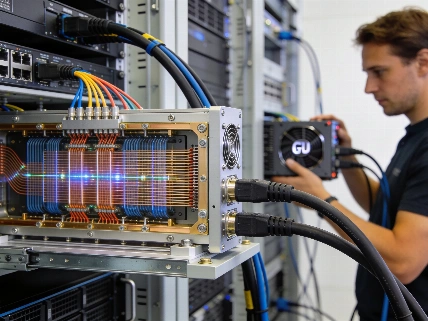
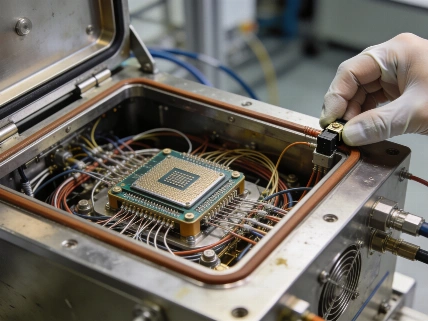
The architecture pairs the photonic molecule with a sub-millimeter metallic resonator operating near 263 GHz. The reported vacuum electro-optic coupling rate is approximately 60 kHz, and the maximum electro-optic cooperativity is 0.27 ± 0.03. The technical paper, published in Nature Photonics, is titled Coherent transduction and dynamical back-action between light and millimeter waves.
Using thermal photons
The researchers report a millimeter-wave resonance linewidth of about 15 GHz, while the optical linewidth is roughly two orders of magnitude narrower. In this reversed dissipation regime, the optical cavity selects a narrow spectral band from room-temperature thermal millimeter-wave photons. The measured electro-optic coupling is about 60 times greater than comparable coupling rates in the microwave domain.
That filtered thermal signal provides an uncalibrated internal reference for estimating device cooperativity. Under coherent drive, the interaction also changes the optical response: beam-splitter up-conversion broadens the optical linewidth, while parametric down-conversion anti-damps the mode and narrows it. The experiment demonstrated this dynamical back-action alongside frequency conversion.
The 67% figure describes conversion inside the device, not end-to-end transfer from a freely propagating millimeter-wave beam to an off-chip optical output. Total off-chip wireless efficiency is reported at 1.6 × 10⁻⁴, with coupling a free-space beam into the integrated antenna remaining a major constraint. A separate chip-scale spin-wave study examined microwave isolation rather than frequency conversion, offering a distinct example of efforts to connect quantum hardware components.
From chip to system
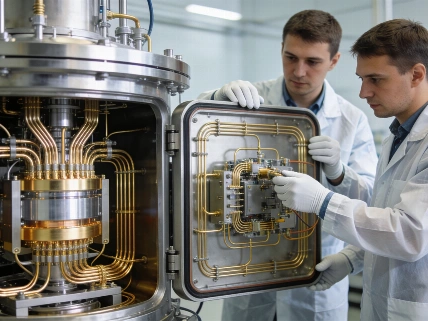
The proposed use is to link systems such as cryogenic processors and neutral-atom registers over optical fiber without adding thermal load. The reported experiment does not demonstrate a complete network link between those systems; its internal efficiency and much lower wireless efficiency describe different parts of the conversion path. The device is a laboratory demonstration, rather than a deployed communications product or a field-tested long-distance wireless link.
The resonator used normal-metal gold. The researchers project that replacing it with a high-gap superconductor such as niobium titanium nitride could suppress internal ohmic damping and raise total transduction efficiency at liquid-helium temperatures.