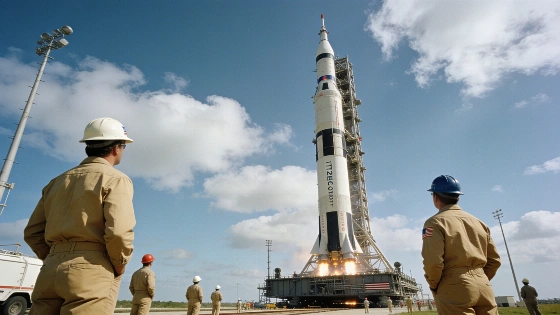
NASA's Voyager 2 spacecraft began its journey to the outer planets on August 20, 1977, using a rare planetary alignment to visit Jupiter, Saturn, Uranus, and Neptune and extend humanity's reach into interstellar space
On August 20, 1977, NASA launched Voyager 2 from Cape Canaveral, Florida, sending the spacecraft on a trajectory that would take it past the four giant planets of the outer solar system. Although Voyager 2 was named as the second in its series, it was the first of the twin Voyager probes to leave Earth, taking advantage of a rare planetary alignment that occurs only once every 176 years. This alignment allowed the spacecraft to use gravitational assists to reach Jupiter, Saturn, Uranus, and Neptune in a single mission-an unprecedented opportunity in planetary exploration.
Mission Design and Trajectory
Voyager 2's flight path was carefully calculated to exploit the gravitational fields of the giant planets, enabling the probe to gain speed and alter its course with each flyby. After launch aboard a Titan IIIE-Centaur rocket, Voyager 2 first encountered Jupiter in July 1979, followed by Saturn in August 1981. Unlike its sibling Voyager 1, which ended its planetary tour after Saturn, Voyager 2 continued onward, becoming the only spacecraft to visit Uranus in January 1986 and Neptune in August 1989. Each encounter provided new data on planetary atmospheres, magnetic fields, and moons, with the probe's instruments returning images and measurements that remain foundational to planetary science.
Scientific Discoveries and Instrumentation
Voyager 2's suite of instruments included imaging cameras, spectrometers, magnetometers, and plasma detectors, allowing it to characterize the outer planets and their environments in detail. Among its most significant findings were the detection of active geysers on Neptune's moon Triton, evidence of complex ring systems, and the discovery of new moons. The probe's observations of Uranus and Neptune, in particular, revealed atmospheric dynamics and magnetic field structures that had not been predicted by existing models. These results have shaped subsequent theories of planetary formation and evolution.
Extended Mission and Interstellar Space
After completing its planetary encounters, Voyager 2 continued to operate far beyond its original mission timeline. The spacecraft's power source-a radioisotope thermoelectric generator using plutonium-238-has gradually declined in output, but careful management has kept several science instruments active. In November 2018, Voyager 2 crossed the heliopause, the boundary where the solar wind is overtaken by the interstellar medium, making it the second human-made object to enter interstellar space. The probe continues to transmit data on cosmic rays, magnetic fields, and plasma conditions from this remote region, complementing the earlier crossing by Voyager 1.
Legacy and Ongoing Operations
Voyager 2's nearly five-decade journey has established it as a unique scientific asset. It remains the only spacecraft to have visited all four giant planets and to have directly sampled the environments of Uranus and Neptune. The mission's longevity has required innovative engineering solutions, such as reducing power consumption by shutting down non-essential systems. NASA engineers recently extended the probe's operational life by adapting its thermal management, a challenge reminiscent of the resourcefulness seen in other long-duration missions, including those described in coverage of the Curiosity rover's extended operations on Mars. As Voyager 2 continues to send back data, it provides a rare window into the conditions beyond the Sun's influence.
To understand Voyager 2's journey, it is important to grasp the concept of gravitational assist, or slingshot maneuvers. By flying close to a planet, a spacecraft can use the planet's motion and gravity to gain speed and alter its trajectory without expending additional fuel. This technique was essential for Voyager 2 to reach all four outer planets within a practical mission duration. The success of these maneuvers depends on precise timing and navigation, as well as a deep understanding of orbital mechanics. Gravitational assists remain a cornerstone of interplanetary mission design, enabling spacecraft to reach distant targets that would otherwise be inaccessible with current propulsion technology.