

Voyager 1 is nearing a distance light travels in a day as it heads outward from the Sun. A Deep Space Network tracking figure puts it at 25.80 billion km while the twin craft carry Golden Records bearing sounds and images from Earth
A rare planetary alignment gave NASA the chance to send two spacecraft on a grand tour of the outer solar system. Their journey now extends beyond the heliosphere, while Voyager 1 approaches a distance measured in the time light takes to travel. Nearly half a century after launch, it remains the most distant human-made object and continues operating in interstellar space.
A Rare Alignment
NASA launched Voyager 1 and 2 in 1977, taking advantage of an alignment of Jupiter, Saturn, Uranus, and Neptune that occurs about once every 175 years. Together, the probes used six gravity assists to pass the giant planets and observe several of their moons. By the 1980s, their routes diverged at Saturn.
Voyager 2 continued toward Uranus and Neptune. Voyager 1 made a final portrait of the solar system that excluded Mercury and Mars and included the pale blue dot we call home.
Records From Earth
Each spacecraft carries a 12-inch Golden Record. It contains spoken greetings in 55 languages. The record also holds 27 musical tracks, alongside 116 images and other sounds from Earth.
An outer cover carries etchings that show the Sun's position relative to 14 pulsars and instructions for playing the record. Copper and gold plating protect the record; the cover is aluminum. It was electroplated with an ultra-pure sample of uranium-238, whose half-life is 4.468 billion years.
Beyond the Heliosphere
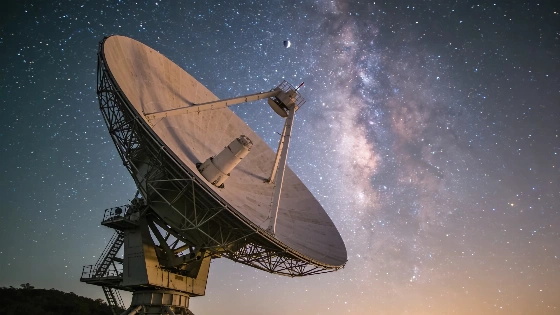
Voyager 1 crossed the heliopause in August 2012; Voyager 2 followed in November 2018. The boundary marks where the Sun's solar wind meets the interstellar medium. Both spacecraft are now outside the heliosphere, the Sun-created bubble of particles and magnetic fields, and NASA describes them as the only probes to have directly studied interstellar space. NASA communicates with the spacecraft through the Deep Space Network, an international network of large radio antennas.
A tracking reading cited in the account put Voyager 1 at 25.80 billion km, or just over 16 billion miles, with the Canberra antenna tracking the spacecraft. On October 29, 2026, NASA's Jet Propulsion Laboratory reported that Voyager 1 was traveling at about 38,000 mph (61,155 kph). NASA expects it to reach the one-light-day key stage on November 18, 2026, when it will be about 16.09 billion miles (25.89 billion km) from Earth. The article's key stage is framed as a distance from the Sun; the JPL figure is measured from Earth. A JPL mission overview also places the Voyagers within a wider account of planned work across the solar system.
At one light-day, a radio signal will take about 24 hours to travel from Earth to Voyager 1, and a reply will take another 24 hours to return. NASA's Jet Propulsion Laboratory update emphasizes that reaching the distance will not change the spacecraft or its surroundings; it is a communications-distance key stage, not a physical boundary.
The long-lived mission is also operating with shrinking power reserves. Voyager's radioisotope thermoelectric generators convert heat from decaying plutonium into electricity, and each spacecraft loses about 4 watts of electrical power per year. NASA has been switching off nonessential systems and instruments to conserve energy. The probes originally carried 10 dedicated science instruments; some were turned off after their planetary encounters, while others continued studying the outer heliosphere.
NASA's Voyager archive records that the team completed a months-long power-conservation effort in September 2026. In October, an unexpected communications interruption lasted about 48 hours before resolving. Engineers then sent commands to investigate the interruption and check spacecraft operations. NASA reported the episode in its October Voyager archive.
A light-day is the distance light travels in one day; a light-minute measures the same way over one minute. These are units of distance, not durations. They describe how far light travels, rather than how long a spacecraft has been travelling.







