

Voyager 1 is nearing a light-day from Earth as JPL marks 90 years since its first rocket tests. Planned missions target Mars, the Moon, the Sun, asteroids and Earth, with launch dates still ahead
On Nov. 18, 2026, Voyager 1 is expected to reach a distance from Earth that light takes 24 hours to cross. That one-light-day distance is about 25.9 billion kilometers, or 16.1 billion miles. The milestone comes as NASA's Jet Propulsion Laboratory marks 90 years since its first rocket-propulsion tests in Pasadena, while several new missions remain in development or are aiming for launch in the coming years.
A distant milestone
A light-day is a measure of distance, not a signal delay already experienced in a particular communication. It is the distance light travels in 24 hours. Voyager 1, launched on Sept. 5, 1977, continues into interstellar space. Once it reaches the one-light-day mark, a radio command from Earth will take nearly a day to arrive, and a reply will take nearly another day, making a complete command-and-response cycle longer than two days. The milestone will not itself end communication or the spacecraft's science operations. NASA's Deep Space Network, developed by JPL during the Apollo era, receives signals through antennas in the United States, Spain and Australia. As the spacecraft's power supply declines, NASA has been switching off selected systems and instruments to extend the operation of those that remain.
The milestone is also a reminder of the long timescale of planetary exploration. Ed Stone led the Voyager mission for 50 years and served as JPL director for 10 years. He died in 2024. The probes are approaching their 50th anniversary next year, and Voyager 1 remains the most distant human-made object from which scientific information can still be received.
Voyager 1 and Voyager 2 launched in 1977 to explore the outer planets. Voyager 1 flew past Jupiter in 1979 and Saturn in 1980, then continued on a trajectory carrying it beyond the planets and into interstellar space. The missions' extended work studying the space beyond the solar system followed their planetary flybys.
From Arroyo Seco to JPL
The lab's origin dates to Oct. 31, 1936, when Caltech graduate students and enthusiasts tested rocket propulsion in Pasadena's Arroyo Seco. JPL later began as a contractor for the U.S. Army and joined the newly formed NASA in 1958, while remaining operated by Caltech. That year it launched Explorer 1, the first U.S. satellite. An onboard Geiger counter detected radiation belts surrounding Earth, making the spacecraft a scientific mission as well as an orbital one.
JPL's history also includes Ranger 7, the first U.S. mission to the Moon, sent in 1964. Before impact, it transmitted the first close-up images of the lunar surface. The laboratory went on to lead missions that achieved early planetary flybys and visits to the four giant planets, as well as the first infrared telescope and the first rovers and rotorcraft to operate on Mars. These milestones provide context for the new plans.
Dave Gallagher, JPL director since 2025, began at the lab as an engineer. In 1992 he led the team that built and tested the Wide-Field and Planetary 2 Camera for NASA's Hubble Space Telescope. The camera produced many of the telescope's best-known images. NASA's wider public-data activity includes the 2026 NASA Space Apps Challenge, a separate program inviting teams to work with agency data.
Missions still ahead
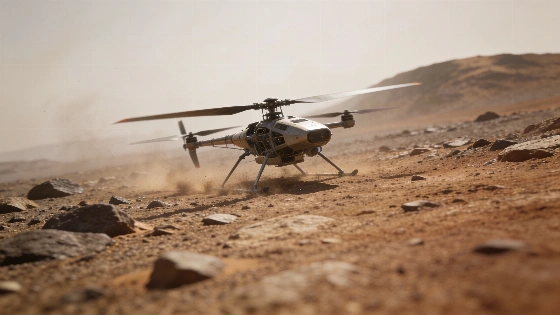
JPL-managed SkyFall is aiming for a 2028 launch. Its plan calls for three helicopters to deploy during descent over Mars, searching for and mapping hidden ice deposits while analyzing weather patterns. MoonFall, also in development for a 2028 launch, is intended to land large propulsive drones near the lunar South Pole as part of work supporting NASA's Moon Base. Neither mission has launched or is operating.
SunRISE is targeting a 2027 launch. Six satellites, each about the size of a toaster oven, are designed to fly in formation and function as a radio antenna dish miles wide. The mission will study solar activity; its findings could help inform efforts to make human space exploration safer.
JPL also manages NEO Surveyor, which is intended to search for potentially hazardous asteroids that other telescopes may miss. Finding an object would allow NASA to assess its threat and plan accordingly. The mission is designed for detection and assessment.
Reading Earth and the far infrared
JPL's Earth work includes missions that will measure changes in gravity to track water movement and study how powerful tropical convective storms form. Another will examine how different kinds of air pollution affect human health. NISAR, a joint mission with the Indian Space Research Organisation, can pinpoint changes in Earth's surface associated with natural disasters. The airborne AVIRIS instruments, developed at JPL, can detect rare Earth elements important to modern technology.
The lab's Microdevices Laboratory developed the "camera on a chip" technology used in cellphone cameras. It is also developing detectors for PRIMA, a newly announced NASA mission that will study radiant energy visible only in the far-infrared. The mission is intended to improve understanding of the universe.
A light-day is useful because it translates an abstract distance into the time light needs to travel it. It does not mean a spacecraft is one day away at its own speed: Voyager 1 travels far more slowly than light. Radio signals between Earth and the probe therefore take nearly a day to cross the distance at the milestone, before accounting for the time needed to process a command or data.







