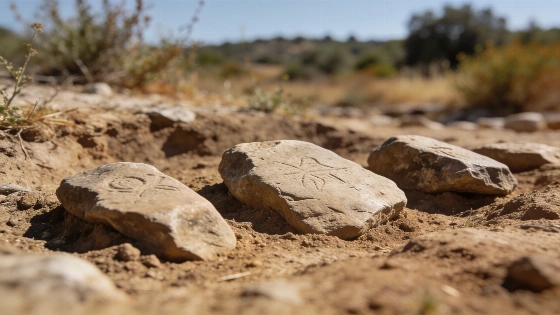
The tools were found near Alpiarça in a setting researchers describe as unusually well preserved. Their estimated age is 300,000 to 350,000 years, although the hominin population responsible remains unidentified
The stone tools at Vale do Forno were found in an unusually intact archaeological context. Their position among surrounding deposits can help researchers assess how they entered the ground and whether later movement disturbed the evidence. Archaeologist Carlos Ferreira of the University of Lisbon, who is involved in the research, says the tools remain in their original context: where prehistoric people left them.
Tools in context
Near Alpiarça, in Portugal's Santarém district, archaeological investigations have identified more than 200 stone artefacts. Their estimated age is between 300,000 and 350,000 years, placing the assemblage in the Middle Pleistocene. A team associated with the University of Lisbon's Centre for Archaeology has worked at the site since 2024. Archaeologist João Ribeiro has called Vale do Forno the oldest known site of human activity in the western Iberian Peninsula. He said the Alpiarça area may have been among the first parts of present-day Portugal to experience more prolonged human occupation. Nauka w Polsce reported the findings on 14 October 2026.
The age estimate is a range, not a single calendar date. It places the assemblage in a period of major change in hominin populations and stone-tool traditions across Europe. The artefacts show human activity, but researchers have not identified the population that made or used them.
Stone artefacts were first noticed in the area during the 1990s. Later investigations brought the scale and preservation of the deposits into sharper focus. Researchers describe the more than 200 objects as a preserved assemblage, rather than artefacts scattered from their original setting. Ferreira says the tools were found where prehistoric people left them.
Context can sharpen interpretation without revealing everything about an object's use. A separate account of the Xpujil Maya residence also turns on the relationship between material evidence and its setting. At Vale do Forno, the evidence is stone tools and their reported depositional context.
What remains unknown
The assemblage's age places the activity in a period of major change in hominin populations and stone-tool technologies across Europe. Researchers have not identified which hominin population made or used the tools. The artefacts alone cannot establish a species or population identity. The interpretation of prolonged occupation concerns the Alpiarça region, not a precise duration at the site.
The findings point to the Alpiarça region as a possible early area of prolonged human occupation in present-day Portugal. Ribeiro's claim concerns the oldest known evidence of human activity in western Iberia; it does not identify a particular hominin species.
Further work includes closer analysis of the stone artefacts. Researchers have also considered investigating ancient animal DNA associated with the archaeological context. This genetic material could shed light on animals and the environment in central Portugal during the period. It would not, by itself, identify the hominins who visited the site.
Archaeological context refers to an object's position in relation to deposits and other material at a site. An artefact found in place can preserve information about those relationships, while movement after deposition may alter them. Context does not automatically show how an object was used or prove that all items were deposited at the same time. At Vale do Forno, researchers' interpretation of the tools' preserved position is central to the site's significance.