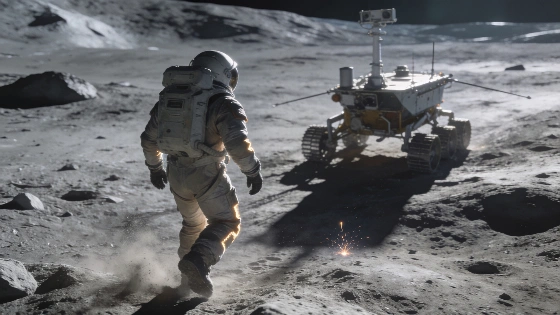
NASA has opened a challenge for systems and procedures that can safely bring astronauts to electrical equilibrium before they touch a lander during Artemis operations near the lunar South Pole.
A suited astronaut returning from a lunar EVA could approach the lander carrying a hidden electrical hazard: charge accumulated on the spacesuit through contact with the surface and interaction with the surrounding plasma. NASA is seeking designs and operational methods that can neutralize that charge before direct contact with the spacecraft.
The challenge concerns Artemis operations near the lunar South Pole, where a grounding procedure must work as part of the sequence between surface travel and re-entering or contacting a lander. The goal is not merely to build a grounding device, but to create a reliable capability for bringing a suited astronaut to electrical equilibrium without compromising the suit, the crew or the vehicle.
The problem begins as an astronaut walks across the Moon. Contact with lunar regolith can produce triboelectric charging, while the surrounding plasma can add further charging to the suit. NASA describes these effects as coupled environmental interactions rather than as simple static electricity generated by footsteps alone.
The charge becomes more difficult to balance when the astronaut enters lunar shadows or a Permanently Shadowed Region. In those dark areas, photoelectron emission is absent and the flow of positive ions is limited, removing processes that would otherwise help offset accumulated electrons. The astronaut can therefore remain electrically isolated while moving through terrain where natural charge-neutralization pathways are weak.
The lunar surface creates additional engineering complications. Regolith particles are abrasive, can become electrostatically charged and may contaminate seals, optical surfaces, radiators, mechanisms, connectors, solar panels and spacesuits. A grounding procedure must therefore address electrical risk without turning a dust-control operation into another source of contamination or mechanical wear.
The danger appears during the return to the spacecraft. In a sunlit region, the stationary lander may hold a different electrical potential from a highly charged astronaut. If the voltage difference is sufficiently large, physical contact could trigger an electrostatic discharge: a rapid electrical arc that may damage sensitive electronics, degrade suit materials or threaten crew and vehicle safety.
This is not simply a matter of a person feeling a static shock. It is a systems-engineering problem involving the suit, the lander, the local plasma environment, lunar terrain and the exact sequence of astronaut operations. Any practical method would need to control the discharge path and rate while remaining usable by a crew member wearing a pressurized suit and working in a dusty, low-gravity environment.
Through the Lunar Grounding Challenge, NASA is requesting innovative designs and operational solutions for a lunar bringing-to-equilibrium capability. The proposed capability must safely discharge a suited astronaut after high triboelectric and plasma-related charge buildup during lunar surface EVAs at the South Pole.
The central requirement is timing. A mitigation system would need to neutralize the astronaut safely and quickly under an extreme charge differential before the astronaut directly interacts with the lander. Because the challenge does not prescribe a preferred hardware architecture, solutions may involve a dedicated contact or proximity system, a controlled operational procedure, or a combination of both.
The issue fits into a wider pattern in lunar mission engineering: conditions that are negligible or self-correcting on Earth can become operational hazards on the Moon. NASA's separate work on lunar materials has also examined how local surface material might support future equipment, as described in an earlier lunar materials report, but grounding addresses a different constraint: controlling the electrical state of the crew before contact with a vehicle.
There is already a related, but distinct, line of technology development. During Firefly's Blue Ghost Mission 1 in 2025, NASA demonstrated an electrodynamic method that used electrodes to move charged dust away from protected surfaces. Such technology shows that electric fields can help manage lunar particles in situ, but it does not demonstrate that a spacesuit or astronaut can be safely brought to electrical equilibrium.
Reported performance figures for the electrodynamic dust shield illustrate why the distinction matters: removal was reported at up to 97% of particles from a glass surface and up to 82% from a thermal-radiator surface. As discussed in reported dust-control results, those values describe particle removal, not neutralization of a spacesuit's electrical charge, and cannot be transferred directly to the Lunar Grounding Challenge.
The challenge opened on October 5, 2026, and submissions are due by January 15, 2027. The supplied verified material does not confirm winners, a prize-fund amount or post-launch decisions. It identifies the South Pole as the operating environment and focuses on electrostatic-discharge mitigation rather than on a completed flight system.
That distinction matters. NASA is seeking concepts because the charge-accumulation problem must be addressed before astronauts can safely move between the lunar surface and a lander under the described conditions. No winning design or deployed solution is established in the available material.
Triboelectric charging refers to the transfer and buildup of electrical charge associated with contact between materials. Plasma charging adds a separate interaction between the suit and charged particles in the surrounding environment. On the Moon, the absence of a thick atmosphere and the sharp contrast between illuminated ground and shadowed terrain make the astronaut's electrical state a mission variable rather than a minor nuisance.
NASA's challenge therefore sits at the intersection of plasma physics, spacecraft electrical design, spacesuit engineering and crew procedures. Its value will depend on whether proposed systems can neutralize charge reliably without compromising suit materials, electronics, crew safety or the lander environment. On the lunar South Pole, managing electricity at the astronaut's surface may be as important as managing movement across it.