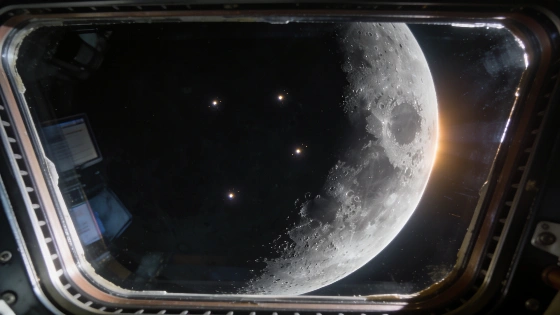
A tablet image from Artemis II records five faint impact flashes seen near the eclipsed Moon from Orion 46,000 miles away; NASA's later analysis ruled out cosmic rays and spacecraft reflections and released the mission's lunar science dataset.
Five brief flashes appeared on the dark lunar surface while Artemis II astronauts watched from Orion on April 6, 2026. Their handwritten annotations provide a record of where each faint burst appeared during the eclipse and which crew members saw it. NASA later reported that the observations survived checks against alternative explanations, including cosmic-ray events and reflections from Orion.
Five lunar flashes
NASA astronauts Reid Wiseman and Victor "Ike" Glover and CSA (Canadian Space Agency) astronaut Jeremy Hansen marked the observations on a simulated view of the eclipsed Moon using a tablet and OneNote. Wiseman used blue ink, Glover green and Hansen red, allowing the released image to distinguish individual sightings from locations where observations overlapped.
The crew reported five extremely faint pinpricks of light. These were impact flashes produced when rocky fragments struck the Moon. The observations do not show the incoming fragments directly; they record the brief visible light generated at the lunar surface when the impacts occurred. NASA described the Artemis II events as probably the faintest impact flashes ever noticed with the unaided eye.
The annotations identify flashes around several positions on the lunar disk. One appeared near the 4 o'clock position, another near 8 o'clock and a third near 3 o'clock. A fourth was marked near 6 o'clock and was noted as occurring later, while a fifth appeared near 12 o'clock toward the end of the observation.
Evidence from Orion
Orion was 46,000 miles from the Moon when the crew watched the eclipse. That distance matters because the astronauts were not examining a close-up surface scene: they were trying to detect momentary light against a largely dark lunar disk from a crewed spacecraft far from the target. The flashes occurred during a planned communications blackout while Orion was on the Moon's far side, creating a period in which the crew could make observations without normal radio contact with Earth.
The image released by NASA is a visualization rather than a conventional photograph of the flashes. It is a simulated representation of the crew's view with their observations added afterward. The colored dots and handwritten notes therefore function as an observation record, not as independent measurements of impact energy, fragment size or crater dimensions. The later confirmation was based on the broader analysis of the observations and available mission data, rather than on the annotated image alone.
Wiseman also grouped three of his marked flashes as occurring roughly 10 minutes into the eclipse. The note links the timing of those sightings, but the material provided does not give precise timestamps for all five events or measurements of the impacts. NASA reported that Wiseman and Hansen independently described seeing one impact at the same time, an agreement within the crew rather than a conclusion drawn only from a later image review.
Mission dataset released
Artemis II traveled to the Moon and back between April 1 and April 10, 2026, completing its lunar flyby before returning safely to Earth. During the journey the crew captured imagery and made scientific observations of the Moon, including the eclipse observations now represented in the annotated visualization.
NASA made the full lunar science dataset from the journey available to the global science community and the public on October 7, 2026. The release included a preliminary lunar science report, a science-operations report and a data-user guide, placing the crew's visual records alongside the wider body of mission observations. The NASA science report describes the impact-flash observations and the checks used to distinguish them from cosmic rays and Orion reflections.
The release also sits within a broader stream of NASA activity connected with future aerospace capability, including the earlier NASA report on a proposed Aerospace Power Systems Laboratory. That proposal concerned a planned facility and is separate from the completed Artemis II lunar observations.
What the image shows
The strongest conclusion is specific: three Artemis II crew members reported seeing five very faint flashes and recorded their apparent positions on a shared lunar visualization. Their agreement on some locations gives the dataset useful observational structure, while the different ink colors preserve who reported each sighting. The simultaneous observation reported by Wiseman and Hansen adds an independent human-observation check within the crew.
The image cannot by itself determine how many fragments struck the Moon, how large they were or how much energy they released. Nor does it turn a crew observation into a high-resolution impact survey. Those limits are important because a faint burst seen during an eclipse is evidence of transient light at the lunar surface, not a complete physical description of the impact event.
NASA estimates that the fragments responsible were no more than a few inches in diameter but were traveling at several thousand miles per hour. Because the Moon has no atmosphere, incoming bodies are not slowed or burned up before reaching the surface. Even a small object can therefore generate a short-lived flash when its kinetic energy is released in an impact.
Similar flashes were previously observed by Apollo astronauts from lunar orbit. The Artemis II observations extend that historical record and may help scientists estimate the frequency of small impacts, an issue relevant to the long-term protection of lunar bases, landing zones and other infrastructure. The available material does not provide a sample size large enough for a new impact-rate estimate, nor does it report p-values, confidence intervals or a peer-reviewed statistical model; the findings remain a documented observational dataset and a preliminary scientific interpretation.
The value of the record is its combination of timing, location and independent crew observations during a rare viewing opportunity. NASA's release makes it possible for researchers to compare the visual reports with the mission's wider data products, while preserving a clear distinction between what the astronauts directly saw and what must still be inferred about the impacts.
A lunar impact flash is the short-lived light produced when a meteoroid-sized rocky body collides with the Moon. The Apollo-era observations and Artemis II record show why visual monitoring remains scientifically useful even when an impactor cannot be imaged before collision. The brief signal carries uncertainty about the object, impact angle and surface response, but repeated observations can contribute to estimates of the small-impact environment around the Moon.