

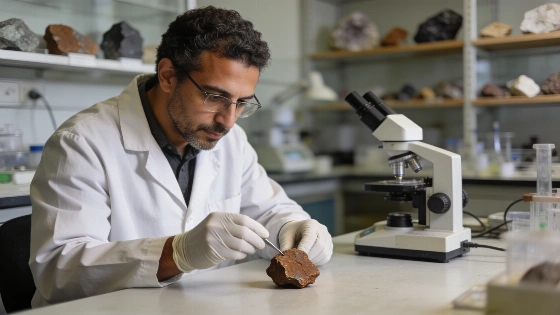
Mineral dating places Teghaza 001's formation more than 4.1 billion years ago, while evidence of water alteration dates to about 4.1 billion years ago. Its unusual minerals offer clues to early Martian geology
Found in Mali's Sahara in 2022, about 34 kilometers from the village of Bir Chali, Teghaza 001 was recovered in eight pieces, the largest roughly the size of a fist. The 800-gram meteorite yielded a history reaching back more than 4.1 billion years when researchers analyzed its minerals. They determined that it formed even earlier and was later altered by water on Mars.
Named after the salt plain where it was discovered, Teghaza 001 is one of roughly 435 known Martian meteorites on Earth. Researchers classify it as a coarse-grained igneous rock, or gabbro, formed as magma cooled slowly beneath the Martian surface. Its varied volcanic minerals preserve evidence of early crust formation and later alteration by subsurface water. Yang Liu, the NASA Jet Propulsion Laboratory planetary scientist who led the Science study, described Martian meteorites as the only samples from Mars available for laboratory study, providing a basis for investigating the planet's early formation and whether ancient conditions could have supported habitability.
A rare crustal record
Teghaza 001 is among the three most ancient Martian meteorites found on Earth. ALH84001 is similar in age but consists almost entirely of one mineral, orthopyroxene. Teghaza 001 contains a more diverse assemblage of volcanic minerals. The meteorite nicknamed "Black Beauty" records a much younger period of Martian crustal history: it formed about 2.1 billion years ago and contains small fragments of volcanic rock.
The new study in Science describes Teghaza 001's mineralogy and compares it with observations of Mars' cratered southern highlands by the Mars Reconnaissance Orbiter. Researchers identified 13 locations whose mineralogy and chemistry are compatible with the meteorite; the comparison narrows the possible geological setting but does not identify a specific Martian source crater. A Scientific American report described the southern highlands as the strongest regional match. A separate Perseverance dust analysis examined ultrafine material on calibration samples, a different kind of evidence from the mineral comparisons used to investigate Teghaza 001.
Dating mineral grains
Researchers at the University of New Mexico identified the rock as Martian by matching its oxygen isotopes with those of other Martian meteorites. It initially appeared to belong to the common shergottite class. Yang Liu examined it more closely after noticing textures and minerals that were unusual for that initial classification. The discovery of zircon crystals enabled more precise dating and helped researchers distinguish the rock's earlier formation from its later alteration by water.
Zircon crystals preserve information about a rock's formation and can be used to determine its age. With Caltech coauthor Francois Tissot, the team applied an in-situ rubidium-strontium dating method to individual mineral grains using a fragment smaller than a fingernail. Unlike bulk analysis, which dissolves an entire sample, this approach left most of the rare meteorite intact for future research.
Evidence of ancient water
The mineral ages indicate that water altered Teghaza 001 around 4.1 billion years ago, after the rock had formed. Oxygen and hydrogen isotope evidence indicates that water moved down through Mars's deeper crust and interacted with material associated with the mantle. The rock's texture and chemistry also record aqueous alteration while it cooled and crystallized underground. Liu described the meteorite as a witness to a time when Mars was likely warmer and wetter than it has been for most of its history; the findings do not establish that life existed there.
Lee Saper, the study's second author, said the rock records interactions between water and rock and may preserve an imprint of the Martian atmosphere as the planet lost water. A separate paper in Science Advances, published in June, detailed the meteorite's water content.
In-situ dating measures mineral grains within a rock rather than dissolving and analyzing the whole sample. In Teghaza 001, the small-fragment method allowed researchers to distinguish the meteorite's formation from a later episode of water alteration while preserving most of the specimen for further study. Its laboratory-scale mineral and isotope evidence can also be compared with orbital observations, connecting analyses of the meteorite with mineral distributions mapped across Mars.







