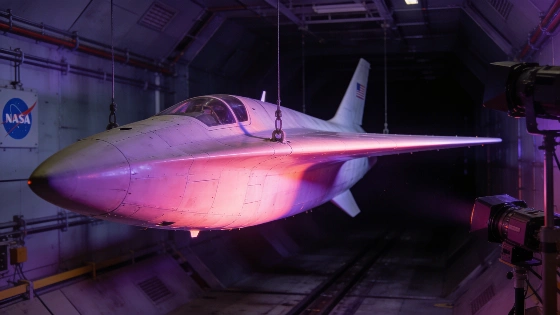
A NASA Langley test made a freely moving model wing glow pink-purple while high-speed cameras recorded full-field pressure changes in a low-oxygen wind-tunnel environment.
A standard NASA wing model glowed pink-purple inside a wind tunnel as researchers captured changing pressure across its surface with ultraviolet light and high-speed cameras. The result was not a visual effect added after the experiment: the coating itself changed brightness as airflow loaded the wing, turning an otherwise difficult measurement into a detailed optical record.
The experiment is significant as an instrumentation milestone, not as a completed aircraft demonstration. The supplied NASA account does not report a statistical sample size, p-values, confidence intervals or a flight-test result; its evidence concerns whether the pressure-sensitive-paint and imaging system could operate on a large, freely moving model under demanding tunnel conditions.
A broader research effort is also developing optical coatings that improve the accuracy and interpretability of wind-tunnel measurements. For example, work reported by the University of Manchester examines how fluorescent molecular responses can support aerodynamic testing, illustrating why paint chemistry and camera calibration are central parts of the measurement chain.
A wing becomes a sensor
The test took place at NASA's Langley Research Center in Hampton, Virginia, inside the Transonic Dynamics Tunnel. Researchers applied unsteady Pressure Sensitive Paint to the Benchmark Supercritical Wing, a standard model designed to improve computer modeling through comparisons with wind-tunnel measurements rather than to represent one particular aircraft.
Pressure Sensitive Paint works as an optical proxy for surface pressure. As airflow pressure changes over the model, the coating varies in brightness. High-speed cameras then record those changes across the wing, producing full-field optical pressure data that can be used to test and refine computational models of airflow.
The important measurement is therefore not the pink-purple color itself. The color is the visible response of a specialized coating, while the scientific value lies in the changing brightness captured across the moving model. In practice, researchers must relate the optical signal to aerodynamic conditions through calibration and account for tunnel illumination, camera timing, coating behavior and model motion.
Why the tunnel matters
This was the first use of unsteady Pressure Sensitive Paint on a large-scale freely moving model in a low-oxygen environment, according to the supplied NASA account. That combination matters because the experiment tested the paint under conditions made possible by the Transonic Dynamics Tunnel rather than on a small stationary model in a simpler laboratory setup.
NASA researchers at Langley and at the agency's Ames Research Center in California's Silicon Valley have spent years working to integrate the technique into wind-tunnel tests for aircraft and rockets. The Langley experiment extends that effort into a setting where the model can move freely while cameras follow rapid changes in the airflow response.
The low-oxygen environment is especially relevant to the test configuration because it allows researchers to evaluate the optical system under the tunnel conditions used for this class of experiment. The supplied material does not establish a universal performance advantage over every conventional pressure sensor, so the result is best interpreted as demonstrating feasibility for a specific large-scale, moving-model application.
From optical signal to model
The test joins two systems with different roles. The benchmark wing provides a repeatable physical shape for comparing measurements and calculations. The paint supplies a surface-sensitive optical signal, and the high-speed cameras preserve changes that would be difficult to capture with a single conventional reading.
That division is essential when interpreting the result. The cameras do not directly photograph pressure as a visible substance; they record brightness changes produced by the coating. Researchers can then use those data to improve computer models, linking the measured optical response to the aerodynamic conditions acting on the wing.
The approach is complementary to astronomy and other remote-sensing work, where instruments also convert physical signals into interpretable data. But unlike the earlier Webb report about dust spectra around young stars, this experiment measures airflow around a controlled model rather than inferring a distant environment from emitted light.
For computational aerodynamics, the value of a full-field measurement is that it can reveal how pressure patterns vary over an entire surface instead of sampling only isolated points. That spatial coverage can help expose differences between a simulation and a physical test, although the comparison still depends on consistent tunnel conditions, image processing and the assumptions built into the aerodynamic model.
What comes next
The immediate significance is practical: NASA now has a tested route for applying unsteady Pressure Sensitive Paint to larger freely moving models in a low-oxygen wind tunnel. The agency expects the method to have further wind-tunnel applications, although the supplied material does not establish a specific aircraft design or a completed flight technology.
The next stated target is flexible aircraft models designed to bend and adapt during flight. Such tests could use the paint and camera system to examine how changing shape affects airflow, while the resulting measurements provide a stronger basis for simulations than assumptions alone.
Flexible structures create a moving target for aerodynamic measurement because their shape and loading can change together. A synchronized optical record could help researchers examine those coupled changes over the wing surface, but future tests will be needed to determine how reliably the technique performs with different materials, deformation rates and flow regimes.
The experiment is best understood as an instrumentation milestone rather than a finished aircraft breakthrough. It demonstrates that a specialized coating and high-speed imaging system can operate together on a large moving model under unusual tunnel conditions, giving future aerodynamic studies a more information-rich way to compare physical tests with computation.
Pressure Sensitive Paint is an indirect measurement method: pressure changes alter the coating's brightness, and calibrated camera data translate that optical response into aerodynamic information. Its strength is spatial coverage across the model rather than a single point measurement. Its usefulness still depends on the paint response, camera recordings, tunnel conditions and the computer models used to interpret the data, which is why this test matters most as a foundation for more demanding experiments rather than as proof of a final aircraft design.
NASA's Langley and Ames programs place the work within a longer development path for optical aerodynamic instrumentation. As in other laboratory fields, including instrument-heavy research published through journals such as Nature, the reliability of the conclusion depends not only on an impressive image but also on calibration, repeatability and transparent comparison with established measurements.