
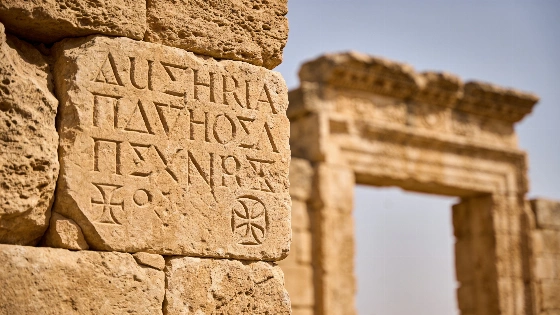
Archaeologists have analyzed over 620 carved marks on the Tauchira Gate at Ptolemais, Libya, uncovering evidence for organized labor, material transport, and possible payment tracking in a major Hellenistic building project more than 2,000 years ago
More than 620 carved marks on the monumental Tauchira Gate at Ptolemais, a major Hellenistic city on Libya's northern coast, have provided new insight into how ancient builders organized large-scale construction. Recent research led by Anna Kordas at the University of Warsaw systematically cataloged 626 stonemasons' marks preserved on the limestone blocks of the gateway, revealing a complex system for managing labor, materials, and possibly payments during the second century BCE.
The Tauchira Gate in Context
Ptolemais, established as a key administrative and commercial center in Cyrenaica under the Ptolemaic dynasty, was known for its monumental architecture. The Tauchira Gate, either built or extensively reconstructed during the reign of Ptolemy VIII Physcon (c. 145-116 BCE), formed a prominent part of the city's fortifications. Hundreds of limestone blocks from the structure survive, many bearing Greek letters, letter combinations, and monograms whose function had long been debated.
Kordas's analysis identified 27 distinct types of marks, including single Greek letters such as alpha through eta, as well as more elaborate monograms. The study, published in the European Journal of Archaeology, suggests these marks were not simply individual signatures but part of a coordinated system for tracking the work of multiple teams and workshops.
Organizing Labor and Materials
The repeated appearance of Greek letters on the blocks indicates that at least seven separate teams may have participated in the construction. Monograms composed of two or more letters could have identified specific workshops or benefactors who contributed labor or resources. The distribution and placement of marks suggest they were used to sort blocks, monitor processing stages, and organize transportation from quarry to site.
Some marks are large and roughly carved, found on unfinished surfaces and sometimes oriented upside down, indicating they were made before the stones were set in place. These are preserved only on the city-facing side, supporting the idea that a wooden staircase once concealed these rougher surfaces. In contrast, more carefully executed marks appear on the finished exterior walls, likely added after installation and intended to remain visible-unusual for Greek and Hellenistic architecture, where such marks were often removed during final finishing.
Tracking Construction and Payments
The sequence of Greek letters may have served as a straightforward way to track the output of different teams, with initial work possibly funded by municipal resources. Higher in the structure, a shift to monogrammed marks could reflect a change in financing, with local workshops or wealthy residents contributing labor as benefactors. Comparable arrangements are documented elsewhere in the Hellenistic world, such as a second-century BCE inscription from Teangela in Caria, present-day Türkiye, which records donated labor for public works.
The marks thus provide rare evidence not only for the logistics of ancient construction but also for the economic relationships underlying monumental building projects. The system allowed for efficient identification of blocks, their intended location, and the responsible workgroup, paralleling modern construction practices that use codes to track prefabricated components. For context, research at other ancient sites, such as the reinterpretation of stone structures near Egypt's Red Pyramid as water management dams, also highlights the complexity of ancient engineering and organization (see analysis of ancient dam systems at Dahshur).
Evidence and Limitations
The study's conclusions are based on the systematic recording and comparison of 626 marks across the surviving blocks. While the marks' forms and distribution support the interpretation of a coordinated system, the precise meaning of some symbols remains uncertain, and alternative explanations-such as personal signatures or quality control-cannot be entirely excluded. The preservation of marks only on certain surfaces and the absence of direct written records about the construction process limit the certainty of some interpretations.
Nevertheless, the Tauchira Gate marks represent one of the most detailed surviving records of ancient construction logistics in the Mediterranean. They offer a rare window into the organization, labor management, and possible economic arrangements of a major Hellenistic building project, grounded in direct material evidence rather than later historical accounts.
Understanding stonemasons' marks requires careful attention to archaeological context. Such marks can serve multiple functions, from identifying work teams and tracking materials to recording stages of processing or payment. Their interpretation depends on their placement, form, and association with other evidence. In the absence of direct written explanations, archaeologists rely on comparative analysis with similar marks from other sites, experimental reconstruction, and the spatial distribution of marks within a structure. This approach helps distinguish between marks used for practical construction management and those with symbolic or commemorative purposes.