SEALSQ's QVault TPM chip now supports hardware-isolated post-quantum cryptography through native wolfTPM integration, offering a silicon-based approach to quantum-resistant key storage and cryptographic operations for embedded systems
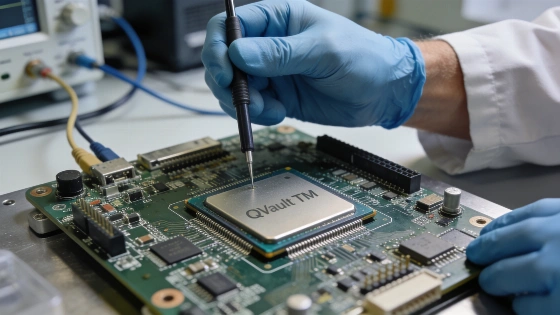
Hardware-based post-quantum cryptography has moved from theory to silicon as SEALSQ's QVault TPM chip, now with native wolfTPM software support, claims to deliver hardware-isolated quantum-resistant operations for embedded and edge devices. The integration, announced by SEALSQ Corp and wolfSSL Inc., positions the QVault TPM as a candidate for secure boot, firmware validation, and encrypted telemetry in sectors where cryptographic agility is no longer optional.
Physical Key Isolation
At the core of the QVault TPM is an 80 MHz 32-bit RISC-V secure processor, engineered to Common Criteria EAL5+ and FIPS 140-3 standards. The chip implements post-quantum cryptography (PQC) primitives-specifically, ML-DSA (FIPS 204 / Dilithium) for digital signatures and ML-KEM (FIPS 203 / Kyber) for key encapsulation-directly in hardware. Private keys for these algorithms are generated, stored, and used entirely within the chip's secure boundary, never exposed to system memory. This approach is designed to reduce the risk of side-channel attacks and key extraction, a persistent vulnerability in software-only cryptographic stacks.
Each device is shipped with pre-provisioned Endorsement Keys (EK) and signed certificate chains (RSA2048, ECC P256, ECC P384), anchored to SEALSQ's root certificate authority. This factory provisioning supports platform attestation and supply-chain integrity, but also ties device identity to SEALSQ's infrastructure, raising questions about vendor lock-in and certificate management at scale.
Software Integration and Verification
The wolfTPM software stack, now supporting QVault TPM, is available as open source and includes a diagnostic command-line tool, pqc_ctrl, for hardware self-tests and parameter verification. Developers can interact with the chip to test entropy generation, validate platform configuration registers, and exercise PQC operations across all NIST-recommended key strengths. The integration was functionally verified on physical QVault TPM silicon and wolfSSL's firmware TPM testbed, with reported successful cycles of ML-DSA signing/verification and ML-KEM encapsulation/decapsulation. However, no independent third-party benchmarks or side-channel resistance studies have been published to date.
Sampling and general hardware availability are scheduled for November 2026, with the software layer already accessible via GitHub. The timeline aligns with other industry efforts to embed quantum-resistant cryptography in silicon, as seen in recent developments from SEALSQ's own ASIC roadmap.
Target Applications and Limitations
The QVault TPM is aimed at embedded platforms where secure boot, firmware update validation, and encrypted telemetry are critical-automotive ECUs, industrial SCADA gateways, smart grid meters, telecom CPEs, and connected medical devices. The chip's compliance with the Trusted Computing Group's TPM 2.0 v1.85 specification and PC client standards positions it for integration into existing security architectures. Yet, the practical deployment of post-quantum cryptography in hardware remains constrained by the lack of field-tested side-channel resistance, the challenge of updating cryptographic primitives as standards evolve, and the operational complexity of managing hardware-based keys at scale.
While the QVault TPM's architecture demonstrates a concrete step toward hardware-enforced post-quantum security, the absence of published independent evaluations and the reliance on proprietary provisioning infrastructure mean that claims of quantum resistance should be treated as provisional. The chip's open-source software stack and diagnostic tooling are positive moves for transparency, but the real test will come with third-party cryptanalysis and operational deployment in adversarial environments. Until then, the QVault TPM represents a technically credible, but not yet fully validated, approach to post-quantum cryptography in embedded hardware.
Understanding Hardware-Isolated Cryptography
Hardware-isolated cryptography refers to the generation, storage, and use of cryptographic keys entirely within a secure hardware boundary, such as a Trusted Platform Module (TPM). Unlike software-based key management, which is vulnerable to memory scraping and side-channel attacks, hardware isolation aims to prevent private keys from ever leaving the chip. This approach is especially relevant for post-quantum cryptography, where new algorithms may have different side-channel profiles and implementation challenges. However, the effectiveness of hardware isolation depends on the chip's resistance to physical attacks, the quality of its random number generation, and the ability to update cryptographic algorithms as standards evolve. As quantum-resistant standards mature, the interplay between hardware security and cryptographic agility will remain a central engineering challenge.