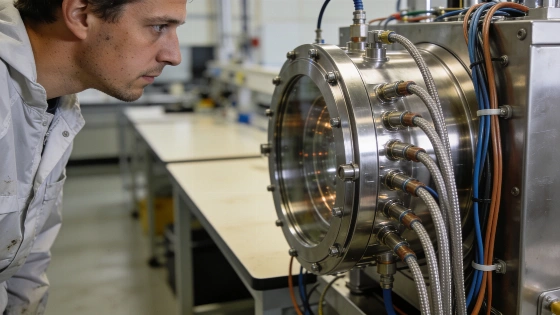
Roadrunner Quantum Lab opened on September 29, 2026, as a 35,000-square-foot Albuquerque facility linking quantum startups with Sandia and Los Alamos scientists, independent benchmarking, cryogenic testing and packaging infrastructure.
A new 35,000-square-foot facility in Albuquerque is putting quantum hardware development next to the testing infrastructure needed to determine whether laboratory devices can become reliable products. Officially launched on September 29, 2026, by New Mexico and Roadrunner Venture Studios, Roadrunner Quantum Lab opens with 15 hardware, software, sensing and capital partners and brings several competing quantum approaches into one regional site.
The facility's central technical asset is the Quantum Demonstration Facility. According to the state, Sandia National Laboratories and Los Alamos National Laboratory will help launch and operate it, providing independent expertise and support for evaluating quantum systems. The two laboratories are also among the three U.S. national laboratories responsible for supporting and maintaining the country's nuclear arsenal, a background that helps explain the emphasis on measurement discipline, engineering assurance and high-consequence technical review.
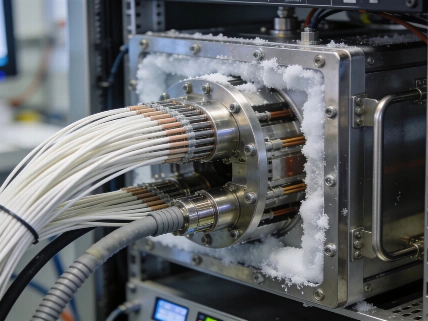
The building is designed around the physical demands of quantum hardware rather than ordinary office use. Reuters reports that it includes extra-thick concrete floors and dilution refrigerators. Heavy structural floors can help limit vibration, while dilution refrigerators provide the millikelvin-scale environments required by some superconducting and other cryogenic devices. These systems do not guarantee useful computation, but they create the conditions in which stability, noise and device behavior can be measured.
That access is structured through Cooperative Research and Development Agreements, or CRADAs. The arrangement matters because quantum companies often face a gap between building a device and proving how it performs under controlled measurement. A shared facility can provide testing capacity without requiring every startup to recreate a national-laboratory environment on its own.
Tech Hub operator Elevate Quantum is also installing open-access sub-kelvin cryogenic component testing rigs and hands-on technician training suites. The Albuquerque site operates alongside a separate low-volume quantum packaging facility, adding testing and assembly capabilities to the local infrastructure rather than limiting the project to office or laboratory space.
Roadrunner Quantum Lab is designed to accommodate neutral-atom, spin, trapped-ion, photonic and cryogenic hardware. These platforms do not share identical control systems, operating conditions or measurement methods, so placing them in a common ecosystem does not make their performance directly interchangeable. It does, however, create a setting where hardware development can be connected to characterization, packaging and workforce training.
The launch roster includes QuEra's photonics testbed, Qunnect's ABQ-Net quantum network and Maybell's dilution refrigerators. The state also reports a $4 million strategic partnership with QuEra Computing to expand testbed infrastructure. Together, these activities represent different layers of the quantum supply chain: photonic testing, network infrastructure and the ultralow-temperature systems required by some quantum devices.
The facility's 15 partners span quantum hardware, software, sensing and capital. The announcement does not provide a performance benchmark for the participating devices, a qubit count, a coherence time, a gate fidelity or a completed commercial deployment. That absence is important: the opening establishes shared infrastructure rather than demonstrating quantum advantage or a finished quantum computer.
The Quantum Demonstration Facility's role is therefore practical and evidential. Characterization tools can measure device behavior, while independent benchmarking can separate a selected laboratory result from a repeatable system-level capability. For quantum hardware, that distinction includes more than a headline metric: calibration stability, control quality, packaging, cryogenic performance, connectivity, readout and device-to-device variation all affect whether a system can operate outside a carefully tuned experiment. These are the kinds of engineering questions routinely emphasized in quantum-information work across institutions such as MIT and in peer-reviewed journals including Nature.
Sub-kelvin testing introduces its own engineering demands. A device may need to function at very low temperature while control electronics, wiring and packaging impose thermal and electrical constraints. The available announcement does not specify the rigs' cooling power, measurement protocols or target component classes, so the installation should be treated as enabling infrastructure rather than proof that those constraints have been solved.
New Mexico says the laboratory is part of a broader $450 million statewide quantum program that combines infrastructure, a capital network, workforce initiatives and other ecosystem elements. The state's official program announcement presents the Albuquerque facility as one component of a larger effort to connect research, company formation and commercialization.
The facility also fits a wider software-to-hardware story described in an earlier report, although this project is focused on physical quantum infrastructure rather than security services. Its stated purpose is to connect research, company formation and commercialization in the Southwest, not to claim that any one architecture has won the race.
Roadrunner Quantum Lab's strongest immediate contribution is organizational and experimental: it places national-laboratory expertise, startup development and specialized equipment in a shared facility. That can reduce duplication and make technical comparisons more accessible, but the opening alone cannot establish scalability, fault tolerance, useful quantum computation or superiority over classical systems.
The meaningful test will come through the measurements produced there. Independent benchmarks must show how devices perform under defined conditions and whether results hold across repeated runs and components. Until those data are available, Roadrunner Quantum Lab is best understood as a launchpad for evidence rather than evidence of a commercial quantum breakthrough.
In quantum technology, infrastructure is not a decorative addition to the experiment; it determines whether claims survive contact with calibration drift, packaging limits, cryogenic operation and reproducibility. Roadrunner Quantum Lab has assembled a setting for that scrutiny, and its value will be measured by the quality and independence of the results generated inside it rather than by the number of platforms housed under one roof.
A physical qubit is an individual controllable quantum system, while a logical qubit encodes information across multiple physical components to detect or correct errors. Nothing in the facility announcement reports logical qubits, error-correction cycles or fault-tolerant operation. Independent benchmarking can help characterize physical devices, but it cannot by itself turn a laboratory component into a protected logical processor or demonstrate a useful algorithm.