Xanadu and Bluefors announced a multi-million-dollar partnership on September 29, 2026, to develop modular cryogenic infrastructure for photonic quantum systems whose SNSPD detectors must operate near 2 kelvins.
Xanadu Quantum Technologies and Bluefors are targeting one of photonic quantum computing's least visible constraints: the infrastructure needed to cool large detector arrays. On September 29, 2026, the companies announced a strategic partnership to develop a prototype modular cryogenic system for utility-scale quantum computing. The announcement describes the collaboration as multi-million-dollar, but does not disclose an exact value. The companies' official partnership announcement presents the work as a step toward a future USQC data centre and a mass-manufacturable cryogenic module.
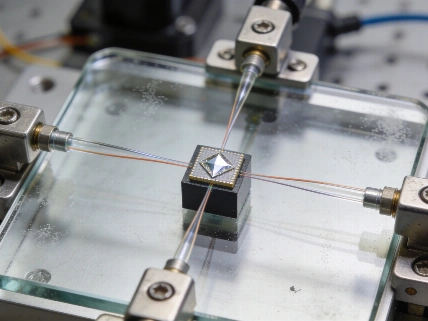
The proposed architecture separates the warm optical processor from the cold measurement layer. Xanadu's photonic quantum processing units use room-temperature components such as squeezed-light sources and interferometric phase-shifter meshes, while the detection stage depends on Superconducting Nanowire Single-Photon Detectors, or SNSPDs, designed to operate near 2 kelvins.
SNSPDs detect individual photons through the change in electrical behavior of a superconducting nanowire after photon absorption. Their operation therefore depends on maintaining a sufficiently cold and stable environment, even when optical generation, manipulation and much of the control electronics remain at room temperature. A peer-reviewed overview in Nature Photonics research established the broader scientific context for superconducting nanowire single-photon detection, while the Xanadu-Bluefors announcement supplies no new detector-performance dataset.
That arrangement creates a physical systems problem rather than a simple refrigerator specification. Large numbers of optical modes would have to connect room-temperature optical switches with detector arrays near 2 kelvins. Each connection affects thermal load, fiber routing, optical loss and the way radio-frequency and control signals enter the cold environment. In cryogenic engineering, even passive wiring and mechanical supports can conduct heat from the laboratory environment into the cold stage.
The temperature is the central number in the announcement: the SNSPD layer is intended to operate near 2 kelvins while the photonic processing hardware remains at room temperature. No detector count, cooling-power figure, fiber-loss measurement, cooldown time, prototype performance result or exact partnership value is disclosed beyond the multi-million-dollar description.
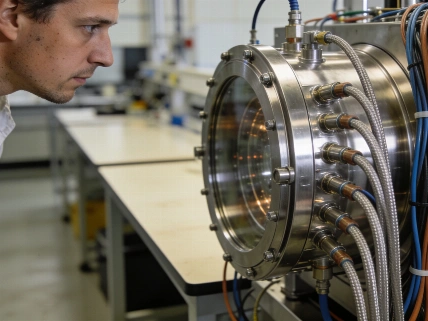
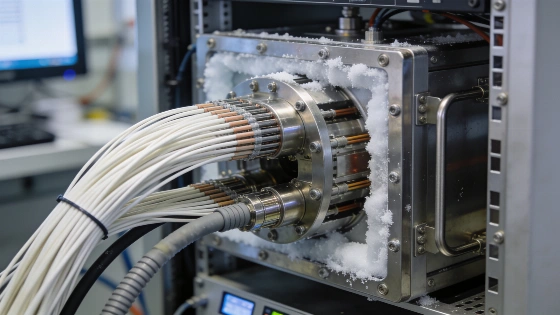
The Xanadu-Bluefors prototype is designed to place high-density optical fiber arrays and flexible radio-frequency and control cabling inside standardized cryogenic modules. The stated objective is to manage heat dissipation and packaging constraints while reducing dependence on traditional, centralized cryoplants. The public materials do not quantify the proposed module's cooling capacity, energy consumption or operating footprint.
Bluefors has previously promoted a Modular Cryogenic Platform as a basis for scalable cryogenic infrastructure. External reporting about that platform describes a claimed capacity of up to 800 kilograms of payload and as many as 32 side-loading wiring ports. Those figures describe the existing platform's published positioning; they are not measurements of the Xanadu-Bluefors prototype and should not be treated as performance results for the new project.
This is an infrastructure proposal and development effort, not a reported demonstration of a completed utility-scale data center. The announcement does not provide measurements showing how much thermal load the module handles, how many channels it supports, or how its optical interfaces perform at scale. It also does not report prototype testing, manufacturing yield or long-term stability.
The partnership connects two different engineering requirements. Photonic processors need large numbers of precisely routed optical paths, while superconducting detectors need a cold and thermally controlled environment. Combining those paths with cabling in a repeatable module could reduce dependence on a single centralized cryogenic facility, but the public disclosure does not establish that the design has already achieved this result in operational hardware.
The distinction between a compact detector module and a large cryogenic plant is familiar from other fields. CERN's accelerator infrastructure demonstrates how demanding cryogenic systems can become when cooling capacity, distribution, vibration and maintenance must be managed across a large facility. A photonic quantum data center would face a different set of constraints, but the comparison underscores why payload, heat lift, access and serviceability must be measured rather than inferred from a concept announcement.
For Xanadu, the collaboration is intended to provide an architectural foundation for a future utility-scale photonic quantum data center. It is also meant to define a standardized cryogenic rack specification that could be adopted more broadly. These are development goals rather than evidence of commercial deployment or independent industry acceptance.
The proposed modular approach matters because photonic scaling is not governed only by the number of optical modes generated or processed. Detection efficiency, optical loss, routing density, thermal leakage, vibration and control integration all affect whether a larger system can preserve usable measurement performance. Work at institutions such as MIT has repeatedly illustrated the importance of integrating photonic components with packaging and control systems, but no independent MIT evaluation of this proposed module is cited here.
A useful comparison with conventional cryogenic infrastructure is also absent. There is no reported figure for energy consumption, cooling capacity, footprint, maintenance burden or cost, and no independent evaluation is cited. The strategic disclosure therefore supports a claim about design direction rather than a verified advantage over existing cryogenic systems.
The companies' stated goal is to decouple photon-detection scaling from central cryogenic facilities and create a path toward millions of physical qubits. That language describes an intended framework; it does not demonstrate millions of qubits, logical qubits, fault-tolerant operation or a useful quantum computation.
The missing evidence is substantial. A credible utility-scale system would need reproducible data on detector-array operation, thermal performance, optical coupling, cabling density, calibration, vibration and long-term stability. It would also need to show that the modular units can be manufactured and integrated consistently rather than functioning only as a successful prototype.
The strategic disclosure can still be significant without proving those claims. Cryogenic packaging is part of the computing architecture when measurement depends on detectors near 2 kelvins, and modularization may be a necessary engineering step for photonic systems seeking much greater scale. But the partnership should be read as an attempt to solve a systems bottleneck, not as evidence that fault-tolerant quantum data centers have been built. A related account of quantum hardware commercialization appears in an earlier report, but the present announcement concerns physical infrastructure rather than quantum-safe cybersecurity.
That distinction is the important one. Xanadu and Bluefors have committed to developing a modular cryogenic blueprint whose value will depend on measurements the announcement does not yet provide. Until those results show repeatable thermal, optical and control performance, the partnership is best understood as serious infrastructure planning with a prototype in development-not as a demonstrated route to utility-scale fault-tolerant computing.
In photonic quantum hardware, physical qubits are encoded in optical modes or other photonic degrees of freedom, while detectors convert measurement events into classical signals. A system can therefore keep its processing optics warm and still require a cold detector layer. The gap between those temperatures makes routing and heat management part of the quantum architecture, not merely facility support.