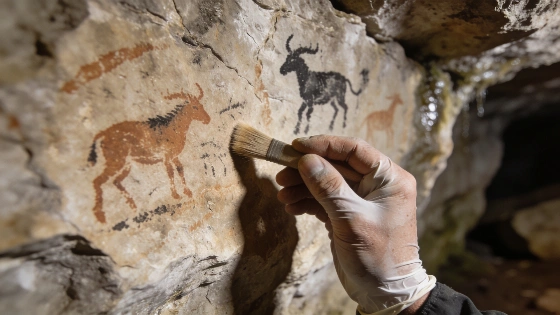
Archaeologists have identified prehistoric engravings and paintings in eight caves in southwest Ireland, potentially extending the earliest evidence for human presence on the island by 5,000 years and raising new questions about Ice Age migration routes
Prehistoric engravings and pigment traces discovered in eight caves in southwest Ireland may force a major revision of the island's human timeline. The newly identified art, including animal figures and finger markings, could indicate that people reached Ireland at least 15,000 years ago-well before the previously accepted date of first settlement.
Evidence from the Caves
The research team, working as part of the Lost Land Bridge Project, documented engravings, ochre and charcoal paintings, and finger-drawn lines on limestone and clay surfaces. Among the most recognizable images are depictions interpreted as deer and mammoth, animals known to have inhabited Ice Age environments. The art was found in eight out of 28 caves identified as promising by a computer model, which compared Irish cave characteristics to those of prehistoric sites in south Wales.
Until now, the earliest direct archaeological evidence for humans in Ireland dated to around 10,500 years ago. The new cave art, if securely dated to 15,000 years ago, would extend the known human presence by approximately 5,000 years. The precise locations of the caves are being withheld to protect the sites from potential disturbance or looting.
Researchers used digital mapping and algorithmic analysis to narrow their search, a method that allowed them to target caves with the highest likelihood of preserving prehistoric art. The project involved specialists from University College Dublin, the University of Adelaide, and collaborators in Wales, Portugal, and Dubai.
Migration and the Ice Age Landscape
The hypothesis that hunter-gatherers reached Ireland from Wales is grounded in both environmental and archaeological evidence. During the last Ice Age, sea levels were much lower, exposing a land corridor between what is now Pembrokeshire and southeast Ireland. This corridor, estimated at roughly 76 kilometers wide, would have supported grassland and large herbivores such as wild horses, bison, reindeer, and mammoth.
Archaeological evidence from south Wales documents human occupation between 35,000 and 40,000 years ago, with caves along the Gower Peninsula and other regions preserving both habitation traces and early art. The Irish cave art may represent a continuation or adaptation of these traditions, suggesting that mobile groups followed animal herds and seasonal resources across the exposed landscape.
For hunter-gatherer communities, caves offered shelter from extreme cold and a stable environment for survival. The presence of art in multiple Irish caves implies repeated visits or occupation, but the absence of older archaeological material elsewhere on the island remains a significant limitation for reconstructing the full migration route.
Dating and Interpretation Challenges
Establishing the age of the Irish cave art is critical for interpreting its significance. While the style and subject matter are consistent with Upper Paleolithic art in Britain and continental Europe, direct dating of pigments or associated deposits is needed to confirm the proposed 15,000-year age. Without radiocarbon or other absolute dating, the art's chronology remains provisional.
The variation in artistic techniques-engraving, painting, and finger fluting-offers insight into symbolic expression among late Ice Age populations. However, not all markings may have been intended as art, and some could reflect practical or incidental activity. The preservation of finger flutings, in particular, is rare and provides direct evidence of human presence inside the caves, even if their original purpose is uncertain.
Researchers caution that the absence of earlier archaeological evidence elsewhere in Ireland does not prove that people were not present. Instead, it may reflect limited preservation, sampling bias, or the destruction of older sites. The team expects that further investigation along the ancient land corridor, especially in counties Wexford, Waterford, and Cork, could reveal additional sites or even earlier evidence.
Implications for Ireland's Human Story
If the cave art is confirmed to date to the late Ice Age, it would not only push back the earliest known human activity in Ireland but also support the idea of migration across now-submerged landscapes. This scenario aligns with evidence from other parts of Europe, where hunter-gatherers moved in response to changing environments and animal migrations.
The discoveries highlight the importance of integrating digital modeling, targeted fieldwork, and multidisciplinary collaboration in archaeological research. As with the previous investigation of early Christian remains in Hungary, the combination of new methods and careful site protection is reshaping what is possible to learn from fragile archaeological contexts.
While the Irish cave art does not yet rewrite the entire narrative of human arrival, it demonstrates that the absence of evidence is not evidence of absence. The next steps-direct dating, expanded survey, and cautious interpretation-will determine whether these caves truly mark the beginning of Ireland's human story or represent one chapter in a much longer and more complex process of Ice Age migration and adaptation.
Radiocarbon dating is the primary method for establishing the age of organic archaeological material, but its application to cave art is often limited by the lack of suitable samples. Pigments such as ochre cannot be directly dated, while charcoal-based paintings may yield dates if uncontaminated material is present. In the absence of direct dating, archaeologists rely on stylistic comparison, stratigraphic association, and contextual clues, but these approaches carry greater uncertainty. Secure dating is essential for integrating new discoveries into the broader framework of human migration and cultural development.