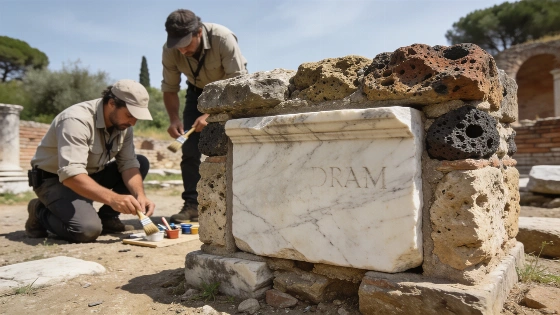
A marble inscription found at Hadrian's Villa in Tivoli records a site believed to have been struck by lightning at night, offering new insight into Roman religious practices and the physical marking of sacred ground
Archaeologists working at Hadrian's Villa in Tivoli recently uncovered a marble slab inscribed with the words "FVLGVR SVBMANIVM." This find is more than just another artifact from the Roman imperial era-it directly links a specific natural event to the religious practices of the time. The inscription marks a spot believed to have been struck by lightning, an event Romans saw as a message from the gods. The excavation, led by a team from the University of Urbino Carlo Bo and authorized by the Italian Ministry of Culture, preserved the slab in its original location within the area known as the "Amphitheatre." The team followed established archaeological protocols to document and protect the find.
Inscription and Ritual Context
The marble slab, about 40 by 35 centimeters, was found in the villa's Amphitheatre area. Unlike many inscriptions that turn up out of context, this one was still connected to a small rectangular structure built from volcanic tufa blocks and mortar. The Latin text combines "fulgur" (lightning) and "submanium," a reference to Summanus, the Roman god associated with thunder and lightning at night. This suggests the lightning strike happened at night and was formally recognized as falling under Summanus's domain. Roman religious texts often distinguish between lightning by day (attributed to Jupiter) and by night (Summanus), a distinction supported by comparative studies in the field.
Romans treated lightning as a direct sign from the gods, requiring a ritual response. Sites struck by lightning were often marked or enclosed, and sometimes the affected material was buried in a rite called fulgur conditum-the burial or concealment of lightning. The structure at Hadrian's Villa appears to be a rare surviving example of this practice, with the inscription still in its original setting. This fits with other documented cases of ritual responses to natural events in Roman Italy.
Material Evidence and Archaeological Significance
This discovery stands out because the slab was not moved or added later; it remains with the structure built to mark the strike. This allows archaeologists to study both the inscription and the physical response to the event, offering a glimpse into how Romans changed their surroundings in response to what they saw as divine intervention. The excavation team used detailed stratigraphic analysis and architectural documentation to record the find.
Hadrian's Villa, built in the second century CE as an imperial retreat, is known for its grand architecture and sprawling grounds. Yet this modest marker shows that even in an emperor's residence, a single lightning strike could lead to the creation of a sacred space. The slab's survival in its original context is especially valuable, since many similar inscriptions have been found without their associated structures, making them harder to interpret.
Other ritual responses to lightning have been found elsewhere in Roman Italy. At San Casciano dei Bagni, for example, a bronze lightning bolt and flint arrow were deposited in a sanctuary, likely as part of the same fulgur conditum tradition. Finds like these, along with the evidence from Hadrian's Villa, help clarify how Romans responded to extraordinary natural events. For more on this topic, see this Discover Magazine feature.
Interpreting the Evidence
The inscription's mention of Summanus, rather than Jupiter, matters. Roman religion made a clear distinction: lightning by day was Jupiter's domain, while lightning at night belonged to Summanus. The explicit reference to nocturnal lightning in this inscription is a rare confirmation of that belief in the archaeological record, not just in written sources.
While the slab and structure provide strong evidence for ritual marking of the strike site, some details remain unclear. It's not possible to say exactly when the structure was built or to date the event itself from the inscription alone. The materials used match the villa's broader architecture, but without direct dating, the timeline of the ritual response is still open to further study. Such gaps are common in archaeology.
Material evidence for ritual responses to unusual events is often incomplete. The survival of both the inscription and its architectural context at Hadrian's Villa allows for a more detailed interpretation than is possible at sites where only texts or isolated artifacts remain. This approach is similar to recent discoveries elsewhere, where the association of objects and structures has shed new light on ancient practices.
Limitations and Broader Implications
The find at Hadrian's Villa does not reveal the full range of rituals performed after the lightning strike, nor does it show how often such events were commemorated in the Roman world. The evidence is limited to a single inscription and its structure, with no human remains or additional ritual deposits reported from the immediate area. The interpretation of the site as a fulgur conditum is supported by the inscription and its context, but could change if new evidence comes to light.
Still, the discovery shows that Roman religious responses to natural events were not limited to literary tradition or major temples. They could leave lasting marks on the landscape, even within an emperor's private estate. The slab at Hadrian's Villa is a reminder that the boundaries between natural events, religious meaning, and built environment were actively negotiated and physically recorded in Roman society. The value of this evidence lies in its secure archaeological context, which helps ground interpretation and avoids overstating what a single artifact can tell us about the past.
Inscriptions like FVLGVR SVBMANIVM are part of a broader pattern of Roman engagement with unpredictable forces of nature. Their survival in context lets archaeologists move beyond general claims about belief and ritual, and instead trace the concrete ways extraordinary events shaped the ancient world.
Understanding the archaeological context of inscriptions and ritual structures depends on careful attention to provenance. An object found in place, with clear links to architectural features and stratigraphic layers, provides stronger evidence than one recovered without context. Secure provenance allows researchers to reconstruct the sequence of actions that led to the deposition of an artifact or the construction of a monument, clarifying the relationship between material evidence and historical interpretation. In the case of the Hadrian's Villa inscription, the survival of both the slab and its associated structure offers a rare chance to see how Romans responded materially to events they saw as divine intervention, while also highlighting the limits of what even the best-preserved finds can reveal.