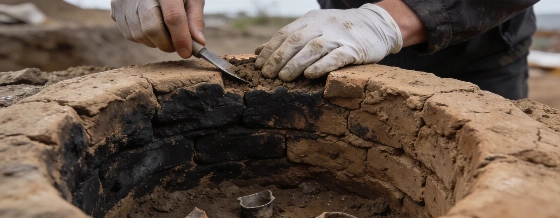
An approximately 850-square-metre workshop complex in western Dortmund preserves kilns, hearths and pits dating from the 1st to the 5th centuries CE, offering rare evidence of organized Germanic craft production and possible Roman-metal reuse.
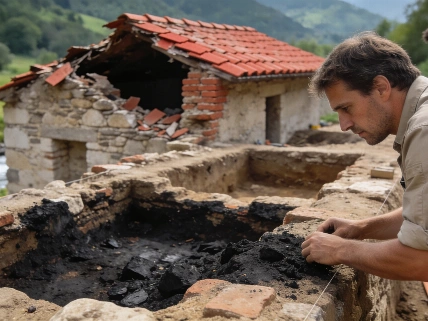
Crucibles and specially built kilns at a workshop complex in western Dortmund provide rare physical evidence for Germanic communities processing metal beyond the Roman Empire's Rhine frontier. The excavation also revealed hearths, pits and the first pottery kiln documented in this part of the western Germanic settlement area. Together, the features allow archaeologists to investigate the organization of production rather than infer it only from finished objects.
The settlement was used between the 1st and 5th centuries CE. That broad chronological span indicates repeated or layered use of the site, not necessarily uninterrupted operation of every kiln and workshop. Individual structures will need to be assigned to separate phases through stratigraphy, associated finds and laboratory study.
Excavation director Dr Eva Cichy of LWL Archaeology for Westphalia described the metalworking workshops as exceptionally well preserved. This condition is scientifically important because craft installations usually survive less completely than domestic structures or finished artefacts. The Dortmund remains may preserve relationships among furnaces, working surfaces, waste deposits and access routes that are normally lost.
The discovery has been presented as the first documented pottery kiln of this type in the western Germanic settlement area. That priority applies to the identified combination of a pottery kiln and unusually well-preserved metalworking facilities; it does not mean that no other ancient craft activity existed elsewhere in the region. The excavation report also indicates that the archaeological work was still continuing when the findings were announced, with further recovery planned at least through the following week. These details are summarized in the WDR excavation report.
At Dortmund, scrap metal appears to have been placed in crucibles inside round or oval clay-lined kilns. Bellows could have supplied additional air through the sides of such structures, helping workers reach and control the temperatures required for metalworking. The excavated features demonstrate production activity, but they do not yet establish how much metal was processed, which Roman objects supplied it or what finished products were made.
This distinction matters archaeologically. Roman objects found in a settlement can indicate exchange, raiding, migration or diplomatic contact; a melting installation adds evidence for deliberate material recovery and technological transformation. It still cannot show that all Germanic communities recycled Roman metal in the same way, nor that the practice remained unchanged across the four-century chronological range.
The find has been described by Tobias Zacharias of Dortmund City Archaeology as having supra-regional importance because it addresses a gap in the physical record. The assessment is strongest when limited to the documented production complex: the kilns connect the circulation of Roman material with local manufacturing practice. Broader claims about centralized authority, regional markets or the scale of metal supply will require additional excavation and compositional analysis.
Removing the best-preserved kiln in its entirety for eventual public display is also a scientific conservation decision. An intact recovery can retain relationships among the clay walls, firing chamber and surrounding deposits that would be difficult to reconstruct from scattered fragments. Conservation will therefore help preserve both the structure and the contextual evidence needed for later study.
The investigation fits a wider archaeological pattern. A related Roman site in southern Switzerland has produced evidence of metalworking waste, but the Dortmund discovery addresses a different question: how communities beyond Roman political control processed materials that originated inside the empire.
Future work may combine ceramic petrography, metallographic examination and chemical analysis of residues. Such methods can distinguish production debris from naturally occurring sediment and may help identify similarities between metal artefacts and ores or recycled alloys. The excavation team has not yet published a complete analytical dataset, so no statistical estimates, confidence intervals or definitive provenance assignments can currently be attached to the Dortmund materials.
That analytical caution follows the broader standards of materials research associated with the Max Planck Society and peer-reviewed journals such as Nature, where interpretations are normally separated from directly measured results. For Dortmund, the secure evidence is the spatially concentrated group of hearths, pits and kilns, together with the exceptionally preserved metalworking area and the pottery kiln.
What the complex establishes is not a complete economic history but a well-defined technological setting. Its kilns and crucibles show that metal could enter a new production cycle among Germanic communities, while the pottery kiln demonstrates that several craft activities were represented on the same approximately 850-square-metre site. Further phasing and laboratory study will determine how these activities related to one another over time.
In archaeology, a chronological range such as the 1st to 5th centuries CE describes the period represented by a site rather than the exact age of every feature. Individual structures must be related to their deposits and associated finds through excavation and stratigraphic analysis. Because separate dates for each kiln have not yet been reported, the possibility remains that metalworking, pottery production and other activities changed substantially between different phases of occupation.