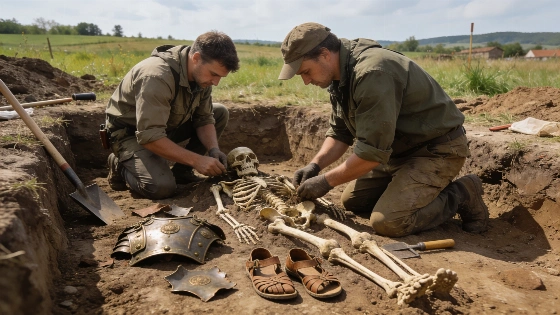
Archaeologists have identified a large Roman military camp near Šurany, Slovakia, containing hastily buried remains of soldiers and military equipment, offering new evidence for Roman campaigns during the Marcomannic Wars
A recently excavated Roman military camp near Šurany in southwestern Slovakia has provided rare insight into the realities of Roman frontier warfare in the late second century CE. Archaeologists from the Institute of Archaeology at the Slovak Academy of Sciences, working with MH Invest, uncovered the remains of a substantial temporary encampment, likely established during the Marcomannic Wars under Marcus Aurelius. The site, covering approximately 7.4 hectares (18.2 acres), is only the second Roman military installation identified in western Slovakia, and its preservation offers an unusual opportunity to examine the aftermath of conflict along the empire's northern border.
Excavation and Site Features
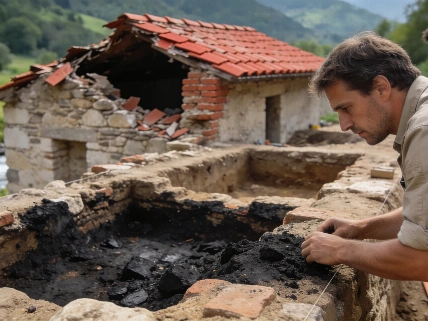
The Šurany camp displays clear defensive architecture, including five entrance gates, a system of ditches and ramparts, and evidence of rapid construction and abandonment. The camp's layout is consistent with Roman marching or legionary camps, designed for mobility and short-term occupation during military campaigns. Archaeologists documented a range of features associated with Roman military presence, such as fortifications and internal organization, but the most striking finds were the numerous human remains recovered from shallow graves, ditches, and wells within the camp perimeter.
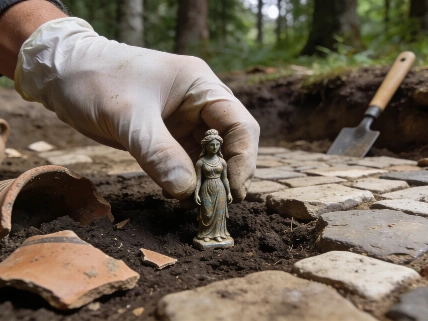
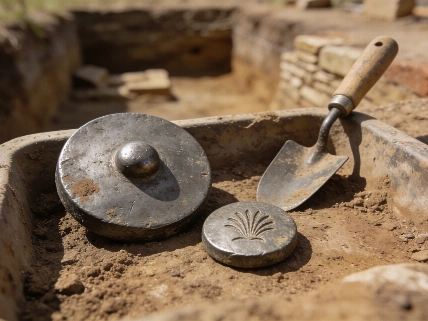
Preliminary analysis suggests that most of the individuals were Roman soldiers, based on the presence of military equipment and personal items found with the skeletons. Artifacts recovered include spearheads, arrowheads, fragments of helmets, pieces of segmented and scale armor, legionary brooches, coins, and the iron-nailed soles of caligae-distinctive Roman military sandals. X-ray analysis of clay blocks revealed intact sandal nails, now undergoing further laboratory study to assess their preservation and possible individual identification.
Burial Context and Preservation
The burial context at Šurany is highly unusual for Roman military sites. Many skeletons and partial remains were found in positions suggesting hurried or improvised burial, with some bodies deposited in wells or storage pits rather than formal graves. The reasons for this treatment remain uncertain. Possible explanations include rapid abandonment following combat, disease outbreak, or logistical constraints during retreat. The presence of intact military equipment with the bodies raises questions about why the remains were not looted or recovered by surviving forces.
Archaeologists have begun detailed laboratory analyses, including genetic and isotopic studies, to clarify the origins, health, and possible causes of death for the individuals recovered. The scale of the site and the volume of material mean that comprehensive results will require years of multidisciplinary research. Comparable discoveries of Roman military burials in frontier contexts are rare, but similar patterns of hasty burial and commingled remains have been documented elsewhere in the Roman world, such as in the mass grave of Roman-era soldiers beneath a soccer field in Vienna, as discussed in .
Chronology and Historical Context
The camp is dated to the period of the Marcomannic Wars (166-180 CE), a series of conflicts between the Roman Empire and Germanic groups living north of the Danube River. Marcus Aurelius, who ruled from 161 to 180 CE, personally led campaigns in this region to secure the empire's frontier. The wars ended with his death and the subsequent peace negotiated by his son Commodus. The archaeological evidence at Šurany aligns with historical accounts of temporary Roman encampments established during these campaigns, but the rapid abandonment and unusual burial practices suggest a chaotic or crisis-driven episode rather than routine military withdrawal.
Among the measurable findings, the site covers 7.4 hectares and includes at least five entrance gates and multiple defensive ditches. The number of individuals recovered has not yet been finalized, but the presence of both complete and partial skeletons, along with associated military artifacts, indicates a significant loss of life within a short period. The preservation of footwear, armor, and personal items provides rare material for reconstructing the lived experience of Roman soldiers on the frontier.
Ongoing Research and Uncertainties
Laboratory work is ongoing to determine the biological profiles of the individuals, including age-at-death, sex estimation, health status, and possible geographic origins through isotopic and ancient DNA analysis. The cause of death for most individuals remains undetermined, with both combat trauma and epidemic disease considered plausible. The lack of systematic looting or recovery of equipment may reflect the speed of abandonment or the dangers faced by any survivors.
Researchers emphasize that the full interpretation of the Šurany camp will depend on continued excavation, laboratory analysis, and comparison with other Roman military sites in Central Europe. The discovery contributes to a growing body of evidence for the complexity and variability of Roman military operations beyond the empire's formal borders, and highlights the challenges of reconstructing events from incomplete and sometimes ambiguous archaeological records.
Understanding the context of mass or unusual burials in archaeology requires careful attention to taphonomy-the processes that affect remains after death and burial. Factors such as soil chemistry, waterlogging, animal activity, and human intervention can alter the preservation and appearance of skeletons and artifacts. In cases like Šurany, distinguishing between deliberate burial practices, emergency responses to crisis, and post-depositional disturbance is essential for interpreting the archaeological record. Laboratory methods including ancient DNA, isotopic analysis, and radiocarbon dating can help clarify individual histories, but the broader social and historical context must be reconstructed from a combination of material evidence and critical engagement with historical sources.