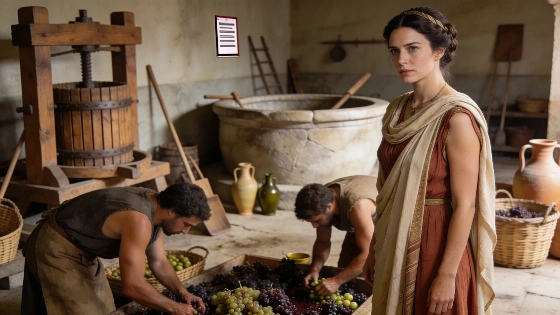
A new analysis of Roman-era texts and archaeological evidence reveals that women known as vilicae managed large-scale wine and olive oil production, challenging the long-held view that their roles were limited to domestic tasks
Recent research into Roman agricultural texts and archaeological findings has prompted a reassessment of the roles played by women on ancient Roman farms. Contrary to the traditional interpretation that female farm managers, or vilicae, were primarily responsible for household duties, new evidence suggests they held significant authority over the production of key agricultural commodities, including wine and olive oil.
Textual Evidence and Misinterpretation
Roman agricultural manuals, particularly those authored by Lucius Junius Moderatus Columella in the 1st century CE, provide detailed accounts of farm management. Columella distinguishes between the vilicus (male manager) and vilica (female manager), both of whom were often enslaved and tasked with overseeing the villa's operations. While earlier historians focused on Columella's citation of the Greek philosopher Xenophon-who described elite women as confined to domestic supervision-Columella himself repeatedly clarifies that these Greek ideals do not reflect Roman agricultural practice.
Columella's own instructions for the vilica emphasize her responsibility for supervising the harvest, extracting grape juice, adding preservatives and flavorings, and ensuring successful fermentation. The vilica was also tasked with processing olives into oil, a labor-intensive and economically vital activity. These duties extended beyond the household, involving the management of large-scale production facilities and coordination of labor.
Material Evidence and Scale of Production
Archaeological investigations at Roman villa sites have uncovered substantial wine and oil production installations, some capable of processing between 50,000 and 100,000 liters annually. The scale of these operations required skilled oversight, and the vilica's role in managing these processes is supported by both textual and material evidence. Legal documents from the 1st century BCE, such as those attributed to the jurist Trebatius, include the vilica among the essential personnel required for productive estate work, further indicating her integration into the economic core of Roman agriculture.
Additional references in the writings of Cato the Elder, dating two centuries before Columella, list both male and female managers as necessary staff for vineyards and olive farms. While Cato's descriptions are brief, they include tasks such as poultry keeping and the processing of seasonal produce, as well as the maintenance of workspaces-responsibilities that align with estate management rather than purely domestic service.
Ritual Duties and Visual Depictions
Roman agricultural practice also involved ritual obligations. Columella and Cato both assign the vilica the duty of making offerings to the gods to secure agricultural abundance. Archaeological evidence, including altars found in wine-making buildings and mosaics depicting women performing sacrifices, supports the integration of ritual and production roles. One mosaic from Sicily shows a woman presenting garlands at an altar, accompanied by a jug for wine offerings and a male figure, possibly representing the vilica and vilicus together.
Visual representations of women overseeing agricultural labor are rare but not absent. A fragmentary wall painting from Rome appears to show a female figure supervising wine production, consistent with Columella's account. These images, while limited, provide additional support for the interpretation that vilicae were active participants in the productive and ritual life of Roman estates.
Reconsidering Gendered Labor in Roman Agriculture
The combined textual, legal, and archaeological evidence challenges the longstanding assumption that Roman women on farms were confined to domestic roles. Instead, vilicae emerge as key figures in the management of agricultural production, with responsibilities that included technical oversight, labor coordination, and ritual practice. The absence of first-person accounts from vilicae limits our understanding of their experiences, but the available evidence suggests a more complex and economically significant role than previously recognized.
This reevaluation of gendered labor in Roman agriculture parallels debates in other ancient contexts, such as the interpretation of musculoskeletal changes in Egyptian royal women, where activity patterns are inferred from physical and textual evidence. For example, analysis of upper-body muscle attachments in Middle Kingdom Egypt has raised questions about the range of activities performed by elite women, as discussed in this related report.
Understanding the vilica's role requires careful attention to both the limitations and strengths of the available evidence. While direct testimony is lacking, the convergence of written records, legal texts, and archaeological remains provides a foundation for a revised interpretation of women's work in the Roman rural economy.
In Roman agricultural studies, the term vilica refers to a female manager responsible for overseeing estate production. Unlike modern job titles, ancient terms often encompassed a range of duties that crossed domestic, technical, and ritual boundaries. Interpreting these roles requires contextual analysis of both textual sources and material evidence, as well as an awareness of how later historians' assumptions can shape our understanding of the past. The vilica's example illustrates the importance of integrating multiple lines of evidence when reconstructing ancient labor and social organization.