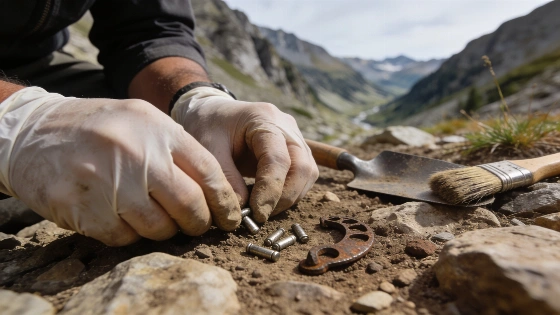
Archaeologists have identified a Roman military camp in the eastern Pyrenees using lead sling bullets and other artifacts, revealing evidence of a violent local uprising against Roman forces in 39 BCE in what is now Catalonia, Spain
Archaeological fieldwork in the eastern Pyrenees has uncovered a Roman military camp dating to 39 BCE, providing new evidence for a local revolt against Roman occupation in the region now known as Cerdanya, Catalonia. The discovery centers on dozens of lead sling bullets, iron sandal studs, brooches, and coins, all recovered from the alpine pass of Collet de Jovell. These finds offer a rare glimpse into the material realities of Roman military presence and local resistance during the late first century BCE.
Material Evidence of Conflict
The most significant artifacts are the lead sling bullets, some of which bear the stamped initials CND, identifying the Roman governor Gnaeus Domitius Calvinus. This numismatic evidence, combined with the typology of the bullets and associated coins, allows researchers to date the camp and the conflict to 39 BCE. The bullets were likely cast on site, a practice that enabled Roman soldiers to rapidly produce ammunition during campaigns. The presence of these projectiles, scattered across the camp area, is interpreted as evidence of a sudden attack-consistent with historical accounts of an ambush by the Indigenous Ceretani people, who had resisted Roman expansion for generations.
In addition to the sling bullets, archaeologists recovered iron studs from Roman military sandals (caligae), fibulae used to fasten clothing, and several Roman coins. The combination of these artifacts supports the identification of the site as a temporary Roman encampment rather than a permanent settlement. The spatial distribution of the finds suggests a rapid, possibly chaotic, abandonment of the camp, likely in response to a surprise assault.
Context and Chronology
The Roman conquest of the Iberian Peninsula was a protracted and often violent process, with local populations such as the Ceretani mounting repeated resistance. Historical sources, including the Roman historian Cassius Dio, describe a Ceretani revolt in 39 BCE, but until now, the precise location of these events remained uncertain. The new archaeological evidence from Collet de Jovell situates the conflict firmly within Ceretani territory, challenging previous assumptions that the revolt occurred further west.
Numismatic analysis of the coins and stamped sling bullets provides a secure chronological anchor for the site. The initials CND correspond to Gnaeus Domitius Calvinus, who governed Hispania during the relevant period. This direct association allows for unusually precise dating of the camp and the associated conflict. The recovery of multiple artifact types in a single context strengthens the interpretation of the site as a Roman military installation rather than a later or unrelated occupation.
Aftermath and Historical Implications
While the archaeological evidence points to a violent encounter, it also reveals the limitations of the Roman military presence in the region. According to historical accounts, the Ceretani revolt ultimately failed, and Roman reprisals were severe. However, the material record at Collet de Jovell suggests that Roman forces were not always able to maintain control, and that local resistance could disrupt even well-organized military operations. The discovery of abandoned equipment and ammunition indicates that some Roman soldiers may have fled the camp during the attack, a possibility supported by written sources describing disciplinary measures against troops who retreated under pressure.
This new evidence from the Pyrenees complements recent research on Roman military campaigns elsewhere in Iberia. For example, the identification of an extensive Roman siege network at La Loma, as reported in a recent Science Report analysis, highlights the scale and persistence of Roman efforts to subdue local populations. Together, these findings underscore the complexity and violence of Roman expansion in the western Mediterranean.
Interpreting the Archaeological Record
The Collet de Jovell site provides a rare opportunity to study the immediate aftermath of a military ambush through its material remains. The concentration of sling bullets, iron studs, and coins in a confined area suggests a brief but intense episode of conflict. However, the absence of human remains or clear evidence of casualties limits the ability to reconstruct the full sequence of events. The interpretation of the site as an ambushed Roman camp is supported by both the archaeological context and historical sources, but alternative explanations-such as a hurried withdrawal for other reasons-cannot be entirely excluded without further excavation and analysis.
Preservation conditions in the alpine environment have favored the survival of metal artifacts, but organic materials and human remains are less likely to be recovered. As a result, the evidence is weighted toward durable objects, which may not fully represent the range of activities or the scale of the conflict. Ongoing research aims to clarify the extent of the site and to recover additional data that could refine the interpretation of this episode in Roman-Ceretani relations.
Numismatic evidence plays a crucial role in dating and interpreting archaeological sites from the Roman period. Coins and stamped objects, such as sling bullets, often bear the names or initials of officials, allowing for precise chronological placement when matched with historical records. However, the presence of such artifacts does not always guarantee that the associated events can be reconstructed in detail. Archaeologists must balance the strengths of material evidence with the limitations imposed by preservation, context, and the fragmentary nature of the historical record.