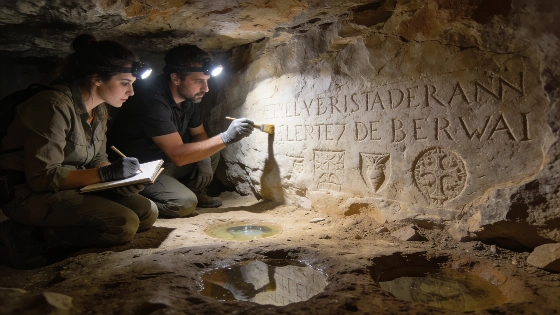
Archaeologists have recorded more than 120 Latin inscriptions in Cova de les Dones, a cave sanctuary near Valencia, Spain, revealing evidence of a Roman-period cult focused on a mysterious goddess known as 'the Lady.'
Recent excavations at Cova de les Dones, an underground site near Valencia in eastern Spain, have uncovered the largest known concentration of Latin inscriptions from the Roman Empire. Archaeologists documented over 120 inscriptions, most dating to the first and second centuries CE, within a deep chamber of the cave. This discovery expands the previously known set of 15 inscriptions recorded at the site in 2024, offering new insight into ritual activity during the Roman period.
Evidence from the Cave Sanctuary
The inscriptions were found on the walls and ceilings of a secluded chamber, which researchers have identified as a Roman-period sanctuary. The texts are concentrated in a specific area away from the cave entrance, suggesting deliberate organization and restricted access. Among the 120 inscriptions, five refer to a previously undocumented goddess, addressed as Domina-Latin for 'the Lady.' Three of these also include the name 'Malaci,' which may represent an epithet or local aspect of the deity, though its precise meaning remains under study.
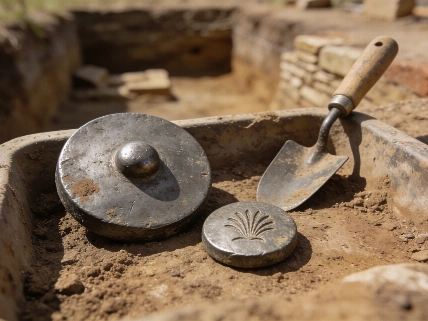
Material evidence from the sanctuary includes chalice-shaped vessels, two rings, a bracelet, ceramic fragments, and plant remains. Notably, spindle whorls-tools associated with textile production-were also recovered, pointing to the involvement of women in the cave's ritual activities. Several inscriptions contain female names, further supporting the interpretation that women played a central role in the cultic practices at the site.
Interpreting the Goddess 'the Lady'
The identity and attributes of 'the Lady' remain uncertain. Preliminary analysis suggests a possible association with water, as the sanctuary chamber contains small natural pools, known as gours, that collect groundwater. Archaeologists observed that offerings appear to have been deposited in these pools, but it is not yet clear whether these were dedicated exclusively to 'the Lady' or to other deities. The presence of both inscriptions and offerings in a controlled context supports the interpretation of an organized cult, but the full range of beliefs and practices remains to be established.
While the inscriptions provide direct evidence of ritual activity, their content is still being deciphered. The majority of texts are brief, and only a small subset explicitly mention 'the Lady.' Researchers caution that further analysis is needed to clarify the goddess's role and the nature of her worship. The cave's archaeological sequence also includes more than 100 Paleolithic paintings and engravings, some over 24,000 years old, indicating that Cova de les Dones has served as a significant site for human activity across multiple periods.
Context and Comparative Evidence
The scale of inscriptional evidence at Cova de les Dones is unique within the Roman Empire, with no other known sanctuary yielding as many Latin texts in a single context. The inscriptions and associated artifacts suggest a localized cult with a strong female presence, but the absence of comparable finds elsewhere limits broader interpretation. The cave's continuous use, from the Paleolithic through the Roman period, raises questions about the persistence of ritual traditions and the adaptation of sacred spaces over time.
Archaeologists emphasize that the findings are preliminary and that ongoing analysis of the inscriptions and material assemblage may reveal additional details about the cult and its participants. The research at Cova de les Dones adds to a growing body of evidence for diverse ritual practices in Roman Iberia, complementing discoveries such as the recently identified merchant shipwreck off Andros, which has provided new data on Aegean trade networks (see coverage of the Andros shipwreck).
Deciphering Ancient Inscriptions
Latin inscriptions from archaeological contexts are valuable for reconstructing aspects of ancient belief, language, and social organization. However, interpretation depends on preservation, legibility, and context. In the case of Cova de les Dones, the concentration of texts in a restricted area, their association with ritual objects, and the presence of female names provide a rare opportunity to study the intersection of gender and cult in the Roman world. Yet, the brevity of most inscriptions and the lack of detailed narrative content mean that many questions about the goddess 'the Lady' and her worshippers remain open.
Understanding ancient inscriptions requires careful documentation, transcription, and, where possible, translation. Damage, erosion, and incomplete texts can limit interpretation, and the meaning of names or epithets may be lost without comparative evidence. Archaeologists must balance direct observation with cautious inference, recognizing that even a large assemblage of inscriptions may not capture the full complexity of ancient ritual life.