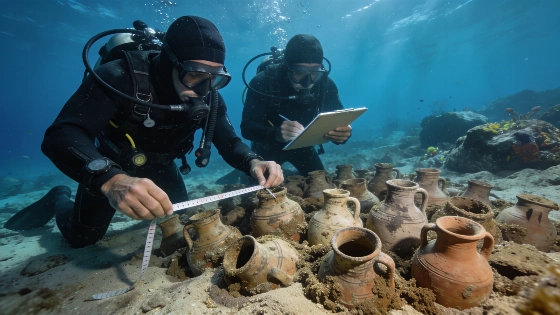
Archaeologists have identified a late Classical period merchant shipwreck off Andros, Greece, containing over 600 amphorae. The find offers new evidence for Aegean maritime trade and cargo transport in the 5th-4th centuries BCE.
The remains of a merchant vessel dating to the late Classical period have been discovered off the coast of Andros, a Greek island in the Aegean Sea. The shipwreck, located at a depth of 39 to 44 meters, was identified by the Ephorate of Underwater Antiquities of the Hellenic Ministry of Culture following a report from a private individual. Underwater investigation revealed a substantial cargo of ceramic amphorae, providing a rare opportunity to examine commercial maritime activity in the region during the late 5th and early 4th centuries BCE.
Amphorae Cargo and Site Context
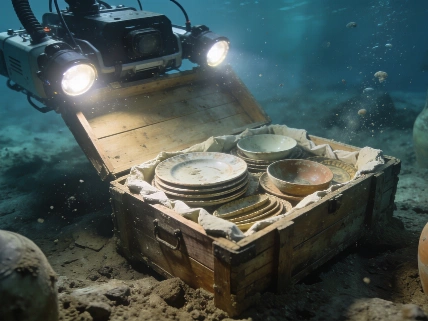
Archaeologists documented between 600 and 650 amphorae scattered across the seabed, most of which are pointed-bottom commercial types commonly used in antiquity for transporting wine, olive oil, and agricultural products. The amphorae were found in association with part of a lead anchor stock and several stones interpreted as possible ballast, suggesting the vessel was engaged in regional trade. The cargo's composition and preservation offer a valuable dataset for understanding the scale and organization of maritime commerce in the Classical Aegean.
Initial assessment of the amphorae's typology and manufacturing features places the shipwreck securely within the late Classical period. The site's depth and the distribution of artifacts indicate that the wreck has remained relatively undisturbed, although further investigation will be required to determine the full extent of preservation and any post-depositional changes.
Research Methods and Ongoing Analysis
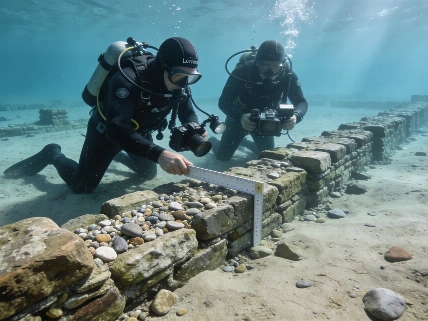
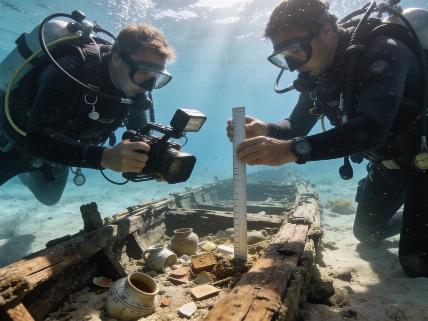
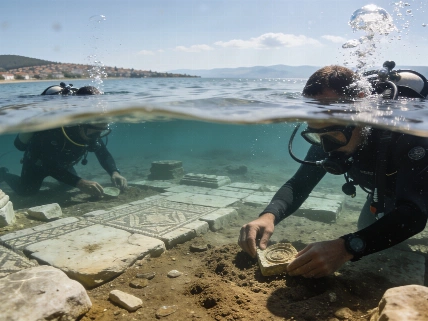
The underwater survey was conducted by a team from the Ephorate of Underwater Antiquities, including diving archaeologists and technical specialists. Documentation involved in situ mapping, photographic recording, and selective recovery of diagnostic artifacts. The amphorae's typological analysis, combined with the identification of anchor and ballast materials, provides the primary basis for dating and interpreting the wreck. No direct radiocarbon dating has yet been reported, and the chronological assignment relies on ceramic typology and comparative material from securely dated contexts.
Researchers anticipate that further study of the amphorae's origin, residue analysis, and potential inscriptions could clarify the ship's route and the nature of its cargo. The discovery adds to a growing body of evidence for complex trade networks in the Aegean during the Classical period, complementing recent finds such as the recovery of Byzantine-era shipwrecks in the Adriatic, which have also contributed to our understanding of maritime exchange and elite mobility across the region. For example, the identification of gold regalia and imperial artifacts in a Croatian shipwreck has provided new perspectives on trade and travel in later periods (see this related analysis).
Implications for Aegean Maritime Trade
The Andros shipwreck represents one of the most significant underwater discoveries in the Aegean in recent years, both for the quantity of preserved amphorae and for the potential to reconstruct aspects of Classical-period trade. The concentration of commercial amphorae suggests a cargo intended for bulk transport, likely between regional production centers and urban markets. The presence of anchor and ballast materials provides additional evidence for the vessel's construction and navigation practices.
While the amphorae's typology points to a late 5th or early 4th century BCE date, further analysis will be necessary to determine the precise origin of the ceramics and the commodities they once contained. The site's relatively undisturbed condition offers an opportunity for systematic study, but researchers caution that interpretation remains provisional until more detailed excavation and laboratory analysis are completed.
Underwater archaeology in the Aegean continues to reveal new evidence for the organization, scale, and risks of ancient maritime trade. The Andros shipwreck, with its large cargo of amphorae, provides a material record of the economic and logistical systems that connected communities across the Mediterranean during the Classical era.
Amphorae are a key artifact type in the study of ancient trade and economy. These ceramic containers, often standardized in shape and size, were used throughout the Mediterranean for transporting liquids and bulk goods. Typological analysis of amphorae allows archaeologists to identify production centers, trade routes, and chronological frameworks. However, the absence of direct dating or inscriptions can limit the precision of such reconstructions, and post-depositional processes may affect the preservation and context of amphorae on shipwreck sites.