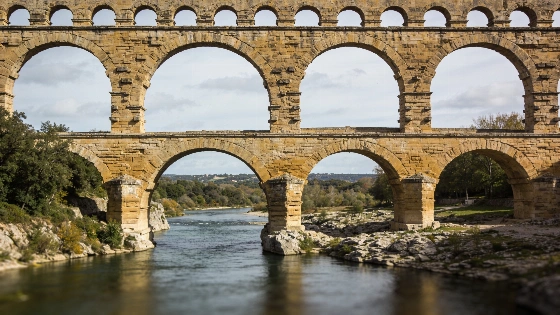
Archaeologists have traced the construction and survival of Roman aqueducts using evidence from preserved structures, ancient surveying tools, and maintenance records, revealing how these monumental water systems functioned and endured for centuries
Remnants of Roman aqueducts still dominate landscapes from France to Turkey, but their survival is not simply a testament to ancient ambition. The continued function of systems like the Aqua Virgo-still supplying water to Rome after more than two thousand years-demonstrates a combination of technical precision, material innovation, and ongoing human intervention that few ancient infrastructures can match.
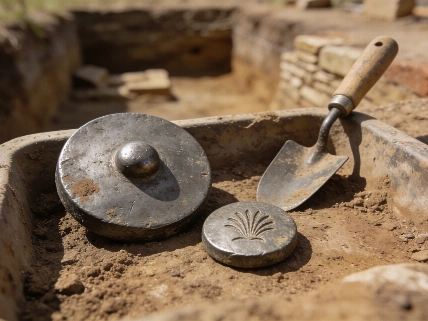
Roman aqueducts were not uniform in design or construction. Some, such as the aqueduct of Valens, stretched over 400 kilometers to reach Constantinople, while others ran mostly underground or relied on arches to cross valleys and rivers. The choice of route was dictated by the need for a consistent, gentle gradient, allowing gravity to move water from source to city. Surveyors used specialized instruments, including the dioptra-a disc with a sighting bar-and the libra, which employed a plumb bob, to measure elevation changes and plot the most stable and efficient paths. These tools enabled Roman engineers to avoid unstable geological formations, such as volcanic zones, and to minimize the risk of structural failure.
Materials and Construction
The durability of Roman aqueducts owes much to their distinctive concrete, which incorporated volcanic ash known as pozzolan. This mixture, combined with lime and water, produced a hydraulic concrete that hardened even underwater and resisted decay far longer than most modern equivalents. The use of this material was especially critical in bridges, arcades, and other exposed elements, where environmental stress was greatest. However, material alone did not guarantee longevity. The selection of stable ground, careful avoidance of geological hazards, and the construction of underground channels in challenging terrain all contributed to the preservation of these structures.
Quantitative estimates from archaeological studies provide a sense of the scale involved. The Hadrianic aqueduct in Athens, for example, extended approximately 20 kilometers and may have required a workforce of around 500 people over a 15-year period. Maintenance was not a minor concern: in Rome itself, hundreds of workers were employed to keep the aqueducts operational, while smaller towns could manage with a dozen or so. These figures highlight the sustained investment of labor and resources necessary to maintain water supply across the empire.
Maintenance and Adaptation
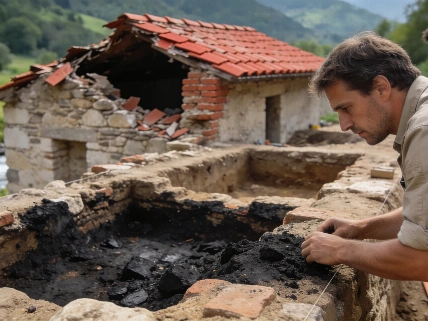
Preservation of Roman aqueducts was not a passive process. Carbonate deposits, formed as minerals precipitated from flowing water, regularly accumulated inside channels. Archaeological research at sites such as Divona in France has documented how maintenance crews scraped away these deposits and replastered the conduits to restore flow. In some cases, workers simply applied new plaster over old deposits, a practice that left layered evidence for modern investigators. The frequency and thoroughness of such interventions varied, but the principle remained: without regular upkeep, even the best-engineered aqueduct would eventually fail.
As water approached urban centers, it often passed through settling basins designed to remove sediment and visible contaminants. These basins allowed heavier particles to sink before the water continued to distribution tanks and, ultimately, to public fountains, baths, and private homes. The integration of filtration and sedimentation into the aqueduct system reflects a sophisticated understanding of water management, not just transport.
Evidence and Uncertainty
While the physical remains of aqueducts are among the most visible Roman monuments, the archaeological record is uneven. Some systems, like the Pont du Gard in France, are exceptionally well preserved, while others survive only as fragmentary traces. Written records and technical treatises supplement the material evidence, but gaps remain in our understanding of construction logistics, labor organization, and the precise chronology of repairs. Comparative studies, such as those referenced in reported earlier, show that the survival of monumental architecture often depended as much on later reuse and adaptation as on original design.
Despite these uncertainties, the archaeological consensus is clear on several points. Roman aqueducts were not static relics but dynamic systems, shaped by ongoing human intervention and adaptation to local conditions. Their endurance is not evidence of lost ancient genius but of a pragmatic approach to engineering, maintenance, and resource allocation that prioritized function over spectacle. The lesson for modern infrastructure is not to romanticize the past, but to recognize that durability depends as much on sustained care as on initial construction.
Understanding the archaeological context of Roman aqueducts requires attention to both material and methodological details. Surveying instruments like the dioptra and libra were essential for establishing gradients, while the use of pozzolanic concrete reflects a deliberate choice of materials suited to specific environmental challenges. Maintenance practices, documented through stratified layers of plaster and carbonate, provide direct evidence of ongoing human involvement. The combination of physical remains, technical analysis, and historical documentation allows archaeologists to reconstruct not just how these systems were built, but how they were kept alive across centuries of change.