Norway's retreating mountain ice has exposed 48 prehistoric arrows and other artefacts dating from more than 6,000 to about 1,800 years ago, forcing archaeologists to reassess how people used high-elevation landscapes.
Norway's melting mountain ice is exposing archaeological material that remained frozen for thousands of years, including artefacts dating back more than 6,000 years. The finds show that high-elevation landscapes were used for more than the Viking Age activities once associated with many ice discoveries.
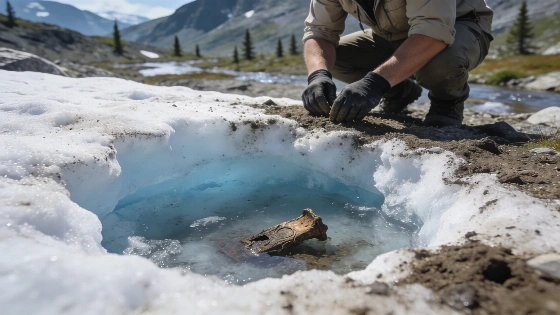
The immediate problem is preservation. Once wood, leather, bone, textiles or feathers emerge from permanently frozen conditions, exposure to air, liquid water, microbes and fluctuating temperatures can trigger rapid deterioration. At some sites around 2,000 metres above sea level, archaeologists may have only days or weeks to locate, document and secure newly exposed material.
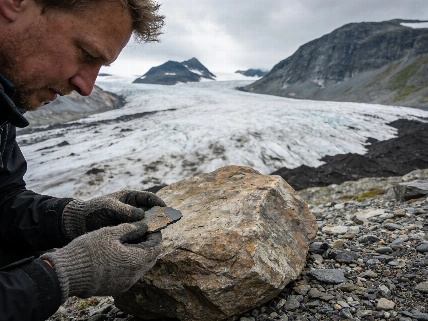
During a three-week 2026 field expedition in the Jotunheimen massif, archaeologists surveyed the Langfonne, Storfonne and Hånklefonne ice fields in the Kvitingskjølen area. Work was still continuing as finds were documented and recovered. The expedition formed part of Secrets of the Ice, a glacier-archaeology programme that has investigated a network of high-altitude ice patches since 2006 rather than a single archaeological site.
During the latest field season, archaeologists working with the earlier arrow report and the Secrets of the Ice programme recovered 48 prehistoric arrows. Published dates range from more than 6,000 years ago to approximately 1,800 years ago. The oldest specimen has a slate arrowhead and part of its wooden shaft, a combination that preserves both technological and organic evidence. A concise account of the artefacts appears in National Geographic Polska.
Archaeologist Julian Robert Post-Melbye of the University of Oslo said the evidence challenges older interpretations of mountain use during the Stone and Bronze Ages. The finds do not establish a single permanent settlement at these elevations, nor do they show that every artefact belonged to one episode. They do, however, demonstrate repeated human activity in places where ice patches preserved objects that would normally have decayed.
The numerical picture is clear even if the wider interpretation remains cautious: 48 prehistoric arrows were recovered in the latest field season; the published age range extends from more than 6,000 to about 1,800 years ago; the oldest identified arrow includes a slate point and wooden shaft; and some work took place at an altitude of about 2,000 metres. The new series also extends the chronological range already documented by Secrets of the Ice, whose earliest finds date to more than 6,000 years ago.
That distinction between measured evidence and broader interpretation is central to archaeological reporting. As in studies discussed in journals such as Nature, an artefact's material, position and dating can support specific conclusions, while claims about population size, social identity or long-term settlement require separate evidence. The Norwegian discoveries are therefore strongest as evidence of repeated activity, not as a complete reconstruction of mountain society.
Many discoveries are associated with reindeer hunting. In warm summer conditions, reindeer moved from valleys toward patches of snow and ice, where they could avoid insects and regulate body temperature. Stone Age hunters appear to have recognized these predictable concentrations and positioned themselves where animals gathered.
Arrows found at such locations may have missed their targets before becoming embedded in snow and eventually sealed within the ice. Their presence does not mean the mountains were ice-free when people visited. Instead, the artefacts indicate that people used the surfaces and margins of ice patches that remained largely undisturbed for millennia.
The wider collection complicates a purely hunting-based account. Clothing and tools could relate to movement through the mountains, while everyday objects and children's toys point to people whose activities were not limited to pursuing reindeer. The evidence is therefore strongest as a record of varied mountain use rather than proof of a single social group or a fully reconstructed way of life.
Ice created an unusually effective archive for organic materials. Frozen conditions can preserve wood, leather, bone, textiles and feathers for thousands of years, but that archive is temporary. At some locations studied over the past 15 years, researchers have reported that about half of the ice has already disappeared, leaving them to recover objects before the conditions that protected them vanish.
This reverses a standard archaeological priority. Excavators often leave parts of a site undisturbed so future researchers can apply improved methods. Melting ice offers no equivalent reserve: an object left in place may not survive until another field season, or even until the end of the current one. The time pressure resembles emergency conservation more than the slower sampling strategies commonly used in laboratory-led research at institutions such as MIT.
The possibility of finding a preserved human body comparable to Ötzi the Iceman remains speculative. Such a discovery would require a person to have died directly on the ice, avoided recovery or disturbance by people and scavengers, and then been rapidly covered by snow and ice under stable frozen conditions. The possibility is real but depends on a sequence of exceptional preservation events, not simply on the age of the ice.
Ice-patch archaeology is best understood as a race against environmental loss rather than a license for sweeping claims about prehistory. The artefacts directly document ancient movement, hunting and material use at high elevations; they cannot by themselves establish population size, permanent settlement or the full social identity of the people who left them. The most important result is more precise: Norway's mountain ice has preserved a broader and older record of human activity than archaeologists previously recognized, while continued melting is destroying the same evidence that makes that revision possible.
Ice preservation differs from ordinary archaeological burial because freezing can halt or greatly slow decay without permanently protecting an object once it is exposed. Snow and ice may shield organic materials from oxygen, microbes and physical disturbance, but the protection ends as melting progresses. This means that an exposed artefact can be both exceptionally informative and exceptionally vulnerable.
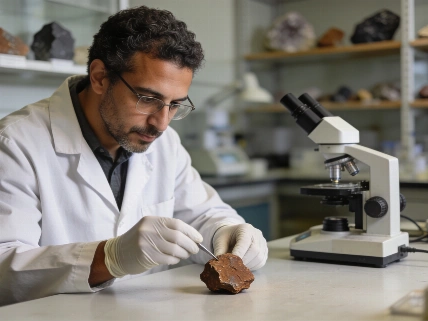
The response requires rapid field recording, careful recovery and conservation after excavation. It is not comparable to the controlled, instrument-heavy environments used by NASA or CERN, where samples and measurements can often be revisited under stable conditions. In Norway's mountains, the environmental archive itself is changing while researchers work. The archaeological record emerging from the ice is therefore not only a record of past activity but also a record whose survival depends on recovery before the ice disappears.