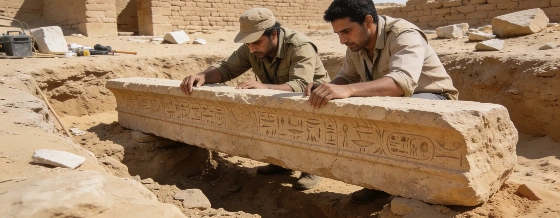
Archaeologists at Tell Abu Saifi in northern Sinai have uncovered a sandstone lintel inscribed with the name of Ramesses II and a reference to Mesn, alongside temple remains reused during the Roman period, offering new clues to Egypt's eastern frontier settlements
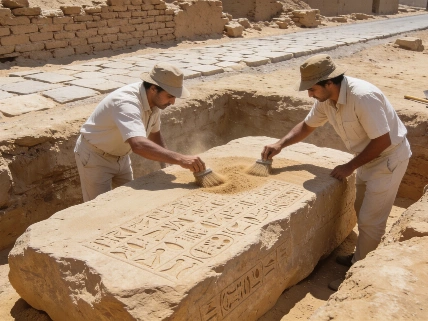
Excavations at Tell Abu Saifi, a site in Egypt's northern Sinai near Qantara East, have revealed a sandstone lintel inscribed with the royal titles of Ramesses II and a reference to the ancient city of Mesn. The lintel, found broken into two pieces and bearing inscriptions on three sides, was recovered during ongoing archaeological work along the Way of Horus, a historic military route connecting Egypt to Canaan. The discovery provides rare material evidence for Mesn, a city whose precise location has long been debated by Egyptologists.
Inscription and Temple Context
The lintel's inscriptions include the name and titles of Ramesses II, who ruled during Egypt's 19th Dynasty in the 13th century BCE. Of particular interest is an inscription mentioning restoration work on a statue of "Horus, Lord of the City of Mesn." This reference has led researchers to consider whether Tell Abu Saifi could be identified with Mesn, a settlement known from ancient texts but not previously located with certainty. However, the evidence remains circumstantial, and further excavation is required before any definitive identification can be made.
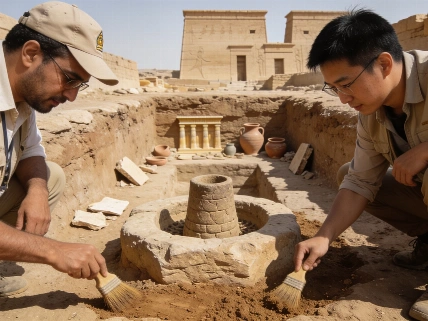
In addition to the lintel, archaeologists uncovered substantial remains of a temple complex at the site. The structure includes a large mudbrick enclosure wall, gateways, internal chambers, storerooms, service areas, and a sanctuary. Stratigraphic evidence suggests the temple underwent multiple phases of construction and reconstruction, reaching its largest extent during the Ptolemaic period (4th-1st centuries BCE). After Egypt came under Roman rule, parts of the temple were dismantled and reused in the construction of a Roman military camp, or castrum, around the 3rd century CE. The Romans also quarried building materials from the temple, and two large circular kilns built over the sanctuary corners indicate the area was later used for lime production.
Roads, Artifacts, and Site Function
Excavations also revealed two successive stone-paved roads connecting the area outside the fortifications to the temple complex. These roads, dated to the Ptolemaic and Roman periods, highlight the site's long-term strategic importance. Among the artifacts recovered were a schist statue from Egypt's 26th Dynasty depicting an army scribe with a damaged shrine, a headless and footless statue from the Late Period, the torso of a royal statue carved from basalt, and fragments of falcon statues made from basalt and limestone. These finds suggest that Tell Abu Saifi served religious, administrative, and military functions over several centuries.
Archaeological evidence from Tell Abu Saifi points to a complex history of occupation, transformation, and reuse. The site's location near Egypt's eastern frontier and its association with the Way of Horus-a fortified road linking the Nile Delta to northern Sinai and Canaan-underscore its strategic role in ancient Egyptian defense and administration. The discoveries at Tell Abu Saifi add to a growing body of research on settlement continuity and change along Egypt's borderlands, complementing work at other sites such as Montbellant hill in Burgundy, where long-term occupation and transformation have also been documented.
Uncertainty and Future Research
While the lintel's reference to Mesn is significant, archaeologists caution that it does not constitute definitive proof that Tell Abu Saifi is the lost city. The inscription may indicate the presence of a cult or administrative center associated with Mesn, or it could reflect the movement of objects and materials across the region. Further excavation, analysis of associated finds, and comparison with textual sources will be necessary to clarify the relationship between Tell Abu Saifi and Mesn. The site's complex stratigraphy and evidence for extensive reuse during the Roman period present additional challenges for interpretation.
According to Egypt's Ministry of Tourism and Antiquities, ongoing research at Tell Abu Saifi is expected to yield further insights into the settlement's role in Egypt's eastern frontier network. The combination of monumental architecture, administrative artifacts, and references to ancient place names offers a valuable opportunity to reconstruct the dynamics of borderland communities and their integration into wider political and military systems.
Understanding Archaeological Provenance
Establishing the provenance of artifacts and inscriptions is central to archaeological interpretation. Provenance refers to the documented origin and context of an object, including its stratigraphic position, association with other finds, and recovery method. Secure provenance allows researchers to link material evidence to specific historical events, settlements, or individuals. When objects are found in secondary contexts or have been reused, as at Tell Abu Saifi, interpretation becomes more complex. Careful excavation, stratigraphic analysis, and comparison with securely provenanced material are essential for building reliable historical narratives and avoiding unsupported claims about site identity or function.