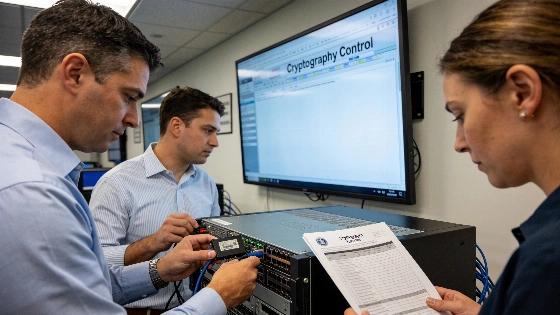
QuSecure's QuProtect R3 platform is now available through Carahsoft's GSA Schedule, offering U.S. federal agencies a route to upgrade cryptographic systems in line with post-quantum security mandates and migration deadlines
QuSecure, Inc. has announced that its QuProtect R3 encryption modernization platform is now listed on Carahsoft Technology Corp.'s GSA Schedule contract, a procurement channel used by U.S. federal agencies. This addition is intended to streamline the acquisition of post-quantum cryptography (PQC) and crypto-agility solutions for defense, intelligence, and civilian agencies facing deadlines to transition critical systems away from cryptographic algorithms vulnerable to future quantum computers.
Federal Migration Mandates
The U.S. government has set explicit timelines for federal agencies to migrate high-value information systems to quantum-resistant cryptography. Executive orders and National Security Memorandum 10 (NSM-10) require agencies to upgrade key establishment protocols by December 31, 2030, and digital signature algorithms by December 31, 2031. These mandates reflect concerns that sufficiently powerful quantum computers could eventually compromise widely used public-key cryptosystems, exposing sensitive data to retrospective decryption.
QuProtect R3 Platform Architecture
QuProtect R3 operates as an external cryptographic control plane, enabling administrators to manage and update encryption algorithms and enforce crypto-agility policies across legacy, cloud, and air-gapped environments. The platform is designed to avoid the need for source code changes or disruptive infrastructure replacement, addressing a major barrier to cryptographic migration in complex federal IT systems. QuProtect R3 integrates three core modules: Discovery, which performs live packet inspection and maintains an inventory of cryptographic assets; Remediation, which allows dynamic algorithm swapping and policy updates without system downtime; and Governance, which compiles audit-ready telemetry and generates Cryptographic Bill of Materials (CBOM) outputs aligned with standards such as NSA CNSA 2.0, CNSSP 15, FIPS, and GDPR.
Procurement and Deployment Channels
In addition to the GSA Schedule (Contract No. 47QSWA18D008F), QuSecure's solutions are available to public sector customers through other contract vehicles managed by Carahsoft, including NASA SEWP V, U.S. Army ITES-SW2, NASPO ValuePoint, and OMNIA Partners. These channels are intended to reduce procurement friction and support agencies in meeting federal cryptographic migration requirements. The integration of QuProtect R3 into these frameworks reflects a broader trend of government IT modernization in response to quantum risk assessments. For context on the evolving quantum technology landscape and its impact on federal procurement, see Science Report's coverage of IonQ's acquisition of SkyWater Technology to secure quantum hardware fabrication.
Technical and Policy Considerations
While QuProtect R3 is positioned as a crypto-agility solution, its effectiveness will depend on integration with existing agency infrastructure, the quality of cryptographic asset discovery, and the ability to enforce policy updates without introducing new vulnerabilities. The platform's reporting features are designed to support compliance with evolving federal and international standards, but the transition to post-quantum cryptography remains a complex engineering and operational challenge. Agencies must balance the urgency of migration with the need for robust implementation, ongoing monitoring, and independent validation of cryptographic controls.
Post-quantum cryptography refers to cryptographic algorithms designed to resist attacks from both classical and quantum computers. Unlike quantum key distribution, which relies on quantum physical principles, PQC algorithms are implemented on conventional hardware and are intended as drop-in replacements for current public-key systems. The security of PQC depends on mathematical problems believed to be hard for quantum computers, such as lattice-based constructions. Migration to PQC requires careful inventory of existing cryptographic assets, assessment of algorithm compatibility, and ongoing monitoring for implementation vulnerabilities. Crypto-agility-the ability to rapidly switch cryptographic algorithms and protocols-has become a central requirement for organizations seeking to future-proof sensitive data against advances in quantum computing.