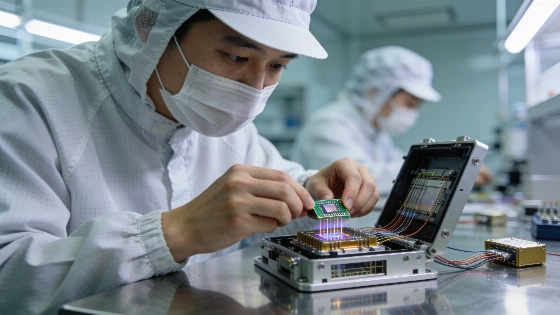
Quandela has identified South Korea as a potential Asian center for photonic quantum hardware, system integration and joint R&D, while emphasizing that the initiative remains a partner-search and development framework rather than a completed manufacturing agreement.
Quandela is positioning South Korea as the proposed Asian center of its photonic quantum hardware strategy. Announced on 28 September 2026, the plan would connect processor manufacturing, system integration and joint research across semiconductor fabrication, optical packaging, cryogenic control and hybrid high-performance computing. Korean media describe the effort as a two-year search for strategic partners, not as an already signed production deal.
The French company has divided the proposed cooperation into three linked areas: photonic quantum hardware production; cryogenic control and system integration; and operation of quantum systems alongside artificial intelligence, graphics processing units and high-performance computing. That structure treats a quantum processor as part of a complete computing platform rather than an isolated laboratory instrument.
The technical agenda includes heterogeneous integration of photonic integrated circuits and electronic integrated circuits, together with single-photon sources and superconducting nanowire single-photon detectors. In a photonic processor, sources generate the optical states, interferometric circuits manipulate them, and detectors convert single-photon events into electrical readout signals. The quality of each interface affects loss, timing stability, calibration burden and ultimately the usable circuit depth. These elements have been identified as joint-development targets, but the available reports do not establish that serial manufacturing has begun.
The proposed industrial consortium could involve South Korean semiconductor manufacturers such as Samsung Electronics and SK hynix and optoelectronic system integrators including LG Innotek. However, reports published at the time of the announcement said that Quandela had not yet signed specific joint-development or supply agreements with those companies. The distinction is important: industrial capability, partner discussions and a production line are different stages of technology deployment.
The initiative builds on earlier cooperation rather than starting from zero. In April 2026, Quandela reportedly signed separate agreements with KAIST, the Korea Research Institute of Standards and Science and the Semiconductor Joint Research Institute at Seoul National University. The company also previously entered an investment agreement with the Seoul Metropolitan Government valued at 57 million dollars. These links provide an institutional framework, but they do not by themselves demonstrate manufacturing yield, component reliability or commercial availability.
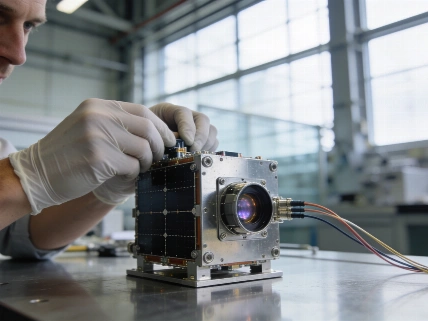
The plan assigns a practical role to cross-border engineering. Hardware teams from KAIST are deploying to Paris to integrate Korean-fabricated electronic control units into Quandela's physical QPU chassis. This is a concrete supply-chain objective: electronics produced in South Korea would be fitted into a processor system developed in France.
For photonic quantum computing, packaging is not a cosmetic detail. Optical components must be aligned and coupled to electronic control systems while maintaining low optical loss, stable thermal behavior and repeatable assembly. Heterogeneous integration can combine components made in different fabrication processes, but it also introduces challenges involving alignment tolerances, electrical parasitics, thermal expansion, optical crosstalk and testability. The announcement identifies integration as part of a proposed full-stack architecture, but it provides no yield figures, device-failure rates, packaging tolerances, optical-loss measurements or production timetable.
Superconducting nanowire detectors add a further systems constraint because they operate at cryogenic temperatures and require high-speed readout electronics. Their inclusion in the Korean agenda explains why cryogenic management is listed separately from ordinary electronic packaging. It does not, however, establish a particular detector efficiency, timing jitter, dark-count rate or system operating temperature for a future Quandela platform.
Research programs at institutions such as MIT have helped establish the broader scientific basis for integrated photonics and quantum optical control, while results reported in a Nature experiment demonstrated why single-photon interference and detection remain central to photonic quantum information. Those foundational results should not be confused with evidence that Quandela's proposed Korean manufacturing network has reproduced the same performance at industrial scale.
Quandela's manufacturing proposal is tied to an existing software and infrastructure effort with NVIDIA. The companies reported reducing GPU-to-QPU communication latency to the millisecond regime, with the stated aim of enabling faster hybrid error mitigation and job execution across high-performance computing clusters.
The cited example is the 12-qubit Lucy processor deployed at France's TGCC facility. The figure identifies the processor's physical-qubit count, not the number of logical qubits or the performance of a useful quantum algorithm. The available material reports no gate fidelity, readout fidelity, coherence time, circuit depth, error rate, total workflow time or classical baseline. It therefore supports a claim about faster communication between classical and quantum resources rather than a claim of quantum advantage.
That distinction matters. Millisecond-scale transfer can reduce an overhead in hybrid workloads, but it does not by itself show that the quantum processor solves a task better or faster than a classical system. Nor does error mitigation mean error correction: mitigation uses classical or procedural methods to reduce the effect of observed errors, whereas fault-tolerant computing requires encoded logical information, repeated syndrome extraction and controlled suppression of errors as the system scales. The engineering problem resembles the broader systems challenge recognized across quantum-computing programs at institutions such as CERN, where control electronics, calibration and classical infrastructure are inseparable from the quantum device itself.
The proposed intellectual-property framework would leave pre-existing IP with the individual partners. Manufacturing protocols and integrated optical modules developed jointly would instead be shared according to institutional contributions. That division could help separate ownership of existing technologies from rights created through collaboration, but the announcement gives no legal terms for valuation, licensing, exclusivity or dispute resolution.
South Korea's role would therefore extend beyond hosting facilities. The intended model combines foundry capability, optical integration, electronic control and software coordination in one regional supply chain. Regional quantum infrastructure has also included network-focused engineering efforts such as the earlier network report on SK Telecom and KISTI, but Quandela's proposal concerns processor manufacturing and hybrid computation rather than quantum key distribution or a quantum internet.
The evidence supports a serious industrial direction but not a finished Asian hub or a demonstrated fault-tolerant platform. South Korea is being identified as the site of a proposed manufacturing and R&D structure while the available technical result is a reported reduction in GPU-to-QPU latency and a planned integration of control electronics. The significance lies in making fabrication, packaging and classical-quantum coordination explicit engineering targets; the decisive test will be reproducible hardware output with disclosed performance data rather than the partnership architecture alone.
A physical qubit is an individual quantum system used to store or manipulate information, while a logical qubit encodes information across multiple physical resources to detect and correct errors. The available material identifies Lucy as a 12-qubit processor but does not report any logical qubits or error-correction code. That omission is important: a manufacturing plan and rapid classical control link may support future system development, yet neither establishes logical protection nor fault tolerance. For now, the announcement describes an industrial proposal with a useful integration milestone, not a completed quantum computer.