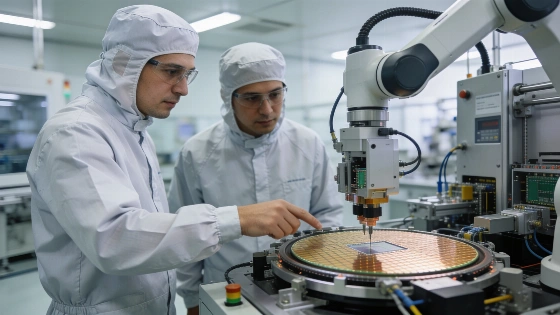
IonQ has received final regulatory clearance to acquire SkyWater Technology, a U.S.-based semiconductor foundry, in a deal that will bring fabrication and packaging for quantum hardware under direct company control
IonQ has secured the final regulatory approval required to complete its planned acquisition of SkyWater Technology, the largest exclusively U.S.-based semiconductor foundry. The $1.8 billion cash-and-stock transaction, first announced in January 2026, is scheduled to close on July 31, 2026. Once finalized, SkyWater will operate as a wholly owned subsidiary, retaining its established brand and continuing its commercial foundry services while providing IonQ with dedicated fabrication lines for quantum hardware development.
Vertically Integrated Quantum Fabrication
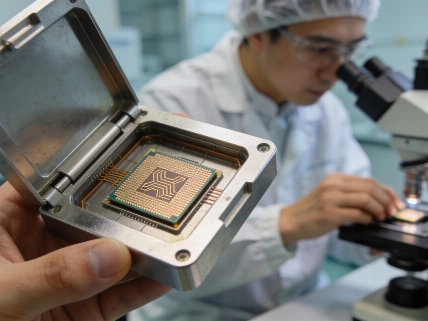
This acquisition positions IonQ as the first quantum hardware developer to control the full stack of design, wafer fabrication, advanced packaging, and system integration within a single domestic infrastructure. By acquiring a DMEA Category 1A Trusted Foundry, IonQ gains direct access to SkyWater's facilities in Minnesota, Florida, and Texas, eliminating the need to rely on external merchant foundries for device production. This integration is expected to reduce wafer iteration times and accelerate the company's technical roadmap for trapped-ion quantum processors.
Impact on Quantum Hardware Development
IonQ reports that direct access to SkyWater's fabrication and cryogenic testing capabilities will allow for faster hardware iteration and earlier functional testing of large-scale quantum processing units (QPUs). The company projects that this could advance the timeline for testing 200,000 physical-qubit QPUs-intended to support over 8,000 logical qubits-to 2028, and speed up development of architectures targeting 2 million physical qubits. SkyWater's Minnesota facility will enable cryogenic wafer testing adjacent to manufacturing lines, reducing the risk of wafer damage and shortening feedback cycles for device optimization.
Supply Chain Security and Defense Alignment
With SkyWater's status as a U.S. trusted foundry, IonQ will have an onshore, secure supply chain for quantum hardware fabrication. This is particularly relevant for defense and sovereign technology programs, including participation in the U.S. Department of Defense's Microelectronics Commons network and IonQ Federal initiatives. The acquisition is intended to strengthen IonQ's position in government procurement and national security-related quantum projects, while maintaining SkyWater's existing commercial and defense customer relationships.
Merchant Foundry Model and Ecosystem Effects
SkyWater will continue to serve its established customer base in aerospace, industrial, and microelectronics sectors, and has previously provided foundry services to other quantum hardware developers such as D-Wave, EeroQ, Silicon Quantum Computing, and PsiQuantum. IonQ plans to leverage SkyWater's merchant foundry model to distribute its own quantum sensing and networking solutions through these commercial channels. The integration of fabrication and packaging is expected to reduce bottlenecks and improve device yield, but the long-term impact on the broader quantum ecosystem will depend on how open SkyWater remains to external quantum customers.
For context on public investment in quantum hardware and photonics startups, see this report on New Mexico's recent funding for early-stage quantum technology companies.
IonQ and SkyWater are scheduled to present their combined Q2 2026 financial results on August 5, 2026, with an investor day planned for September 8, 2026. As with all roadmap-driven milestones, the practical consequences for quantum computing utility and scalability will depend on demonstrated device performance, reproducibility, and the ability to translate fabrication advances into reliable, error-corrected quantum operations.
In quantum computing, the distinction between physical and logical qubits is central to evaluating progress. A physical qubit is a single controllable quantum system, such as a trapped ion or superconducting circuit, that can be manipulated and measured. However, physical qubits are prone to errors from noise, decoherence, and imperfect control. Logical qubits encode information across many physical qubits using error-correcting codes, allowing for detection and correction of certain errors. The number of physical qubits required per logical qubit depends on the error rates and the code used. Achieving practical, fault-tolerant quantum computation requires not only increasing the number of physical qubits but also improving their quality and integrating robust error correction, so that logical qubits can perform useful algorithms reliably over many cycles.