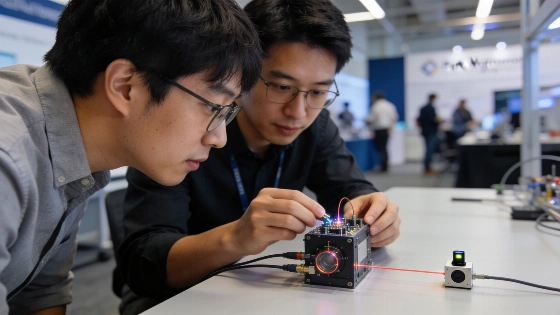
KIST used the Quantum World Congress in College Park to connect South Korean quantum startups with D-Wave, Microsoft and East Asian research networks, while OptiQ-Labs plans a US East Coast office for November 2026.
OptiQ-Labs plans to establish a physical regional headquarters on the US East Coast in November 2026 after joining a Korea Institute of Science and Technology delegation at the Quantum World Congress in College Park, Maryland. The plan was presented as a future market-entry step, not as evidence that a completed facility is already operating. If realized, it would be the first reported permanent North American operational presence for a startup participating in South Korea's Deeptech Incubator Project for Startups.
Quantum World Congress 2026 took place from September 23 to 25 at The Hotel at the University of Maryland and on the University of Maryland campus. KIST's participation placed Korean deep-tech companies in a setting where hardware developers, cloud providers, research organizations and prospective industrial users could discuss commercialization pathways rather than only laboratory research.
The proposed headquarters is the clearest commercial outcome reported from the delegation. It would give OptiQ-Labs a base from which to connect its quantum technology work with North American cloud platforms, research partners and testing facilities. The available reporting does not provide a location beyond the US East Coast or describe the facility's staffing, equipment or operating schedule, so the announcement should be read as a market-entry plan rather than evidence of a completed deployment.
KIST organized the delegation through its Global Bridge Program, jointly planned with the U.S. Embassy in Korea. The program is part of South Korea's Deeptech Incubator Project for Startups, overseen by the Ministry of SMEs and Startups and administered by the Korea Institute of Startup & Entrepreneurship Development. This institutional structure matters because it links international business development with a government-backed startup support system rather than treating the conference as an isolated networking event.
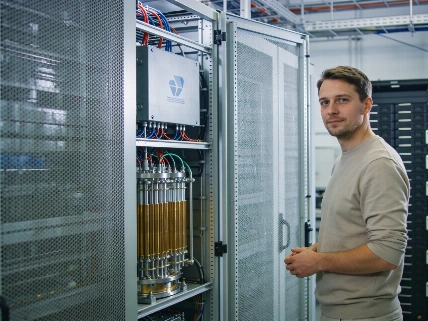
The delegation's most concrete technical arrangement involved D-Wave Systems. KIST established bilateral ties with the commercial annealer vendor, and participating Korean startups received direct access to D-Wave's application programming interface and quantum-annealing infrastructure for development and practical testing. That arrangement concerns access to a commercial platform; it does not by itself demonstrate a new algorithm, a new processor or a quantum advantage over classical computing.
Quantum annealing is a specialized approach that differs from universal gate-based quantum computing. In an annealing workflow, an optimization problem is commonly mapped onto an energy landscape represented by interacting binary variables, after which the hardware seeks low-energy configurations. The usefulness of the result depends on factors including problem encoding, embedding overhead, calibration, sampling statistics, classical preprocessing and the quality of the best available classical solver.
An API can provide a route to run workloads on hardware but says nothing on its own about solution quality, total workflow time, energy consumption or whether a particular problem benefits from quantum hardware. The reported delegation activities provide no benchmark results, confidence intervals, p-values or independently reproduced comparison with classical methods. A meaningful evaluation would need a predefined problem set, transparent metrics, repeated trials and a fair accounting of all classical and quantum processing costs.
This distinction is consistent with the broader scientific history of quantum computing. Research groups at MIT and other institutions have shown that error correction, control fidelity and system scaling are central engineering constraints for gate-based machines, while annealing platforms address a different computational model. A Nature study of logical qubits illustrates why hardware demonstrations must be assessed through quantitative error rates and scaling behavior rather than through access alone.
The group also engaged with Microsoft to discuss software-stack alignment. In practical terms, compatibility can reduce friction between startup tools and cloud-based quantum services, improve portability of experiments and simplify access to development environments. The reported meeting does not establish that an integration has been completed or that any application has entered production.
KIST's discussions extended beyond US companies. The delegation met Japan's Q-STAR industry consortium and the National Institute of Advanced Industrial Science and Technology, known as AIST, to strengthen cross-border East Asian quantum supply chains. The reported objective is industrial coordination rather than a disclosed scientific result, and no details were provided on contracts, manufacturing volumes, procurement commitments or jointly validated products.
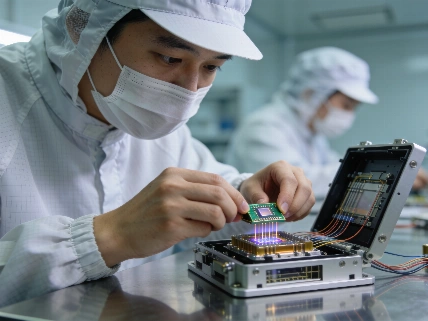
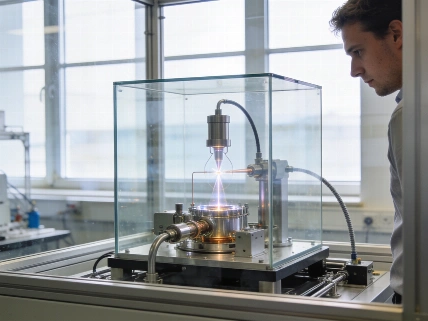
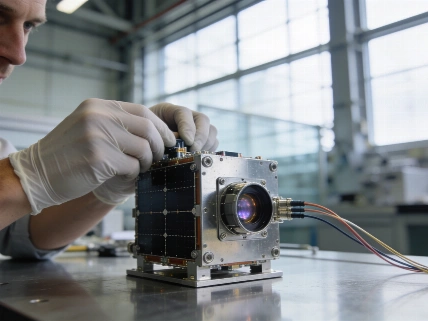
The technologies represented by the startups span several difficult hardware layers. They include trapped-ion laser-control systems, cryogen-free quantum-dot single-photon sources and room-temperature nitrogen-vacancy magnetometry. These systems address control, light generation and sensing respectively. The announcement does not report operating wavelengths, photon purity, collection efficiency, magnetometer sensitivity, calibration procedures or device yield.
Trapped-ion platforms generally require precise optical addressing and control of charged atomic states. Single-photon sources are assessed through measures such as brightness, spectral indistinguishability and multiphoton emission probability. NV magnetometers use spin-dependent optical and microwave responses to infer magnetic fields, but their practical value depends on sensitivity, bandwidth, temperature stability, geometry and noise rejection. These technical dimensions are familiar across quantum laboratories, including research programs associated with CERN and the Max Planck Society, but none of the startup-specific performance values were disclosed here.
That absence is important. A quantum device can be scientifically credible while still requiring substantial work in packaging, calibration, environmental control, software integration and repeatable manufacturing. The same caution applies to market access: a partnership can provide infrastructure and contacts without proving that a product is reliable outside a laboratory or competitive with established instruments.
The initiative creates a structured route for Korean physics research to reach international partners in defense, energy and medical markets. Those are stated target sectors rather than disclosed customer deployments. No contract values, named customers, field trials or performance data are provided, and the announcement does not report independent testing or peer-reviewed results from the participating startups.
KIST said it would continue supporting Korean quantum startups in developing technology partnerships, entering global markets and creating concrete commercialization opportunities. That commitment gives the program a longer-term institutional objective, but it should not be confused with evidence that any participating technology has already achieved commercial scale.
OptiQ-Labs' planned US base nevertheless gives the program a tangible milestone. It shifts the story from conference networking toward a possible physical presence, while the D-Wave arrangement offers participating companies access to a commercial annealing platform and the Microsoft engagement addresses software compatibility. The three elements form a commercialization pathway, but each remains distinct from proof that a quantum product has solved a useful industrial problem.
That boundary is familiar in quantum technology. An earlier sensor report likewise illustrates why hardware access and market ambition should be assessed separately from demonstrated field performance. Here the evidence supports a serious bridge-building effort, not a measured claim of quantum advantage, scalable manufacturing or commercial readiness.
For now, the strongest conclusion is institutional rather than computational: KIST has connected Korean quantum startups with US infrastructure and East Asian industrial networks while one company plans a permanent US foothold. That is meaningful progress in commercialization architecture, but the decisive technical questions remain unanswered-how these systems perform under realistic conditions, how consistently they can be manufactured and whether customers gain something unavailable from classical technology.
Quantum hardware access is not the same as a useful quantum result. In annealing systems, the relevant test is whether a defined optimization task produces a better answer or a lower total cost than a strong classical method. In sensors, the test is measured sensitivity and stability under the environmental conditions of use. Without those comparisons, the initiative should be read as an enabling step between research and deployment rather than as evidence that the gap has been closed.