
Qunnect and Monarch Quantum have announced a partnership to develop modular, miniaturized entanglement distribution hardware for quantum networks, aiming to reduce system size and cost through advanced photonic manufacturing techniques
Qunnect and Monarch Quantum have announced a collaboration focused on advancing the engineering and manufacturing of entanglement-based quantum networking hardware. The partnership aims to address a persistent challenge in quantum communication: how to transition laboratory-scale entanglement distribution systems into compact, robust, and cost-effective devices suitable for deployment in real-world environments.
Integrated Photonics and System Miniaturization
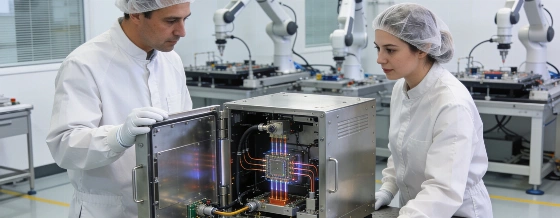
The joint effort will combine Qunnect's field-tested entanglement distribution technology with Monarch Quantum's expertise in photonic system engineering and automated manufacturing. Qunnect's current Carina platform integrates photon sources, polarization compensators, and single-photon detectors within a 36U rack-mounted system. The companies plan to develop modular variants of this platform, targeting a reduction to a 2U or 3U form factor. Achieving this level of miniaturization will depend on integrating non-cryogenic photon detectors and leveraging Monarch's robotic assembly processes, which are designed to improve optical alignment and reduce photon loss compared to manual assembly.
Manufacturing Scale and Engineering Constraints
Monarch Quantum is expanding its manufacturing capacity, with a move to a 60,000 square foot facility in San Diego and an 8,000 square foot clean room scheduled to house 20 to 25 robotic assembly stations by September. The use of machine-vision guided robotics is intended to deliver more precise and repeatable photonic packaging, a critical factor in reducing optical losses and improving device reliability. These engineering advances are expected to lower both the cost and physical footprint of quantum networking hardware, but the practical impact will depend on the integration of all system components and the ability to maintain performance under operational constraints such as temperature, vibration, and power limits.
Deployment Environments and Use Cases
The next-generation hardware is being designed for environments where size, weight, and power are tightly constrained, including satellites, defense platforms, remote infrastructure, edge computing, and telecommunications. Qunnect has indicated that future products may include specialized versions of the Carina platform, such as the Orian system, tailored for applications like Quantum Position Verification (QPV) and quantum-based network security monitoring. These use cases require not only robust entanglement distribution but also reliable operation in challenging field conditions, which places additional demands on packaging, thermal management, and system integration.
Context in Quantum Networking Development
The push to commercialize quantum networking hardware comes amid broader efforts to move quantum technologies from laboratory demonstrations to scalable, deployable systems. Similar challenges in scaling quantum photonic devices have been reported by other companies and research groups, as seen in recent efforts to expand quantum dot laser production for optical interconnects in data centers-an area explored in coverage of Innolume's manufacturing expansion. The transition from prototype to manufacturable product remains a central hurdle for the field, with device yield, reproducibility, and integration of high-performance detectors and sources as ongoing engineering bottlenecks.
Entanglement distribution is a foundational capability for quantum networks, enabling protocols such as quantum key distribution, quantum teleportation, and distributed quantum sensing. In practice, the performance of these systems is limited by photon loss, detector efficiency, and the stability of optical alignment. Integrated photonics offers a pathway to reduce these losses and improve scalability, but the engineering required to package and align components at scale remains nontrivial. As quantum networking hardware moves toward commercial deployment, the ability to manufacture reliable, miniaturized, and cost-effective systems will be a decisive factor in determining which technologies reach operational status beyond the laboratory.