D-Wave Quantum Inc. has released its Q2 2026 results, highlighting a surge in bookings, expanded commercial adoption, and technical milestones in both annealing and gate-model quantum computing platforms
D-Wave Quantum Inc. has published its financial and technical results for the second quarter and first half of 2026, reporting a sharp increase in bookings and outlining new milestones for its quantum hardware platforms. While recognized revenue for the quarter remained at $3.1 million-unchanged from the same period in 2025-the company's backlog and long-term commitments grew substantially, reflecting a shift in customer demand from experimental pilots to production-oriented quantum computing workloads.
Bookings and Commercial Adoption
The most significant development in D-Wave's report is the more than tenfold year-over-year increase in first-half bookings, which reached $35.5 million. This figure includes a $20 million system sale and $2.3 million attributed to the acquisition of Quantum Circuits, Inc. The company's remaining performance obligations (RPOs) rose to $40.7 million, with 57% expected to convert to revenue within the next year. Commercial customers accounted for 67.7% of first-half revenue, up from 16.0% in the first half of 2025, and Forbes Global 2000 clients contributed nearly half of total revenue. Production applications now represent over a third of D-Wave's Quantum Computing as a Service (QCaaS) revenue, indicating a gradual transition toward more sustained enterprise use.
Technical Roadmaps and Hardware Platforms
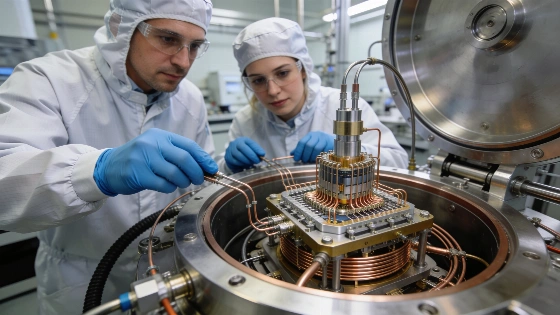
D-Wave continues to develop both its annealing and gate-model quantum computing architectures. On the annealing side, the company has detailed a multi-chip fabric design for its Advantage3(TM) platform, aiming to overcome single-chip scaling limits. The roadmap targets 20,000 qubits by 2029 and 100,000 qubits by 2031, though these are internal projections rather than achieved milestones. In gate-model quantum computing, D-Wave has published peer-reviewed research in Nature describing a high-fidelity two-qubit gate based on a dual-rail superconducting architecture. This approach is intended to reduce hardware overhead for future fault-tolerant systems. The company's gate-model roadmap sets out targets of 17 physical qubits in 2026, 181 physical qubits by 2028, 10 logical qubits by 2030, and a 100-logical-qubit system capable of over one million operations by 2032. These targets remain subject to significant engineering and fabrication challenges.
Financial Performance and Engineering Constraints
Despite the increase in bookings and backlog, D-Wave's quarterly revenue remained flat, reflecting the timing of system sales and the long lead times associated with quantum hardware deployment. Operating expenses rose to $55.0 million in Q2 2026, up 93% from the previous year, as the company expanded research and development and go-to-market activities. The net loss for the quarter narrowed to $48.0 million, primarily due to reduced non-cash warrant liability charges, while cash and investments stood at $546.2 million at the end of the period. The company's financial position was also affected by the acquisition of Quantum Circuits, Inc., which contributed to both bookings and expenses. D-Wave's technical progress is supported by additional government funding, including a $1.57 million National Science Foundation grant under the NQVL ERASE project and continued defense-related funding.
Benchmarks, Limitations, and Industry Context
While D-Wave's hardware roadmaps and commercial metrics indicate momentum, the company has not yet demonstrated large-scale, fault-tolerant quantum computation. The reported two-qubit gate fidelity in the dual-rail superconducting architecture is a step toward error-corrected operation, but scaling to logical qubits and practical algorithms remains a substantial challenge. The company's plans for multi-chip annealing systems and error-aware simulation tools are intended to address some of these barriers, but the transition from laboratory demonstration to reliable, scalable quantum computing is not guaranteed by roadmap targets alone. In the broader context of quantum hardware development, D-Wave's focus on both annealing and gate-model systems distinguishes its approach from other industry players. For comparison, recent advances in quantum hardware security modules, such as those described in coverage of post-quantum cryptography migration hardware, highlight the diversity of strategies being pursued to address quantum-era computational and security challenges.
To understand the significance of D-Wave's technical milestones, it is important to distinguish between physical and logical qubits. A physical qubit is a single controllable quantum system, such as a superconducting circuit or trapped ion, that can be manipulated and measured. Logical qubits, by contrast, encode information across multiple physical qubits using error-correcting codes to detect and correct errors arising from noise and decoherence. Achieving reliable logical qubits with low error rates is essential for practical quantum computing, but requires high-fidelity gates, stable operation, and substantial hardware overhead. Most current quantum processors, including those described in D-Wave's roadmap, remain in the regime where noise and error rates limit the depth and reliability of computations. Progress toward scalable, fault-tolerant quantum systems will depend on continued advances in device fabrication, control electronics, error correction, and system integration.