QuiX Quantum has launched Alquor 2.0, a rack-mountable photonic processor platform based on silicon nitride integrated circuits, aiming to support quantum optics and information processing research with improved stability and automation
QuiX Quantum, a hardware developer based in Enschede, Netherlands, has announced the commercial release of Alquor 2.0, its second-generation programmable photonic processor platform. The system is built on silicon nitride (Si3N4) photonic integrated circuits and is designed to provide a stable, rack-mountable alternative to traditional free-space optical table setups for quantum optics, boson sampling, quantum communications, and optical information processing research.
Device Architecture and Integration
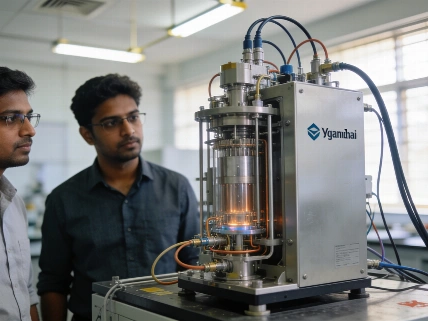
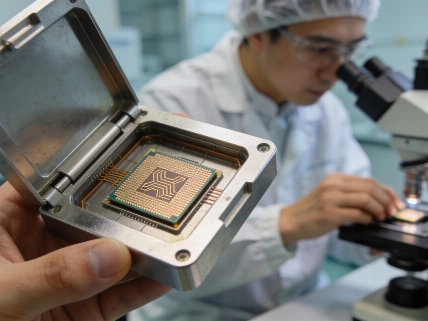
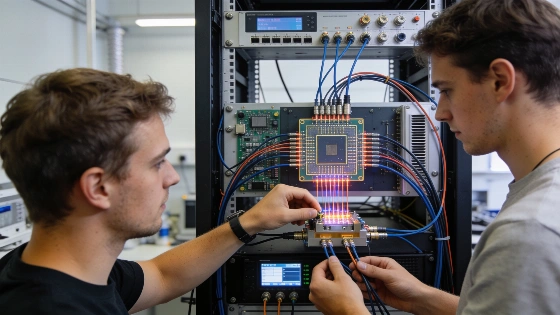
Alquor 2.0 is available in 8-mode, 20-mode, and 32-mode configurations, each referring to the number of optical modes the processor can manipulate. The platform is engineered to operate at room temperature and is housed in a 3U 19-inch chassis, making it suitable for laboratory, data center, and high-performance computing environments. The system integrates directly with QuiX Quantum's Photonic Assembly Control Unit (PACU) architecture, supporting automation and workflow integration through a Python API. The design includes current-driver-based control electronics to suppress electrical crosstalk across phase shifters, enabling management of up to 1,000 thermo-optic modulators. For external control and active feed-forward operations, the processor provides 32 high-speed RF connectors. Air-cooled thermal management and hot-swappable photonic assemblies with pre-loaded calibration data are also incorporated to support continuous operation and rapid maintenance.
Experimental Use and Research Applications
Over 20 first-generation Alquor units have been deployed as experimental testbeds in academic and institutional research. Notable applications include simulation of dissipative quantum systems, reconstruction of molecular vibronic spectra using Gaussian boson sampling, benchmarking of boson sampling protocols, photon distillation to reduce indistinguishability errors, and hardware acceleration for Monte Carlo integration. For example, researchers at ENEA and INFN Roma Tre used a 20-mode Alquor processor to simulate non-Hermitian quantum dynamics, while teams at Paderborn University and HQS Quantum Simulations applied the platform to molecular spectroscopy tasks. Other collaborations have explored deterministic Grover search algorithms and compared Gaussian and non-Gaussian boson sampling using the processor as a core component.
Technical Specifications and Pricing
The Alquor 2.0 platform's technical features are aimed at supporting reproducible, automated experiments in photonic quantum information science. The system's control electronics are designed to minimize electrical interference, and the modular photonic assemblies are calibrated for immediate use. Pricing is structured in three tiers: €240,000 for the 8-mode processor, €490,000 for the 20-mode version, and €790,000 for the 32-mode configuration. QuiX Quantum is offering a 20% discount on 8-mode units for academic and public research institutions that place orders by September 30, 2026. The company's approach reflects a broader trend toward integrating photonic quantum processors into standard laboratory and data center infrastructure, with an emphasis on stability, automation, and compatibility with existing research workflows.
Context in Quantum Hardware Development
Photonic quantum processors such as Alquor 2.0 are part of a growing ecosystem of hardware platforms targeting quantum simulation, sampling, and communication tasks. Unlike superconducting or trapped-ion systems, photonic processors operate at room temperature and leverage integrated optics for scalability and stability. However, challenges remain in scaling up the number of controllable modes, managing optical loss, and achieving high-fidelity control across large photonic circuits. The integration of feed-forward mechanisms and automated calibration in Alquor 2.0 addresses some of these engineering barriers, but the practical utility of photonic quantum processors continues to depend on advances in source quality, detector efficiency, and error mitigation. For comparison, recent efforts to integrate quantum hardware into operational workflows, such as AT&T's deployment of D-Wave quantum annealing for network optimization, highlight the diversity of approaches and the ongoing need for robust, reproducible hardware platforms.
Understanding photonic quantum processors requires familiarity with the concept of optical modes and linear optical interferometry. In these systems, information is encoded in the quantum states of photons, which are manipulated through a network of beam splitters and phase shifters. The number of modes determines the processor's capacity for parallel operations and the complexity of quantum interference patterns it can generate. Achieving precise control over these modes is essential for reliable quantum simulation and sampling, but is limited by optical loss, crosstalk, and calibration drift. As photonic processors scale, engineering solutions for stability, automation, and error management become increasingly critical for both research and potential commercial applications.