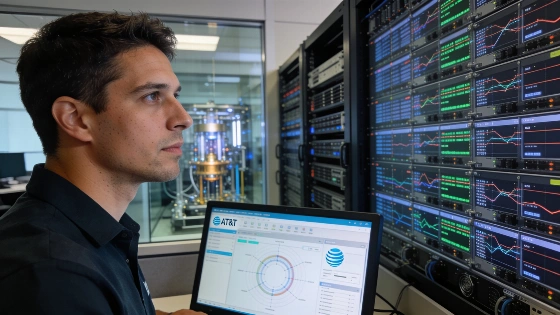
AT&T is expanding its use of D-Wave's quantum annealing hardware to optimize network management tasks, integrating quantum optimization with agentic AI workflows and evaluating future applications in quantum communications and security
AT&T has announced a commercial agreement to extend its deployment of D-Wave Quantum Inc.'s quantum annealing technology within its network infrastructure operations. The company aims to integrate quantum optimization into its operational tooling, focusing on tasks that challenge classical computing resources, such as outage response, field technician routing, and dynamic bandwidth allocation. This move builds on earlier pilot benchmarks in which D-Wave's quantum annealing hardware reportedly reduced a network optimization workload from approximately one hour to under 15 seconds, according to company data. The integration is intended to support AT&T's agentic artificial intelligence (AI) systems, which automate high-intensity network management tasks.
Quantum Annealing for Network Optimization
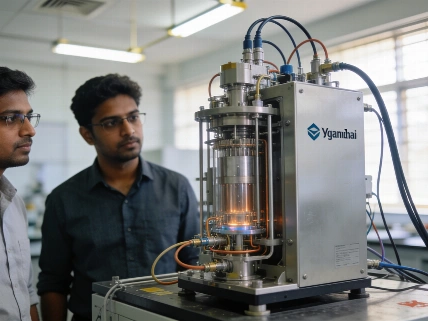
Quantum annealing is a specialized approach to solving combinatorial optimization problems by exploiting quantum tunneling and superposition. D-Wave's hardware, accessed via the Leap(TM) quantum cloud platform, is designed to find low-energy solutions to complex optimization tasks that can be computationally intensive for classical systems. In AT&T's reported benchmarks, quantum annealing was applied to network routing and resource allocation scenarios, with the company claiming significant reductions in processing time. However, the precise scale of the problems solved, the number of qubits used, and the comparative performance of optimized classical algorithms were not disclosed in detail. The company's agentic AI workflows, which reportedly reduced customer downtime by 12 million hours in 2025, are now being augmented with quantum optimization to address bottlenecks in outage detection, incident mitigation, and technician dispatch.
Integration Challenges and Engineering Limits
While quantum annealing hardware can accelerate certain optimization tasks, its practical utility depends on the structure of the problem, the quality of the quantum hardware, and the integration with existing classical systems. D-Wave's quantum annealers operate at cryogenic temperatures and are limited by qubit connectivity, noise, and calibration drift. The company has not released detailed error rates, qubit counts, or independent verification of the reported speedup for AT&T's specific workloads. In addition, the integration of quantum optimization into live network operations requires robust interfaces between quantum cloud services and AT&T's AI-driven management systems. The engineering challenge lies in ensuring that quantum solutions can be reliably incorporated into time-sensitive workflows without introducing new sources of error or delay.
Future Directions: Gate-Model Quantum and Security
Beyond current annealing deployments, AT&T is evaluating D-Wave's roadmap for gate-model quantum computing, which aims to support more general quantum algorithms and fault-tolerant architectures. Following D-Wave's acquisition of Quantum Circuits, Inc. and its dual-rail superconducting architecture, AT&T's Chief Data Office is exploring potential applications in quantum key distribution (QKD), network encryption, and quantum-resilient communications. These future systems would require high-fidelity logical qubits, error correction, and secure integration with classical infrastructure. The company's interest in quantum-secured networking reflects a broader industry trend, as seen in other efforts to link quantum processors and photonic nodes for secure communications, such as the EPB Quantum Network's integration of trapped-ion and photonic hardware.
Quantum annealing differs fundamentally from universal gate-based quantum computing. While annealers are effective for certain optimization problems, they are not capable of running arbitrary quantum algorithms or supporting full error correction. The practical impact of quantum annealing depends on the match between the hardware's capabilities and the structure of the real-world problem. In network management, the value of quantum optimization will be determined by the scale of the problem, the quality of the quantum solution, and the ability to integrate results into operational workflows. As quantum hardware and software continue to evolve, careful benchmarking and transparent reporting will be essential to assess genuine utility beyond laboratory demonstrations.