Quantum Motion has established a U.S. base in Maryland's Discovery District to advance silicon spin-qubit quantum processors, aiming to integrate with U.S. defense research and regional quantum industry clusters while leveraging standard semiconductor fabrication
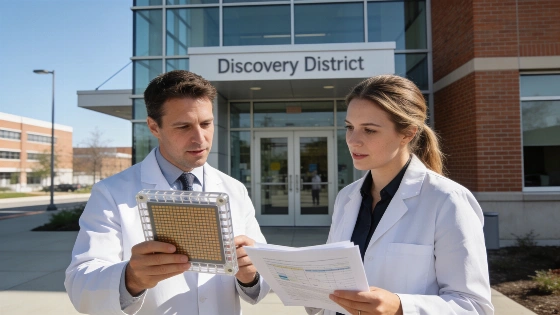
Quantum Motion, a U.K.-based developer of silicon spin-qubit quantum processors, has launched a new operational center in the Discovery District at the University of Maryland, College Park. The facility is intended to support the company's expansion into the U.S. market, with a focus on both commercial and public-sector quantum computing applications. The location places Quantum Motion in proximity to major federal research and defense organizations, including the Defense Advanced Research Projects Agency (DARPA) and the Applied Research Laboratory for Intelligence and Security (ARLIS).
Silicon Spin Qubits and CMOS Integration
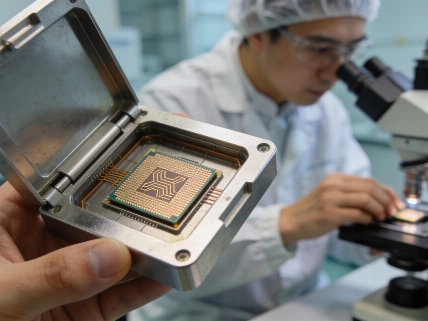
The company's technical approach centers on fabricating spin-qubit quantum processing units (QPUs) using standard silicon complementary metal-oxide-semiconductor (CMOS) manufacturing processes. By leveraging existing semiconductor foundry infrastructure, Quantum Motion aims to address the challenge of scaling up quantum processors by producing high-density quantum chips with established industrial techniques. This strategy is designed to reduce the gap between laboratory prototypes and manufacturable quantum hardware, but the practical limits of device yield, qubit uniformity, and error rates remain active areas of research across the field.
Defense Collaboration and Regional Ecosystem
One of the Maryland hub's primary objectives is to facilitate collaboration with U.S. government and defense agencies. Quantum Motion has signaled its intent to participate in DARPA's Quantum Benchmarking Initiative (QBI), which is focused on developing standardized metrics for scalable quantum hardware and evaluating architectures for fault-tolerant operation. The company's presence in College Park also positions it within a growing regional quantum cluster, alongside organizations such as IonQ, Microsoft Quantum, IQM Quantum Computers, and NanoQT. This integration is expected to support knowledge exchange and workforce development, but the extent to which these collaborations will accelerate practical device performance remains to be demonstrated.
Alignment with State and National Initiatives
The expansion aligns with Maryland's Capital of Quantum (CoQ) initiative, a state-backed program launched in 2025 to promote public-private quantum infrastructure and research partnerships. The initiative aims to strengthen the region's position as a center for quantum technology development, with a focus on both academic research and commercial deployment. Quantum Motion's move follows a broader trend of international quantum companies establishing U.S. operations to access federal research funding and defense procurement opportunities. Similar efforts to bridge quantum research and application have been reported elsewhere, such as the integration of quantum computing platforms into university curricula in India.
While Quantum Motion has not disclosed detailed device specifications or performance benchmarks for its U.S. operations, the company's previous research has focused on single- and two-qubit silicon devices operating at cryogenic temperatures, with gate fidelities and coherence times that remain under active optimization. The transition from laboratory-scale devices to scalable, fault-tolerant quantum processors will require advances in qubit control, error correction, and large-scale integration-challenges that are shared across the quantum hardware sector. Independent verification of device performance and reproducibility at scale will be essential for assessing the practical impact of the Maryland facility.
Silicon spin qubits are quantum bits realized by controlling the spin state of single electrons confined in silicon quantum dots or donor atoms. These qubits are attractive for their compatibility with established semiconductor manufacturing and potential for high-density integration. However, achieving long coherence times, high-fidelity gate operations, and reliable scaling remains a significant engineering challenge. Progress in silicon spin qubit technology depends on advances in material quality, device fabrication, cryogenic control electronics, and error correction protocols. The distinction between physical qubits-individual quantum devices-and logical qubits-error-corrected units built from many physical qubits-remains central to evaluating the prospects for practical quantum computation.