

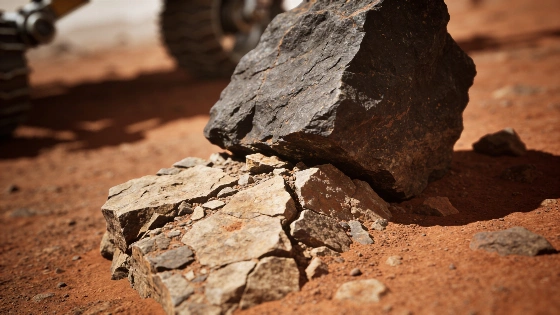
A Mastcam-Z image from Perseverance's Oct. 14 traverse shows brecciated material beside a higher dark outcrop at "Tinga." The view leaves open whether the dark rock belongs to an olivine-bearing unit or was altered by heat
On Oct. 14, 2026, Perseverance was driving along the southern border of the "Idubi" channel when its Mastcam-Z left eye recorded an outcrop at "Tinga." The image shows a potential boundary between lower brecciated material and a higher-standing dark rock. Their close contact is clear; their origins are not.
A boundary on the traverse
The lower unit is interpreted as a likely polymict breccia: a rock made from fragments of different types, with angular clasts. The upper material is darker and stands higher. The image places these distinct-looking units together, but visible appearance alone does not establish their mineral composition or explain how the boundary formed.
The observation has a precise mission timestamp. Perseverance acquired the image on Oct. 14, 2026, during Sol 2009 of the Mars 2020 mission; Sol 2009 is Martian day 2,009. NASA credits the image to NASA/JPL-Caltech/ASU. The supplied description identifies a camera image, not a reported chemical or mineral measurement at the outcrop.
Idubi lies in the Lac de Charmes region beyond Jezero's western rim, where Perseverance is examining terrain that may be more than 4 billion years old. October 2026 coverage placed the rover's investigation in the context of a growing campaign: Perseverance had collected 29 rock and regolith samples from Jezero's crater floor, ancient delta deposits and crater rim. The rover also set an off-world driving-distance record while traversing the region, surpassing the distance driven by NASA's Chance rover.
Two possible origins
Breccia commonly forms through violent geological processes, including impacts. The material at "Tinga" may have formed in an impact event comparable to the one that created Jezero crater, or it could be associated with the formation of Jezero itself. Those are possibilities, not a determination of the breccia's age or origin.
The higher dark rocks have at least two proposed explanations. They could belong to the nearby olivine-bearing unit at "Idubi," an outcrop composed primarily of the mineral olivine that appears to extend onto the plains beyond Jezero's crater rim. Alternatively, they could be breccia that was heated, or "baked," where it met the hotter rocks of "Idubi." The image does not distinguish between these interpretations.
Olivine-bearing geology across the wider Nili Fossae-Jezero region has been interpreted in several ways, including as airfall deposits, lava, impact melt or intrusive material. The regional unit spans more than 100,000 square kilometres. Orbital analyses have combined high-resolution imagery with near-infrared observations: an absorption near 1 micrometre is associated with olivine, while weaker features near 1.9 and 2.32 micrometres are associated with hydrated or hydroxylated minerals. Regional interpretations describe possible exhumed magmatic intrusions in hydrated smectite basement. These findings provide geological context for Idubi, while the Tinga image itself leaves the dark outcrop's relationship to that wider unit unresolved.
The contrast so offers a geological clue rather than a completed reconstruction. If the dark material belongs to the olivine-bearing unit, its relationship to the breccia would differ from a case in which it is altered breccia. Further in situ investigation of the outcrop is needed to establish how the elevated rocks relate to the broader unit. A separate report on NASA's measurement gaps describes how missing lunar and Mars data can shape mission priorities.
What the image establishes
For now, the strongest conclusion is limited to the visible contact between unlike rock types at the rover's traverse. The image supports examining "Tinga" as a place where distinct geological materials meet. It does not, by itself, identify the process that put them together, show when that happened, or confirm that the dark rock is olivine-bearing material.
Idubi's broader scientific interest includes the possibility that its ancient rocks preserve evidence of hydrothermal systems, where heated water once circulated through the crust. Such environments can provide chemical energy and conditions relevant to habitability studies. That research objective does not establish that life existed there or determine the origin of the Tinga contact.
That distinction matters because the two proposed histories imply different relationships between the units. The dark rock may be part of a wider geological unit, or it may be material transformed at the edge of "Idubi." The source description reports no further in situ result that resolves those options.
A geological contact is the boundary where two materials meet. An image can reveal that boundary and help identify where closer examination may be useful. Establishing the materials' composition and history requires evidence beyond their appearance in this view.







