

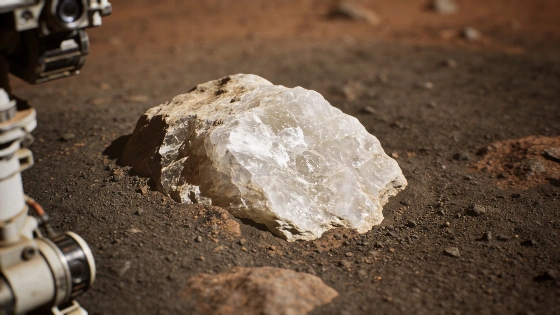
SuperCam data show the bright outcrops are rich in hydrated silica rather than igneous rock. Their scale lets Perseverance examine whether they record ancient water systems and could preserve traces of life
At 13:03:53 local mean solar time on Oct. 29, 2026, Perseverance's left Mastcam-Z camera photographed a bright fragment in the "Idubi" area against darker Martian ground. Idubi lies in the Lac de Charmes region, in ancient Martian crust outside Jezero crater. NASA Science described the discovery in an update published Nov. 16.
SuperCam's mineral clue
Newly downlinked SuperCam data confirm that the light-toned rocks are not igneous in origin. Instead, they are rich in hydrated silica, unlike the igneous and impactite rocks previously examined in the area. The identification is qualitative; no silica concentration or specific mineral phase has been reported. SuperCam supplied the mineralogical clue, while close-range images from the rover's SHERLOC WATSON camera provide complementary views of the rocks.
A closer view came later that Martian day. The SHERLOC WATSON camera on the rover's robotic-arm turret captured a close-up at 17:33:55 local mean solar time; both images were taken on Sol 2023.
A larger target
Perseverance previously encountered silica-rich rocks on Jezero crater's inner rim, but those deposits were too small for proximity instruments to gather the detailed chemical and mineralogical data needed to assess their origin and biosignature-preservation potential. The "Idubi" rocks are larger, and a detailed proximity-science campaign is underway. Research scientist Candice Bedford of Purdue University, who authored the NASA Science update, described the rocks as offering a more promising scale for close investigation.
Hydrated silica has been discussed in other research on Jezero's geology. A 2025 paper in Earth and Planetary Science Letters, "From hydrated silica to quartz: Potential hydrothermal precipitates found in Jezero crater, Mars," examines hydrothermal precipitation as one possible process in the crater. The study provides geological context; it does not establish how the Idubi rocks formed.
A separate Tinga rock-contact report concerns a different geological target, keeping that image-based question distinct from the silica investigation at "Idubi."
What silica can preserve
On Earth, hydrated silica can form in hydrothermal settings, groundwater systems, and through soil-forming processes. Some silica deposits can preserve delicate fossil or biosignature evidence, making them of interest to astrobiologists. The different ways hydrated silica forms mean the mineral alone cannot identify a unique environment.
The composition raises the possibility that the rocks record ancient water systems. It does not establish that life existed at the site. The rover team is investigating whether the deposits hold evidence of ancient water or potentially ancient life, using the larger rocks for more detailed observations.







